

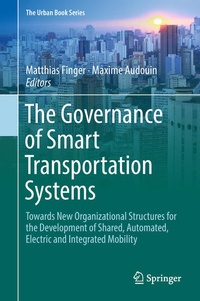
The Governance of Smart Transportation Systems
Towards New Organizational Structures for the Development of Shared, Automated, Electric and Integrated Mobility
Published on 30. October 2018
Book
Hardback
IX, 260 pages
978-3-319-96525-3 (ISBN)
Description
This book presents essential new governance structures to embrace and regulate smart mobility modes. Drawing on a range of case studies, it paves the way for new approaches to governing future transportation systems.
Over the past decades, Information and Communication Technologies have enabled the development of new mobility solutions that have completely redefined traditional and well-established urban transportation systems. Urban transportation systems are evolving dramatically, from the development of shared mobility modes, to the advent of electric mobility, and from the automated mobility trend to the rapid spread of integrated transportation schemes. Given the disruptive nature of those new mobility solutions, new governance structures are needed. Through a series of case studies from around the world, this book highlights governance and regulatory processes having supported, or sometimes prevented, the development and implementation ofsmart mobility solutions (shared, automated, electric, integrated). The combination of chapters offers a comprehensive overview of the different research endeavours focusing on the governance of smart transportation systems and will help pave the way for this important subject, which is crucial for the future of cities.
Over the past decades, Information and Communication Technologies have enabled the development of new mobility solutions that have completely redefined traditional and well-established urban transportation systems. Urban transportation systems are evolving dramatically, from the development of shared mobility modes, to the advent of electric mobility, and from the automated mobility trend to the rapid spread of integrated transportation schemes. Given the disruptive nature of those new mobility solutions, new governance structures are needed. Through a series of case studies from around the world, this book highlights governance and regulatory processes having supported, or sometimes prevented, the development and implementation ofsmart mobility solutions (shared, automated, electric, integrated). The combination of chapters offers a comprehensive overview of the different research endeavours focusing on the governance of smart transportation systems and will help pave the way for this important subject, which is crucial for the future of cities.
More details
Series
Edition
1st ed. 2019
Language
English
Place of publication
Cham
Switzerland
Publishing group
Springer International Publishing
Target group
Professional and scholarly
Illustrations
10 s/w Abbildungen, 1 farbige Abbildung
IX, 260 p. 11 illus., 1 illus. in color.
Dimensions
Height: 241 mm
Width: 160 mm
Thickness: 17 mm
Weight
625 gr
ISBN-13
978-3-319-96525-3 (9783319965253)
DOI
10.1007/978-3-319-96526-0
Schweitzer Classification
Other editions
Additional editions
Matthias Finger | Maxime Audouin
The Governance of Smart Transportation Systems
Towards New Organizational Structures for the Development of Shared, Automated, Electric and Integrated Mobility
Book
12/2018
Springer
€117.69
Shipment within 7-9 days
Matthias Finger | Maxime Audouin
The Governance of Smart Transportation Systems
Towards New Organizational Structures for the Development of Shared, Automated, Electric and Integrated Mobility
E-Book
08/2018
Springer
€106.99
Available for download
Content
Introduction.- Part I: Governance of Shared Mobility.- Regulating Transport Platforms: The Case of Carpooling in Europe.- Regulating of TNCs in Latin America: The Case of UBER Regulation in Mexico city and Bogota.- Governing Carsharing as a Commercial or a Public Service? A Comparison between France and Japan.- Part II: Governance of Automated Mobility.- Data-led Governance of Self-driving Vehicles for Urban Shared Mobility.- How Should We Drive Self-driving Vehicles? Anticipation and Collective Imagination in Planning of Mobility Futures.