

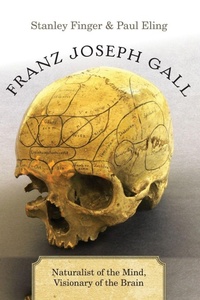
Franz Joseph Gall
Naturalist of the Mind, Visionary of the Brain
Published on 13. June 2019
Book
Hardback
584 pages
978-0-19-046462-2 (ISBN)
Description
Franz Joseph Gall (1758-1828) was always a controversial figure, as was his doctrine, later called phrenology. Although often portrayed as a discredited buffoon, who believed he could assess a person's strengths and weaknesses by measuring cranial bumps, he was, in fact, a serious physician-scientist, who strove to answer timely questions about the mind, brain, and behavior. In many ways a remarkable visionary, his seminal ideas would become tenets of modern behavioral neuroscience. Among other things, he was the first scientist to promote publicly the idea of specialized cortical areas for diverse higher functions, while taking metaphysics out of his new science of mind. Moreover, although he obviously placed too much emphasis on "tell-tale" skull features (mistakenly believing that the cranium faithfully reflects the features of underlying brain areas), he fully understood the strength of "convergent operations," conducting neuroanatomical, developmental, cross-species, gender-comparison, and brain-damage studies on both humans and animals in his attempts to unravel the mysteries of brain organization.
Rather than looking upon Gall's "organology" as one of science's great mistakes, this book provides a fresh look at the man and his doctrine. The authors delve into his motives, what was known about the brain during the 1790s, and the cultural demands of his time. Gall is rightfully presented as an early-19th-century biologist, anthropologist, philosopher, and physician with an inquisitive mind and a challenging agenda--namely, how to account for species and individual differences in behavior. In this well-researched book, readers learn why, starting as a young physician in Vienna and continuing his life's work in Paris, he chose to study the mind and the brain, why he employed his various methods, why he relied so heavily on cranial features, and why he wrote what he did in his books. Frequently using Gall's own words, they show his impact in various domains, including his approach to the insane and criminals, before concluding with his final illness and more lasting legacy.
Rather than looking upon Gall's "organology" as one of science's great mistakes, this book provides a fresh look at the man and his doctrine. The authors delve into his motives, what was known about the brain during the 1790s, and the cultural demands of his time. Gall is rightfully presented as an early-19th-century biologist, anthropologist, philosopher, and physician with an inquisitive mind and a challenging agenda--namely, how to account for species and individual differences in behavior. In this well-researched book, readers learn why, starting as a young physician in Vienna and continuing his life's work in Paris, he chose to study the mind and the brain, why he employed his various methods, why he relied so heavily on cranial features, and why he wrote what he did in his books. Frequently using Gall's own words, they show his impact in various domains, including his approach to the insane and criminals, before concluding with his final illness and more lasting legacy.
Reviews / Votes
I must say that I absolutely enjoyed and wholeheartedly recommend Stanley Finger and Paul Eling's Franz Joseph Gall: Naturalist of the Mind, Visionary of the Brain ... .It is also more than just a biography. Rather, it is a detailed snapshot of the scientific, philosophical, and even theological thinking, as well as of the prevailing social conditions - as they relate to science - at the end of the 18th century. * George Anogeianakis, Cognitive and Behavioral Neurology * [This book is] something special, and deserves to be carefully read, pondered, and added to the literature on psychology's origins and establishment. The authors present beautiful evidence that as they put it, "... Gail is still with us today, knowing that how he shaped many modern disciplines has largely been forgotten". * Craig Bielert, Evolutionary Psychological Science * The beauty of this book is that it is so packed with information that you can spend months following the paths of Gall's ideas for the past 200 years. * Richard E. Brown, History of Psychology News * In this voluminous 564-page book, the authors go beyond the story of a life and present a real history of the origins of neuroscience, in particular, neuropsychology, in 20 information-dense chapters that remain highly readable ... The result is not only a biography of Franz Joseph Gall but also a research tool. * Olivier Walusinski, MD, European Neurology *More details
Language
English
Place of publication
New York
United States
Dimensions
Height: 260 mm
Width: 183 mm
Thickness: 35 mm
Weight
1271 gr
ISBN-13
978-0-19-046462-2 (9780190464622)
Copyright in bibliographic data and cover images is held by Nielsen Book Services Limited or by the publishers or by their respective licensors: all rights reserved.
Schweitzer Classification
Other editions
Additional editions
E-Book
04/2019
1st Edition
OUP eBook
€69.99
Available for download
E-Book
04/2019
1st Edition
OUP eBook
€69.99
Available for download
Persons
Stanley Finger received his PhD from Indiana University and has been on the faculty of Washington University in St. Louis since that time. His is currently Professor Emeritus in the Department of Psychological and Brain Sciences at Washington University, and affiliated with the school's History of Medicine Program. His focus has been on the history of the neurosciences, notably brain and behavior, electric fishes in the history of neurophysiology, Benjamin Franklin's medicine, and how the neurosciences have long been reflected in the arts (e.g., painting, literature, and music). He has served as the editor of the Journal of the History of the Neurosciences for 20 years; was the first President of the International Society for the History of the Neurosciences; and has received many honors, including the latter society's lifetime achievement award in 2016.
Paul Eling studied Psychology at the Catholic University Nijmegen (currently: Radboud University), specializing in cognitive
psychology and finishing his dissertation, titled 'Studies on laterality: Controversial issues in the approach of hemisphere specialization' in 1983. After working for 2 years as a post-doc on an aphasia project at the Max Planck Institut fur Psycholinguistik in Nijmegen, he returned to the university, becoming an assistant professor at the department of Biopsychology, and later an associate professor, teaching neuropsychology. He was involved in a broad range of research projects, examining primarily cognitive disorders following brain lesions. Apart from publishing scientific papers, he was involved as author and editor of a series of books, including textbooks in the area of neuropsychology and neuropsychiatry and books on topics from the history of the neurosciences. In addition, he has always had a great interest in the history of the neurosciences, has been a member of the International Society of the History of the Neurosciences, acted twice as Chairman of this Society and is currently
editor of the Journal of the History of the Neurosciences.
Paul Eling studied Psychology at the Catholic University Nijmegen (currently: Radboud University), specializing in cognitive
psychology and finishing his dissertation, titled 'Studies on laterality: Controversial issues in the approach of hemisphere specialization' in 1983. After working for 2 years as a post-doc on an aphasia project at the Max Planck Institut fur Psycholinguistik in Nijmegen, he returned to the university, becoming an assistant professor at the department of Biopsychology, and later an associate professor, teaching neuropsychology. He was involved in a broad range of research projects, examining primarily cognitive disorders following brain lesions. Apart from publishing scientific papers, he was involved as author and editor of a series of books, including textbooks in the area of neuropsychology and neuropsychiatry and books on topics from the history of the neurosciences. In addition, he has always had a great interest in the history of the neurosciences, has been a member of the International Society of the History of the Neurosciences, acted twice as Chairman of this Society and is currently
editor of the Journal of the History of the Neurosciences.
Content
- Preface
- 1- Formative Years and Childhood Memories
- 2- An Emerging Theory
- 3- Physiognomy: "Facing" the Past
- 4- The Brain and its Functions Prior to Gall
- 5- The Nature of Soul, or is it Just Nature?
- 6- A Man of Skulls, and More
- 7: Of Animal Heads and Animal Tales
- 8- Skull and Cast "Libraries"
- 9- Hostility in Vienna
- 10- Scientific Journey through Germany and Denmark
- 11- Detour to Holland, Switzerland, and Back to Germany
- 12- Settling in Paris
- 13- The Long-Awaited Volumes
- 14- Presenting Organologie
- 15- The Arts and the Faculties in Concert
- 16- New Perspectives on Insanity and Criminality
- 17- "Cranioscopy" in the British Press
- 18- Spurzheim's "Phrenology" and Gall in Britain
- 19- Controversial Final Years
- 20- A Rightful Place in History
- -----
- Appendix: Names and Birth-Death Dates
- References