

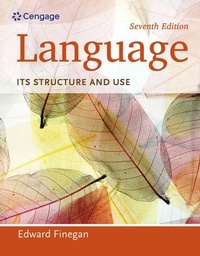
Language
Its Structure and Use
7th Edition
Published on 1. January 2014
Book
Paperback/Softback
608 pages
978-1-285-05245-8 (ISBN)
Description
Whatever you do and wherever you go, you use language to interact. This text explains what human language is and how it works, giving you a look into the multiple fascinating and surprising facets of this uniquely human trait. You'll find many opportunities to ask your own questions and explore the language in use all around you.
More details
Edition
7th edition
Language
English
Place of publication
Belmont, CA
United States
Publishing group
Cengage Learning, Inc
Target group
College/higher education
Dimensions
Height: 232 mm
Width: 189 mm
Thickness: 27 mm
Weight
913 gr
ISBN-13
978-1-285-05245-8 (9781285052458)
Copyright in bibliographic data and cover images is held by Nielsen Book Services Limited or by the publishers or by their respective licensors: all rights reserved.
Schweitzer Classification
Person
Edward Finegan (MA and PhD, Ohio University) specializes in sociolinguistics, discourse analysis, forensic linguistics, and the history and structure of the English language. He served as chair of the Department of Linguistics at USC and currently serves as director of USC's Center for Excellence in Teaching. President of the International Association of Forensic Linguists, Finegan is editor of DICTIONARIES: THE JOURNAL OF THE DICTIONARY SOCIETY OF NORTH AMERICA and has been Liberal Arts Fellow in Law and Linguistics, Harvard University; Visiting Professor at University of Zurich; and Visiting Scholar at University of Helsinki. He also served as Director of American Language Institute/National Iranian Radio and Television [1975-1976 in peaceful times]. He is the recipient of many teaching awards and honors.
Content
1. Languages and Linguistics.
What Do You Think? How Many Languages Are There in the World? Does the United States Have an Official Language? What Is Human Language? Signs: Arbitrary and Non-arbitrary. Languages as Patterned Structures: Grammatical Competence. Speech as Patterned Language Use: Communicative Competence. Modes of Linguistic Communication. Do Only Humans Have Language? Can Chimpanzees Learn a Human Language? The Origin of Human Languages: Babel to Babble. What Is Linguistics? Computers and Linguistics. Summary. What Do You Think? REVISITED. Exercises. Other Resources.
Part 1: LANGUAGE STRUCTURES.
2. Words and Their Parts: Lexicon and Morphology.
What Do You Think? Introduction: Words Seem Tangible. What Does It Mean to Know a Word? Lexical Categories. Morphemes: Word Parts with Meaning or Function. How Are Morphemes Organized Within Words? How Does a Language Increase Its Vocabulary? What Types of Morphological Systems Do Languages Have? Variant Pronunciations of a Morpheme: Allomorphy. Summary. What Do You Think? REVISITED. Exercises. Other Resources.
3. The Sounds of Languages: Phonetics.
What Do You Think? Sounds and Spellings: Not the Same Thing. Phonetics: The Study of Sounds. Describing Consonant Sounds. Kinds of Consonant Sounds. Vowel Sounds. Summary. What Do You Think? REVISITED. Exercises. Other Resources.
4. Sound Systems of Language: Phonology.
What Do You Think? Introduction: Sounds in the Mind. Phonological Rules and Their Structure. Syllables and Syllable Structure. Stress. Syllables and Stress in Phonological Processes. Morphology and Phonology Interaction: Allomorphy.
From Lexical Entries to Surface Realizations: What the Brain Knows.
Summary. What Do You Think? REVISITED. Exercises. Other Resources.
5. The Structure and Function of Phrases and Sentences: Syntax.
What Do You Think? Introduction. Constituency. Major Constituents of Sentences: Noun Phrases and Verb Phrases. Phrase-Structure Expansions. Grammatical Relations: Subject, Direct Object, and Others. Surface Structures and Underlying Structures. Types of Syntactic Operations. Functions of Syntactic Operations. Recursion and Novel Sentences. Summary.
What Do You Think? REVISITED. Exercises. Other Resources.
6. The Study of Meaning: Semantics.
What Do You Think? Introduction. Linguistic, Social, and Affective Meaning. Word, Sentence, and Utterance Meaning. Lexical Semantics. Function Words and Categories of Meaning. Semantic Roles and Sentence Meaning. Semantic Roles and Grammatical Relations. Summary. What Do You Think? REVISITED. Exercises. Other Resources.
7. Language Universals and Language Typology.
What Do You Think? Similarity and Diversity Across Languages. Phonological Universals. Syntactic and Morphological Universals. Types of Language Universals. Explanations for Language Universals. Language Universals, Universal Grammar, and Language Acquisition. Summary. What Do You Think? REVISITED. Exercises. Other Resources.
Part 2: LANGUAGE USE.
8. Information Structure and Pragmatics.
What Do You Think? Introduction: Encoding Information Structure. Categories of Information Structure. Information Structure: Intonation, Morphology, Syntax. The Relationship of Sentences to Discourse: Pragmatics. Summary. What Do You Think? REVISITED. Exercises. Other Resources.
9. Speech Acts and Conversation.
What Do You Think? Language in Use. Sentence Structure and the Function of Utterances. Speech Acts. The Cooperative Principle. Violations of the Cooperative Principle. Politeness. Speech Events. The Organization of Conversation. Cross-Cultural Communication. Summary. What Do You Think? REVISITED. Exercises. Other Resources.
10. Language Variation Across Situations of Use: Registers and Styles.
What Do You Think? Introduction. Language Varies Within a Speech Community. Speech Situations. Registers in Monolingual Societies. Similarities and Differences Between Spoken and Written Registers. Two Registers Compared. Summary. What Do You Think? REVISITED
What Do You Think? How Many Languages Are There in the World? Does the United States Have an Official Language? What Is Human Language? Signs: Arbitrary and Non-arbitrary. Languages as Patterned Structures: Grammatical Competence. Speech as Patterned Language Use: Communicative Competence. Modes of Linguistic Communication. Do Only Humans Have Language? Can Chimpanzees Learn a Human Language? The Origin of Human Languages: Babel to Babble. What Is Linguistics? Computers and Linguistics. Summary. What Do You Think? REVISITED. Exercises. Other Resources.
Part 1: LANGUAGE STRUCTURES.
2. Words and Their Parts: Lexicon and Morphology.
What Do You Think? Introduction: Words Seem Tangible. What Does It Mean to Know a Word? Lexical Categories. Morphemes: Word Parts with Meaning or Function. How Are Morphemes Organized Within Words? How Does a Language Increase Its Vocabulary? What Types of Morphological Systems Do Languages Have? Variant Pronunciations of a Morpheme: Allomorphy. Summary. What Do You Think? REVISITED. Exercises. Other Resources.
3. The Sounds of Languages: Phonetics.
What Do You Think? Sounds and Spellings: Not the Same Thing. Phonetics: The Study of Sounds. Describing Consonant Sounds. Kinds of Consonant Sounds. Vowel Sounds. Summary. What Do You Think? REVISITED. Exercises. Other Resources.
4. Sound Systems of Language: Phonology.
What Do You Think? Introduction: Sounds in the Mind. Phonological Rules and Their Structure. Syllables and Syllable Structure. Stress. Syllables and Stress in Phonological Processes. Morphology and Phonology Interaction: Allomorphy.
From Lexical Entries to Surface Realizations: What the Brain Knows.
Summary. What Do You Think? REVISITED. Exercises. Other Resources.
5. The Structure and Function of Phrases and Sentences: Syntax.
What Do You Think? Introduction. Constituency. Major Constituents of Sentences: Noun Phrases and Verb Phrases. Phrase-Structure Expansions. Grammatical Relations: Subject, Direct Object, and Others. Surface Structures and Underlying Structures. Types of Syntactic Operations. Functions of Syntactic Operations. Recursion and Novel Sentences. Summary.
What Do You Think? REVISITED. Exercises. Other Resources.
6. The Study of Meaning: Semantics.
What Do You Think? Introduction. Linguistic, Social, and Affective Meaning. Word, Sentence, and Utterance Meaning. Lexical Semantics. Function Words and Categories of Meaning. Semantic Roles and Sentence Meaning. Semantic Roles and Grammatical Relations. Summary. What Do You Think? REVISITED. Exercises. Other Resources.
7. Language Universals and Language Typology.
What Do You Think? Similarity and Diversity Across Languages. Phonological Universals. Syntactic and Morphological Universals. Types of Language Universals. Explanations for Language Universals. Language Universals, Universal Grammar, and Language Acquisition. Summary. What Do You Think? REVISITED. Exercises. Other Resources.
Part 2: LANGUAGE USE.
8. Information Structure and Pragmatics.
What Do You Think? Introduction: Encoding Information Structure. Categories of Information Structure. Information Structure: Intonation, Morphology, Syntax. The Relationship of Sentences to Discourse: Pragmatics. Summary. What Do You Think? REVISITED. Exercises. Other Resources.
9. Speech Acts and Conversation.
What Do You Think? Language in Use. Sentence Structure and the Function of Utterances. Speech Acts. The Cooperative Principle. Violations of the Cooperative Principle. Politeness. Speech Events. The Organization of Conversation. Cross-Cultural Communication. Summary. What Do You Think? REVISITED. Exercises. Other Resources.
10. Language Variation Across Situations of Use: Registers and Styles.
What Do You Think? Introduction. Language Varies Within a Speech Community. Speech Situations. Registers in Monolingual Societies. Similarities and Differences Between Spoken and Written Registers. Two Registers Compared. Summary. What Do You Think? REVISITED