

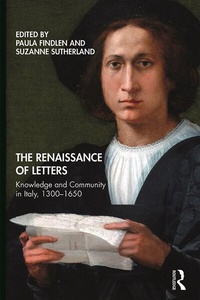
The Renaissance of Letters
Knowledge and Community in Italy, 1300-1650
1st Edition
Published on 6. November 2019
Book
Paperback/Softback
338 pages
978-1-138-36750-0 (ISBN)
Description
The Renaissance of Letters traces the multiplication of letter-writing practices between the fourteenth and seventeenth centuries in the Italian peninsula and beyond to explore the importance of letters as a crucial document for understanding the Italian Renaissance.
This edited collection contains case studies, ranging from the late medieval re-emergence of letter-writing to the mid-seventeenth century, that offer a comprehensive analysis of the different dimensions of late medieval and Renaissance letters-literary, commercial, political, religious, cultural, social, and military-which transformed them into powerful early modern tools. The Renaissance was an era that put letters into the hands of many kinds of people, inspiring them to see reading, writing, receiving, and sending letters as an essential feature of their identity. The authors take a fresh look at the correspondence of some of the most important humanists of the Italian Renaissance, including Niccolo Machiavelli and Isabella d'Este, and consider the use of letters for others such as merchants and physicians.
This book is essential reading for scholars and students of Early Modern History and Literature, Renaissance Studies, and Italian Studies. The engagement with essential primary sources renders this book an indispensable tool for those teaching seminars on Renaissance history and literature.
This edited collection contains case studies, ranging from the late medieval re-emergence of letter-writing to the mid-seventeenth century, that offer a comprehensive analysis of the different dimensions of late medieval and Renaissance letters-literary, commercial, political, religious, cultural, social, and military-which transformed them into powerful early modern tools. The Renaissance was an era that put letters into the hands of many kinds of people, inspiring them to see reading, writing, receiving, and sending letters as an essential feature of their identity. The authors take a fresh look at the correspondence of some of the most important humanists of the Italian Renaissance, including Niccolo Machiavelli and Isabella d'Este, and consider the use of letters for others such as merchants and physicians.
This book is essential reading for scholars and students of Early Modern History and Literature, Renaissance Studies, and Italian Studies. The engagement with essential primary sources renders this book an indispensable tool for those teaching seminars on Renaissance history and literature.
More details
Language
English
Place of publication
London
United Kingdom
Publishing group
Taylor & Francis Ltd
Target group
College/higher education
Illustrations
50 s/w Abbildungen
50 Illustrations, black and white
Dimensions
Height: 234 mm
Width: 156 mm
Weight
660 gr
ISBN-13
978-1-138-36750-0 (9781138367500)
Copyright in bibliographic data and cover images is held by Nielsen Book Services Limited or by the publishers or by their respective licensors: all rights reserved.
Schweitzer Classification
Other editions
Additional editions
Paula Findlen | Suzanne Sutherland
The Renaissance of Letters
Knowledge and Community in Italy, 1300-1650
Book
11/2019
1st Edition
Routledge
€178.27
Shipment within 10-20 days
Paula Findlen | Suzanne Sutherland
The Renaissance of Letters
Knowledge and Community in Italy, 1300-1650
E-Book
10/2019
1st Edition
Routledge
€47.49
Available for download
Paula Findlen | Suzanne Sutherland
The Renaissance of Letters
Knowledge and Community in Italy, 1300-1650
E-Book
10/2019
1st Edition
Routledge
€47.49
Available for download
Persons
Paula Findlen is Ubaldo Pierotti Professor of Italian History at Stanford University, USA. She is the author of Possessing Nature: Museums, Collecting and Scientific Culture in Early Modern Italy (1994) and many other publications on Renaissance / early modern Italy and the history of science. Professor Findlen is the 2016 recipient of the Premio Galileo for her contributions to understanding Italian culture.
Suzanne Sutherland is an Assistant Professor of Early Modern European History at Middle Tennessee State University, USA. She is finishing a book on early modern military entrepreneurs and has worked on Stanford's Mapping the Republic of Letters interdisciplinary digital humanities project since 2008.
Suzanne Sutherland is an Assistant Professor of Early Modern European History at Middle Tennessee State University, USA. She is finishing a book on early modern military entrepreneurs and has worked on Stanford's Mapping the Republic of Letters interdisciplinary digital humanities project since 2008.
Content
Part One: Late Medieval Commerce and Scholarship
Chapter One: Letters, Networks and Reputation among Francesco di Marco Datini and his Correspondents
Jeffrey Miner
Chapter Two: Ciriaco of Ancona and the Limits of the Mediterranean Network
Monique O'Connell
Part Two: Rulers and Subjects
Chapter Three :Saving Naples: The King's Malaria, the Barons' Threat, and Ippolita Maria Sforza's Letters
Diana Robin and Lynn Lara Westwater
Chapter Four: Isabella d'Este's Employee Relations
Deanna Shemek
Chapter Five: Letters as Sources for Studying Jewish Conversion: The Case of Salomone da Sesso/Ercole de' Fedeli
Tamar Herzig
Part Three: Humanism, Diplomacy, and Empire
Chapter Six: Writing a Letter in 1507: The Fortunes of Francesco Vettori's Correspondence and the Florentine Republic
Christopher Bacich
Chapter Seven: Minding Gaps: Connecting the Worlds of Erasmus and Machiavelli
William J. Connell
Chapter Eight: The Cardinal's Dearest Son and the Pirate: Venetian Empire and the Letters of Giovan Matteo Bembo
Demetrius Loufas
Part Four: Science and Travel
Chapter Nine: The Literary Lives of Health Workers in Late Renaissance Venice
Sarah Gwyneth Ross
Chapter Ten: A Florentine Humanist in India: Filippo Sassetti, Medici Agent by Annual Letter
Brian Brege
Chapter Eleven: 'La verita delle stelle': Margherita Sarrocchi's Letters to Galileo
Meredith K. Ray
Part Five: Information, Politics, and War
Chapter Twelve: Publishing the Baroque Post: The Postal Itinerary and the Mailbag Novel
Rachel Midura
Chapter Thirteen: War, Mobility, and Letters at the Start of the Thirty Years War, 1621-23
Suzanne Sutherland
Chapter Fourteen: Making sense of the news: Micanzio's letters, Cavendish, Bacon, and the Thirty Years War
Filippo De Vivo
Epilogue: Lives Full of Letters: From Renaissance to Republic of Letters
Suzanne Sutherland
Chapter One: Letters, Networks and Reputation among Francesco di Marco Datini and his Correspondents
Jeffrey Miner
Chapter Two: Ciriaco of Ancona and the Limits of the Mediterranean Network
Monique O'Connell
Part Two: Rulers and Subjects
Chapter Three :Saving Naples: The King's Malaria, the Barons' Threat, and Ippolita Maria Sforza's Letters
Diana Robin and Lynn Lara Westwater
Chapter Four: Isabella d'Este's Employee Relations
Deanna Shemek
Chapter Five: Letters as Sources for Studying Jewish Conversion: The Case of Salomone da Sesso/Ercole de' Fedeli
Tamar Herzig
Part Three: Humanism, Diplomacy, and Empire
Chapter Six: Writing a Letter in 1507: The Fortunes of Francesco Vettori's Correspondence and the Florentine Republic
Christopher Bacich
Chapter Seven: Minding Gaps: Connecting the Worlds of Erasmus and Machiavelli
William J. Connell
Chapter Eight: The Cardinal's Dearest Son and the Pirate: Venetian Empire and the Letters of Giovan Matteo Bembo
Demetrius Loufas
Part Four: Science and Travel
Chapter Nine: The Literary Lives of Health Workers in Late Renaissance Venice
Sarah Gwyneth Ross
Chapter Ten: A Florentine Humanist in India: Filippo Sassetti, Medici Agent by Annual Letter
Brian Brege
Chapter Eleven: 'La verita delle stelle': Margherita Sarrocchi's Letters to Galileo
Meredith K. Ray
Part Five: Information, Politics, and War
Chapter Twelve: Publishing the Baroque Post: The Postal Itinerary and the Mailbag Novel
Rachel Midura
Chapter Thirteen: War, Mobility, and Letters at the Start of the Thirty Years War, 1621-23
Suzanne Sutherland
Chapter Fourteen: Making sense of the news: Micanzio's letters, Cavendish, Bacon, and the Thirty Years War
Filippo De Vivo
Epilogue: Lives Full of Letters: From Renaissance to Republic of Letters
Suzanne Sutherland