

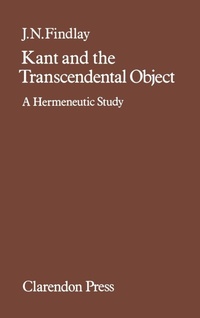
Kant and the Transcendental Object
A Hermeneutic Study
Published on 6. August 1981
Book
Hardback
416 pages
978-0-19-824638-1 (ISBN)
Description
This book is an attempt to conduct a comprehensive examination of Kant's metaphysic of Transcendental Idealism, which is everywhere presupposed by his critical theory of knowledge, his theory of the moral and the aesthetic judgement, and his rational approach to religion. It will attempt to show that this metaphysic is profoundly coherent, despite frequent inconsistencies of expression, and that it throws an indispensable light on his critical enquiries. Kant conceives of knowledge in especially narrow terms, and there is nothing absurd in the view that thinkables must, in his sense, extend far more widely than knowables. Kant also goes further than most who have thought in his fashion in holding that, not only the qualities of the senses, but also the space and time in which we place them, have non-sensuous, non-spatial, and non-temporal foundations in relations among thinkables that transcend empirical knowledge. This contention also reposes on important arguments, and can be given a sense that will render it interesting and consistent. The book explores this sense, and connects it with the thought of Kant's immediate predecessors in the great German scholastic movement that began with Leibniz: this scholasticism, it will be held, is throughout preserved as the unspoken background of Kant's critical developments, whose great innovation really consisted in pushing it out of the region of the knowable, into the region of what is permissively or, in some cases, obligatorily, thinkable.
More details
Language
English
Place of publication
Oxford
United Kingdom
Target group
College/higher education
Professional and scholarly
Dimensions
Height: 235 mm
Width: 157 mm
Thickness: 27 mm
Weight
753 gr
ISBN-13
978-0-19-824638-1 (9780198246381)
Copyright in bibliographic data and cover images is held by Nielsen Book Services Limited or by the publishers or by their respective licensors: all rights reserved.
Schweitzer Classification