

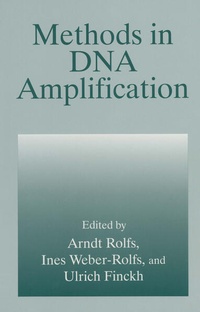
Methods in DNA Amplification
Published on 7. November 2012
Book
Paperback/Softback
IX, 251 pages
978-1-4613-6078-0 (ISBN)
Description
The polymerase chain reaction (PCR) - an in Vitro techniques for producing large amounts of a specific DNA fragment - has rapidly become established as one of the most important, impressive and fascinating methods of molecular biology as well as clinical diagnostics. In the seven years since'the technique was published, it has had a major impact on medical research. However, as there are still problems in instruments, standardized protocols for diagnostic applications and unsolved difficulties to avoid cross-contaminations on the one hand and on the other hand the even present question of how to interpret the biological value of a PCR result, most clinicians prefer to further wait until these topics are clarified. It is the aim of this book to give the reader lab-proven protocols from experienced scientists as well as a general introduction to alternative DNA-amplification procedures and their possible usage such as the NASBA or LCR. This book is divided into four major parts to provide a theoretical (first and second section) and a practical framework for a better understanding of the new technology. In the first part we provide an up-to-date summary of basic problems in this rapidly evolving field. We demonstrate, for example how to use fixed tissue materials and how to quantify PCR products as well as how to prepare nucleic acids in a safe, convenient and proper way, or even how to sequence directly PCR products for the analysis of the DNA structure.
More details
Edition
Softcover reprint of the original 1st ed. 1994
Language
English
Place of publication
New York
United States
Target group
Professional and scholarly
Research
Illustrations
IX, 251 p.
Dimensions
Height: 244 mm
Width: 156 mm
Thickness: 15 mm
Weight
424 gr
ISBN-13
978-1-4613-6078-0 (9781461360780)
DOI
10.1007/978-1-4615-2530-1
Schweitzer Classification
Other editions
Additional editions
Ulrich Finckh | Arndt Rolfs | Ines Weber-Rolfs
Methods in DNA Amplification
Proceedings of the Second International PCR Symposium on Usage of PCR and Alternative Amplification Methods in Infectious and Genetic Diseases Held in Berlin, Germany, February 26-27, 1993
Book
12/1994
1st Edition
Kluwer Academic / Plenum Publishers
€96.00
Article exhausted; check different version
Content
General Aspects of PCR.- The Polymerase Chain Reaction and Fixed Tissues.- Impact of PCR on the Pathologist's World.- Sensitive and Rapid Detection and Quantification of Nucleic Acids.- Polymorphic Keratins as Detected by PCR and SSCP.- Production of Antibodies of Monoclonal Specificity without the Use of Hybridoma Cell Lines.- Use of Chelex 100TM in the Extraction of Viruses from Diverse Cell-Free Clinical Samples for PCR.- Detection of Amplified Oncogenes by Differential Polymerase Chain Reaction.- Resolution of a Secondary Structure in an Unknown mRNA 5'End.- Automated Solid-Phase Sequencing of Genomic DNA Obtained from Polymerase Chain Reaction.- Alternative DNA-Amplification Methods.- Ligase-Mediated Detection Techniques.- Qualitative and Quantitative Detection of Nucleic Acids of Infectious Agents by NASBA.- Application of NASBA to the Detection of Listeria Monocytogenes.- PCR and Virological Problems.- Confirmation of Hepatitis C Virus Carrier State by Polymerase Chain Reaction in Cases with Nondiagnostic Serologies.- Confirmation of Hepatitis C Virus Positive Seras by Polymerase Chain Reaction.- Specific Detection and Rapid Identification of Human Enteroviruses by PCR Amplification.- Detection of Herpes Simplex Virus Using Polymerase Chain Reaction.- Detection of Human Cytomegalovirus (HCMV)-DNA from Granulocytes and Peripheral Blood Mononuclear Cells (PBMNC) of Immunosuppressed Patients by Nested PCR: Lack of Correlation to Isolation of Infectious Virus.- Timing of Mother-to Child Transmission of HIV-1 as Determinated by Nested Polymerase Chain Reaction - A Cohort Study in Kigali, Rwanda.- One-Day Detection of Enteroviruses in Clinical Specimens by Magnetic Bead Extraction of Viral RNA and Nested Polymerase Chain Reaction.- Monitoring of Poliovirus StrainsCirculating in the Environment and Their Intertypic and Intratypic Differentiation by RFLP Analysis of a PCR Product Derived from the 5'Non-coding Region.- Detection of Adenoviruses in Blood by Polymerase Chain Reaction.- Detection of the HPV 16 E2 Gene in Nonkeratinizing Squamous Cervical Carcinomas by PCR.- PCR in the Field of Bacterial and Fungal Problems.- Identification of Toxoplasma-DNA by Polymerase Chain Reaction in Peripheral Blood Leukocytes of Patients with Suspected Toxoplasmosis.- Detection of Mycobacterium Tuberculosis in Clinical Samples by Polymerase Chain Reaction.- Tuberculosis in HIV Infected Patients Detected by PCR: A Comparison with Clinical Data.- Detection of Borrelia Burgdorferi in Human Skin Biopsies by a Nested Polymerase Chain Reaction.- The Application of PCR Fingerprinting to Epidemiological Analysis of Bacterial and Fungal Pathogens.- Contributors.- Suppliers of Special Items.