

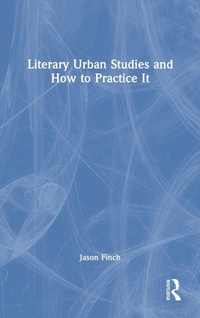
Literary Urban Studies and How to Practice It
1st Edition
Published on 23. November 2021
Book
Hardback
258 pages
978-0-367-51449-5 (ISBN)
Description
Literary Urban Studies and How to Practice It is the first textbook in literary urban studies (LUS). It illuminates and investigates this exciting field, which has grown since the humanities' 'spatial turn' of the 1990s and 2000s. The book introduces city literature, urban methods of reading, classics in LUS and new directions in the field.
It outlines the located qualities of literary narratives, texts and events through three units. First, the concept of the city and the main methods and terms needed as tools for investigating city literatures are introduced. A second section, ordered historically, shows how notions like pre-modern, realist, modernist, postcolonial and planetary actually work in nuanced explorations of actual writers, texts and places. The third unit covers literary urban modes: fictional and non-fictional prose in multiple genres; poetry and the idea of the city; dramatic city representation and the theatre as urban place. Multiple key categories of place are explored: the sacred spaces of religion; entry points such as railway stations and junctions; residential areas such as the 'slum', suburb and mass housing district; hubs of publishing and performance; categories of city such as the port and resort.
In each chapter key terms, reflection questions and tasks labelled 'Research It' support reference and learning. Some Research It tasks enable readers to enter new areas of LUS by engaging with neighbouring disciplines like human geography, cultural history, sociology and urban studies. Others equip users by sharpening particular skills of writing or documentation. A thorough glossary of key terms and concepts aids the reader. Literary Urban Studies and How to Practice It is designed for application to literatures and cities in any period and part of the world. Armed with it, humanities researchers at any career stage can develop their interdisciplinary skills and ability to participate in activism and public debates while becoming specialised in LUS. The book is a gateway to practicing LUS and spatial literary research.
It outlines the located qualities of literary narratives, texts and events through three units. First, the concept of the city and the main methods and terms needed as tools for investigating city literatures are introduced. A second section, ordered historically, shows how notions like pre-modern, realist, modernist, postcolonial and planetary actually work in nuanced explorations of actual writers, texts and places. The third unit covers literary urban modes: fictional and non-fictional prose in multiple genres; poetry and the idea of the city; dramatic city representation and the theatre as urban place. Multiple key categories of place are explored: the sacred spaces of religion; entry points such as railway stations and junctions; residential areas such as the 'slum', suburb and mass housing district; hubs of publishing and performance; categories of city such as the port and resort.
In each chapter key terms, reflection questions and tasks labelled 'Research It' support reference and learning. Some Research It tasks enable readers to enter new areas of LUS by engaging with neighbouring disciplines like human geography, cultural history, sociology and urban studies. Others equip users by sharpening particular skills of writing or documentation. A thorough glossary of key terms and concepts aids the reader. Literary Urban Studies and How to Practice It is designed for application to literatures and cities in any period and part of the world. Armed with it, humanities researchers at any career stage can develop their interdisciplinary skills and ability to participate in activism and public debates while becoming specialised in LUS. The book is a gateway to practicing LUS and spatial literary research.
More details
Language
English
Place of publication
London
United Kingdom
Publishing group
Taylor & Francis Ltd
Target group
College/higher education
Dimensions
Height: 235 mm
Width: 157 mm
Thickness: 19 mm
Weight
552 gr
ISBN-13
978-0-367-51449-5 (9780367514495)
Copyright in bibliographic data and cover images is held by Nielsen Book Services Limited or by the publishers or by their respective licensors: all rights reserved.
Schweitzer Classification
Other editions
Additional editions
Jason Finch
Literary Urban Studies and How to Practice It
Book
11/2021
1st Edition
Routledge
€60.50
Shipment within 15-20 days
Jason Finch
Literary Urban Studies and How to Practice It
E-Book
11/2021
1st Edition
Routledge
€52.49
Available for download
Jason Finch
Literary Urban Studies and How to Practice It
E-Book
11/2021
1st Edition
Routledge
€52.49
Available for download
Person
Jason Finch is Associate Professor, English Language and Literature, at Abo Akademi University. Previous books include E. M. Forster and English Place (2011), Deep Locational Criticism (2016) and, as co-editor, Literary Second Cities (2017). A founder member of the Association for Literary Urban Studies (ALUS), from 2019-22 he is Principal Investigator for Finland on the project 'Public Transport as Public Space in European Cities' (PUTSPACE), funded by the ERC's HERA programme. Jason's literary urban research interests include London, housing representations and public transport.
Content
Acknowledgements
Preface
1 . Introduction
2. Concept, Method and Material
3. Literary Urban Studies of a Pre-Modern World
4. When People Move to Cities: Urbanisation and Realism
5. Urban Modernity, Literary Modernism and Beyond
6. Informal Planet: LUS and Contemporary Urbanity
7. The Prose of the Urban World
8. City Poetry and Poets' Views of Urban Scenes
9. Theatre in the City and Cities in Drama
10. Conclusion: Finding Your Way Through Urban Form and Literary Form
Further reading
Glossary of Concepts and Fields
Index
Preface
1 . Introduction
2. Concept, Method and Material
3. Literary Urban Studies of a Pre-Modern World
4. When People Move to Cities: Urbanisation and Realism
5. Urban Modernity, Literary Modernism and Beyond
6. Informal Planet: LUS and Contemporary Urbanity
7. The Prose of the Urban World
8. City Poetry and Poets' Views of Urban Scenes
9. Theatre in the City and Cities in Drama
10. Conclusion: Finding Your Way Through Urban Form and Literary Form
Further reading
Glossary of Concepts and Fields
Index