

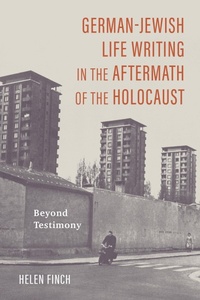
German-Jewish Life Writing in the Aftermath of the Holocaust
Beyond Testimony
Published on 16. May 2023
Book
Hardback
230 pages
978-1-64014-145-2 (ISBN)
Description
Shows how Adler, Wander, Hilsenrath, and Klueger intertwine transgressive political criticism with the shadow of trauma, revealing new perspectives on canon formation and exclusion in postwar German literature.
How did German-speaking Holocaust survivors pursue literary careers in an often-indifferent postwar society? How did their literary life writings reflect their postwar struggles? This monograph focuses on four authors who bore literary witness to the Shoah - H. G. Adler, Fred Wander, Edgar Hilsenrath, and Ruth Klueger. It analyzes their autofictional, critical, and autobiographical works written between the early 1950s and 2015, which depict their postwar experiences of writing, publishing, and publicizing Holocaust testimony.
These case studies shed light on the devastating aftermaths of the Holocaust in different contexts. Adler depicts his attempts to overcome marginalization as a writer in Britain in the 1950s. Wander reflects on his failure to find a home either in postwar Austria or in the GDR. Hilsenrath satirizes his struggles as an emigrant to the US in the 1960s and after returning to Berlin in the 1980s. Finally, in her 2008 memoir, Ruth Klueger follows up her earlier, highly impactful memoir of the concentration camps by narrating the misogyny and antisemitism she experienced in US and German academia. Helen Finch analyzes how these under-researched texts intertwine transgressive political criticism with the shadow of trauma. Drawing on scholarship on Holocaust testimony, transnational memory, and affect theory, her book reveals new perspectives on canon formation and exclusion in postwar German literature.
How did German-speaking Holocaust survivors pursue literary careers in an often-indifferent postwar society? How did their literary life writings reflect their postwar struggles? This monograph focuses on four authors who bore literary witness to the Shoah - H. G. Adler, Fred Wander, Edgar Hilsenrath, and Ruth Klueger. It analyzes their autofictional, critical, and autobiographical works written between the early 1950s and 2015, which depict their postwar experiences of writing, publishing, and publicizing Holocaust testimony.
These case studies shed light on the devastating aftermaths of the Holocaust in different contexts. Adler depicts his attempts to overcome marginalization as a writer in Britain in the 1950s. Wander reflects on his failure to find a home either in postwar Austria or in the GDR. Hilsenrath satirizes his struggles as an emigrant to the US in the 1960s and after returning to Berlin in the 1980s. Finally, in her 2008 memoir, Ruth Klueger follows up her earlier, highly impactful memoir of the concentration camps by narrating the misogyny and antisemitism she experienced in US and German academia. Helen Finch analyzes how these under-researched texts intertwine transgressive political criticism with the shadow of trauma. Drawing on scholarship on Holocaust testimony, transnational memory, and affect theory, her book reveals new perspectives on canon formation and exclusion in postwar German literature.
Reviews / Votes
This is an extremely rich and well-researched volume with a sometimes overwhelming abundance of information. I highly recommend it for making untranslated and sometimes unpublished texts accessible, inspiring readers to re-evaluate Germany's process of Vergangenheitsbewaeltigung and to pay attention to the long-term consequences of the Holocaust. * THE GERMAN QUARTERLY * A highly useful and important book for the emerging fields of German Jewish Studies, Holocaust Studies, comparative literature, and German Studies writ large. The mostly jargon-free and clear language makes it accessible for undergraduate student populations as well as lay readers. It should be required reading for scholars interested in post-1945 literature, history, international relations, and feminist studies. * MONATSHEFTE * Provokes us to historicize not only whose voices count but also which formal modes are rendered timely or untimely by a marketplace governed by national memory regimes. It further challenges us to question the criteria by which survivor voices and affective registers become admissible as Holocaust witnesses. * GERMAN STUDIES REVIEW * Unflinchingly facing the complex trauma of her authors, Finch's monograph offers a new interpretive method for incorporating overlooked post Holocaust testimony into scholarly conversation not only of Holocaust literature, but of the treatment of survivors more generally. ... Her analysis furthermore leads to the understanding that, just as the trauma captured in the pages of her authors is necessarily and always belated, so too is our attention to their texts, making her work all the more urgent in our current political climate. * STUDIES IN TWENTIETH- AND TWENTY-FIRST CENTURY LITERATURE *More details
Series
Language
English
Place of publication
Columbia, MD
United States
Publishing group
Boydell & Brewer Ltd
Target group
Professional and scholarly
Product notice
Cloth over boards
Dimensions
Height: 229 mm
Width: 152 mm
Thickness: 14 mm
Weight
481 gr
ISBN-13
978-1-64014-145-2 (9781640141452)
Copyright in bibliographic data and cover images is held by Nielsen Book Services Limited or by the publishers or by their respective licensors: all rights reserved.
Schweitzer Classification
Other editions
Additional editions
E-Book
05/2023
1st Edition
Boydell & Brewer
€48.99
Available for download
E-Book
05/2023
1st Edition
De Gruyter
€48.99
Available for download
Person
Content
Acknowledgments
Abbreviations
Introduction
1: Modernist Marginalization in Exile: H. G. Adler in the 1950s and 1960s
2: Solidarity and Trauma between Austria and the GDR: Fred Wander from the 1960s to 2006
3: Transnational Transgression: Edgar Hilsenrath from 1980 to 2018
4: Feminist Rage: Ruth Klueger in the New Millennium
Conclusion
Bibliography
Index
Abbreviations
Introduction
1: Modernist Marginalization in Exile: H. G. Adler in the 1950s and 1960s
2: Solidarity and Trauma between Austria and the GDR: Fred Wander from the 1960s to 2006
3: Transnational Transgression: Edgar Hilsenrath from 1980 to 2018
4: Feminist Rage: Ruth Klueger in the New Millennium
Conclusion
Bibliography
Index