

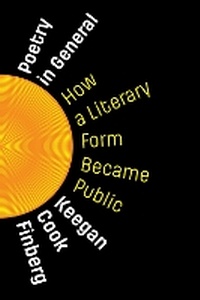
Poetry in General
How a Literary Form Became Public
Published on 4. November 2025
Book
Hardback
264 pages
978-0-231-21921-1 (ISBN)
Description
In the second half of the twentieth century, poetry leapt out of books and became an interdisciplinary public form. Poetry entered bureaucratic systems of organization like index card catalogues; it pushed the boundaries of privately owned public parks. Keegan Cook Finberg argues that poetry became an increasingly capacious force during this period because it could speak directly to the degradation of the social-democratic notion of the public.
Poetry in General explores how poets expanded their practice into the realms of politics, work, and everyday life from 1960 to the present, from the apex of the welfare state to an era of privatization and austerity. It considers a compelling array of figures-including Yoko Ono, George Brecht, Frank O'Hara, Amiri Baraka, Bernadette Mayer, Eleanor Antin, Adrian Piper, and M. NourbeSe Philip-whose works draw on conceptual techniques to transform official documents and spaces. Finberg shows how these public texts expose the mechanisms of the neoliberal consensus about work and leisure, the state's facilitation of capitalism, and enduring racial and gender inequities. She also provides politically charged ways to interpret and critique racial capitalism, antiabortion legislation, and mass debt. A new literary and institutional history of postwar poetics, this book shows how poetic experiments address the privatization of collective life and rethink the category of the public.
Poetry in General explores how poets expanded their practice into the realms of politics, work, and everyday life from 1960 to the present, from the apex of the welfare state to an era of privatization and austerity. It considers a compelling array of figures-including Yoko Ono, George Brecht, Frank O'Hara, Amiri Baraka, Bernadette Mayer, Eleanor Antin, Adrian Piper, and M. NourbeSe Philip-whose works draw on conceptual techniques to transform official documents and spaces. Finberg shows how these public texts expose the mechanisms of the neoliberal consensus about work and leisure, the state's facilitation of capitalism, and enduring racial and gender inequities. She also provides politically charged ways to interpret and critique racial capitalism, antiabortion legislation, and mass debt. A new literary and institutional history of postwar poetics, this book shows how poetic experiments address the privatization of collective life and rethink the category of the public.
Reviews / Votes
Poetry rarely gets to be general, but Keegan Cook Finberg blasts past misconceptions of marginality, framing it as a vibrant, interdisciplinary, public practice. What a relief to see this truth so clearly stated: Poetry-when at its weirdest!-is uniquely positioned to contest the state's facilitation of capital. -- Sarah Dowling, author of <i>Here Is a Figure: Grounding Literary Form</i> Keegan Cook Finberg takes poems seriously enough to see their claims on expanding the genre of poetry itself. Recognizing ambitions beyond individual expression, Poetry in General reads poems not as private refuges from social politics but as urgent interlocutors in a world of increasing privatization and politically managed bodies. -- Craig Dworkin, author of <i>Dictionary Poetics: Toward a Radical Lexicography</i> What a generous and generative study of contemporary American poetry. This is a serious work of materialist criticism in which "poetry in general" is imagined through and with our most important economic and discursive formations, from infrastructure to accumulation to the public sphere itself. Finberg demonstrates throughout an ability to locate in poetry a social archive of our present, and this book will be of interest to all scholars concerned with twenty-first century literary form and philosophical aesthetics. -- Leigh Claire La Berge, author of <i>Wages Against Artwork: Socially Engaged Art and the Claims of Decommodified Labor</i> With Poetry in General, Keegan Cook Finberg advances a notion of the public as a practical fiction enacted in and through social forms that exist not despite the atomized and bureaucratized forms of daily life, but through the extensive paper trails those forms generate. Poetry becomes a way of bearing witness to and living with changing social forms. With wit and verve, Finberg conceptually remaps postwar US poetry. -- Anthony Reed, author of <i>Soundworks: Race, Sound, and Poetry in Production</i>More details
Series
Language
English
Place of publication
New York
United States
Target group
Professional and scholarly
College/higher education
Product notice
Trade binding
Illustrations
16 b&w illustrations
Dimensions
Height: 229 mm
Width: 152 mm
ISBN-13
978-0-231-21921-1 (9780231219211)
Copyright in bibliographic data and cover images is held by Nielsen Book Services Limited or by the publishers or by their respective licensors: all rights reserved.
Schweitzer Classification
Other editions
Additional editions
E-Book
11/2025
1st Edition
Columbia University Press
€33.99
Available for download
Person
Keegan Cook Finberg is an assistant professor of English and affiliated faculty in the Departments of Gender, Women's, and Sexuality Studies and Language, Literacy, and Culture at University of Maryland, Baltimore County.
Content
Introduction
1. Assimilating the Arts: Poetry and Difference in Yoko Ono's Instructions
2. Fluxus Scores and the Bureaucratization of Everyday Life
3. "I Do This, I Do That": Cold War Spatial Poetics and the New York School Poets
4. Feminist Procedure and Durational Constraint: Reproduction, Welfare, and "Losing Myself"
5. Documental Poetry and the Privatization of Interpretation
Coda
Acknowledgments
Notes
Bibliography
Index
1. Assimilating the Arts: Poetry and Difference in Yoko Ono's Instructions
2. Fluxus Scores and the Bureaucratization of Everyday Life
3. "I Do This, I Do That": Cold War Spatial Poetics and the New York School Poets
4. Feminist Procedure and Durational Constraint: Reproduction, Welfare, and "Losing Myself"
5. Documental Poetry and the Privatization of Interpretation
Coda
Acknowledgments
Notes
Bibliography
Index