

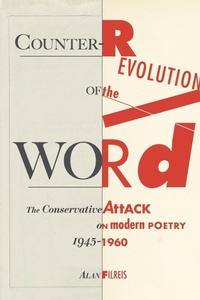
Counter-revolution of the Word
The Conservative Attack on Modern Poetry, 1945-1960
Published on 1. March 2014
Book
Paperback/Softback
448 pages
978-1-4696-1466-3 (ISBN)
Description
During the Cold War an unlikely coalition of poets, editors, and politicians converged in an attempt to discredit--if not destroy--the American modernist avant-garde. Ideologically diverse yet willing to bespeak their hatred of modern poetry through the rhetoric of anticommunism, these ""anticommunist antimodernists,"" as Alan Filreis dubs them, joined associations such as the League for Sanity in Poetry to decry the modernist ""conspiracy"" against form and language. In Counter-revolution of the Word Filreis narrates the story of this movement and assesses its effect on American poetry and poetics.
Although the antimodernists expressed their disapproval through ideological language, their hatred of experimental poetry was ultimately not political but aesthetic, Filreis argues. By analyzing correspondence, decoding pseudonyms, drawing new connections through the archives, and conducting interviews, Filreis shows that an informal network of antimodernists was effective in suppressing or distorting the postwar careers of many poets whose work had appeared regularly in the 1930s. Insofar as modernism had consorted with radicalism in the Red Decade, antimodernists in the 1950s worked to sever those connections, fantasized a formal and unpolitical pre-Depression High Modern moment, and assiduously sought to de-radicalize the remnant avant-garde. Filreis's analysis provides new insight into why experimental poetry has aroused such fear and alarm among American conservatives.
Although the antimodernists expressed their disapproval through ideological language, their hatred of experimental poetry was ultimately not political but aesthetic, Filreis argues. By analyzing correspondence, decoding pseudonyms, drawing new connections through the archives, and conducting interviews, Filreis shows that an informal network of antimodernists was effective in suppressing or distorting the postwar careers of many poets whose work had appeared regularly in the 1930s. Insofar as modernism had consorted with radicalism in the Red Decade, antimodernists in the 1950s worked to sever those connections, fantasized a formal and unpolitical pre-Depression High Modern moment, and assiduously sought to de-radicalize the remnant avant-garde. Filreis's analysis provides new insight into why experimental poetry has aroused such fear and alarm among American conservatives.
More details
Edition
New edition
Language
English
Place of publication
Chapel Hill
United States
Target group
College/higher education
Professional and scholarly
Edition type
New edition
Dimensions
Height: 234 mm
Width: 156 mm
Thickness: 26 mm
Weight
761 gr
ISBN-13
978-1-4696-1466-3 (9781469614663)
Copyright in bibliographic data and cover images is held by Nielsen Book Services Limited or by the publishers or by their respective licensors: all rights reserved.
Schweitzer Classification
Other editions
Additional editions
E-Book
09/2012
The University of North Carolina Press
€29.49
Available for download
Person
Alan Filreis is Kelly Professor of English, faculty director of the Kelly Writers House, and director of the Center for Programs in Contemporary Writing at the University of Pennsylvania. He is author of three other books, including Modernism from Right to Left: Wallace Stevens, the Thirties, and Literary Radicalism.