

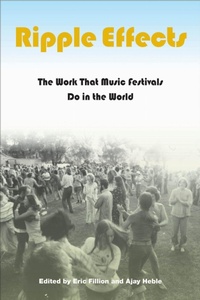
Ripple Effects
The Work That Music Festivals Do in the World
Will be published approx. on 19. March 2027
Book
Paperback/Softback
324 pages
978-1-4399-2833-2 (ISBN)
Description
What is the work that music festivals do in the world? In asking this question, Ripple Effects explores the varied ways in which festivals can act as spaces where new social relations are cultivated, as places for envisioning and enacting repertories of embodied memory and care, as alternatives to fragmented private consumption of culture, as sites for unexpected conversations.
While some case studies discuss structures of dominance inside mammoth corporate-sponsored festivals, other chapters find insubordinate spaces in independent, artist-run festivals designed to honor traditional folk musics, to protest the proliferation of nuclear weapons, to deploy cultural exchanges in defiance of Cold War politics, to build pan-African unity, and to embrace the links between humans and the more-than-human world.
Ripple Effects brings together leading and emerging scholars, artists, and arts presenters to consider the challenges, rewards, and responsibilities associated with the improvisational culture and ethos of music festivals as alternative public spheres.
Contributors: Amina Boubia, Jody H. Cripps, Chris Dodd, Ben Finley, Simon Frith, Maria Giaever Lopez, Chris Greencorn, Jo Haynes, Michael J. Kramer, David A. McDonald, Patricia Nicholson, Melissa Noventa, William Parker, Jeremy Reed, Andrew Snyder, Cheryl Thompson, Steve Waksman, Katharine White, Deborah Wong, and the editors.
In the series Insubordinate Spaces
While some case studies discuss structures of dominance inside mammoth corporate-sponsored festivals, other chapters find insubordinate spaces in independent, artist-run festivals designed to honor traditional folk musics, to protest the proliferation of nuclear weapons, to deploy cultural exchanges in defiance of Cold War politics, to build pan-African unity, and to embrace the links between humans and the more-than-human world.
Ripple Effects brings together leading and emerging scholars, artists, and arts presenters to consider the challenges, rewards, and responsibilities associated with the improvisational culture and ethos of music festivals as alternative public spheres.
Contributors: Amina Boubia, Jody H. Cripps, Chris Dodd, Ben Finley, Simon Frith, Maria Giaever Lopez, Chris Greencorn, Jo Haynes, Michael J. Kramer, David A. McDonald, Patricia Nicholson, Melissa Noventa, William Parker, Jeremy Reed, Andrew Snyder, Cheryl Thompson, Steve Waksman, Katharine White, Deborah Wong, and the editors.
In the series Insubordinate Spaces
More details
Series
Language
English
Place of publication
Philadelphia PA
United States
Target group
Professional and scholarly
Illustrations
12
Dimensions
Height: 229 mm
Width: 152 mm
ISBN-13
978-1-4399-2833-2 (9781439928332)
Copyright in bibliographic data and cover images is held by Nielsen Book Services Limited or by the publishers or by their respective licensors: all rights reserved.
Schweitzer Classification
Persons
Eric Fillion is Director of the International Institute for Critical Studies in Improvisation and Assistant Professor in the School of Languages and Literatures at the University of Guelph. He is the author of JAZZ LIBRE et la revolution quebecoise: musique-action, 1967-1975 and Distant Stage: Quebec, Brazil, and the Making of Canada's Cultural Diplomacy, and the coeditor of Statesman of the Piano: Jazz, Race, and History in the Life of Lou Hooper.
Ajay Heble is University Professor Emeritus in the School of Theatre, English, and Creative Writing at the University of Guelph. Until his retirement, he served as the Founding Director of the International Institute for Critical Studies in Improvisation. He is the author, coauthor, editor, or coeditor of sixteen volumes, and from 1994-2016 he served as the Founding Artistic Director of the Guelph Jazz Festival.
Ajay Heble is University Professor Emeritus in the School of Theatre, English, and Creative Writing at the University of Guelph. Until his retirement, he served as the Founding Director of the International Institute for Critical Studies in Improvisation. He is the author, coauthor, editor, or coeditor of sixteen volumes, and from 1994-2016 he served as the Founding Artistic Director of the Guelph Jazz Festival.