

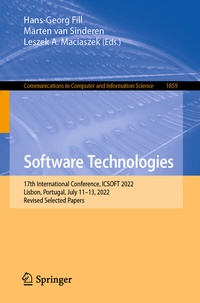
Software Technologies
17th International Conference, ICSOFT 2022, Lisbon, Portugal, July 11-13, 2022, Revised Selected Papers
Published on 19. July 2023
Book
Paperback/Softback
XII, 231 pages
978-3-031-37230-8 (ISBN)
Description
This book includes extended and revised versions of a set of selected papers from the 17th International Conference on Software Technologies, ICSOFT 2022, held in Lisbon, Portugal, during July 11-13, 2022.
The 10 full papers included in this book were carefully reviewed and selected from 102 submissions. They were organized in topical sections as follows: tool assisted empirical approach to reusability models assessment; functional programming; three forms of mutant subsumption: basic, strict and broad; and on the efficiency of building large collections of software: modeling, algorithms, and experimental results.
The 10 full papers included in this book were carefully reviewed and selected from 102 submissions. They were organized in topical sections as follows: tool assisted empirical approach to reusability models assessment; functional programming; three forms of mutant subsumption: basic, strict and broad; and on the efficiency of building large collections of software: modeling, algorithms, and experimental results.
More details
Series
Edition
1st ed. 2023
Language
English
Place of publication
Cham
Switzerland
Publishing group
Springer International Publishing
Target group
Professional and scholarly
Illustrations
38 s/w Abbildungen, 61 farbige Abbildungen
XII, 231 p. 99 illus., 61 illus. in color.
Dimensions
Height: 235 mm
Width: 155 mm
Thickness: 14 mm
Weight
376 gr
ISBN-13
978-3-031-37230-8 (9783031372308)
DOI
10.1007/978-3-031-37231-5
Schweitzer Classification
Other editions
Additional editions
Hans-Georg Fill | Marten van Sinderen | Leszek A. Maciaszek
Software Technologies
17th International Conference, ICSOFT 2022, Lisbon, Portugal, July 11-13, 2022, Revised Selected Papers
E-Book
07/2023
Springer
€85.59
Available for download
Content
Tool Assisted Empirical Approach to Reusability Models Assessment.- Microservices Deployment on a Multi-platform Ecosystem: A Contract-based Approach.- A Decision Model based on an Optimized Choquet Integral: Multifactor Prediction and Intelligent Agriculture Application.-A New Simulation Tool for Sensor Networks based on an Energy-efficient and Fault-tolerant Methodology.- Adapting Cyber-Risk Assessment for the Planning of Cyber-Physical Smart Grids based on Industrial Needs.- Three Forms of Mutant Subsumption: Basic, Strict and Broad.- On the Efficiency of Building Large Collections of Software: Modeling, Algorithms, and Experimental Results.- An AST-based Code Change Representation and Its Performance in Just-in-time Vulnerability Prediction.- Towards Extracting Reusable and Maintainable Code Snippets.- A deep learning architecture based on advanced textual language models for detecting disease through its symptoms associated with a reinforcement learning algorithm.