

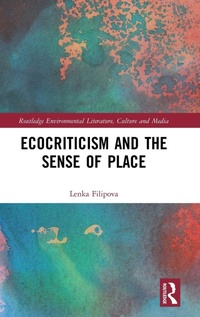
Ecocriticism and the Sense of Place
1st Edition
Published on 30. August 2021
Book
Hardback
176 pages
978-0-367-75458-7 (ISBN)
Description
The book is an investigation into the ways in which ideas of place are negotiated, contested and refigured in environmental writing at the turn of the twenty-first century. It focuses on the notion of place as a way of interrogating the socio-political and environmental pressures that have been seen as negatively affecting our environments since the advent of modernity, as well as the solutions that have been given as an antidote to those pressures.
Examining a selection of literary representations of place from across the globe, the book illuminates the multilayered and polyvocal ways in which literary works render local and global ecological relations of places. In this way, it problematises more traditional environmentalism and its somewhat essentialised idea of place by intersecting the largely Western discourse of environmental studies with postcolonial and Indigenous studies, thus considering the ways in which forms of emplacement can occur within displacement and dispossession, especially within societies that are dealing with the legacies of colonialism, neocolonial exploitation or international pressure to conform. As such, the work foregrounds the singular processes in which different local/global communities recognise themselves in their diverse approaches to the environment, and gestures towards an environmental politics that is based on an epistemology of contact, connection and difference, and as one, moreover, that recognises its own epistemological limits.
This book will appeal to researchers working in the fields of environmental humanities, postcolonial studies, Indigenous studies and comparative literature.
Examining a selection of literary representations of place from across the globe, the book illuminates the multilayered and polyvocal ways in which literary works render local and global ecological relations of places. In this way, it problematises more traditional environmentalism and its somewhat essentialised idea of place by intersecting the largely Western discourse of environmental studies with postcolonial and Indigenous studies, thus considering the ways in which forms of emplacement can occur within displacement and dispossession, especially within societies that are dealing with the legacies of colonialism, neocolonial exploitation or international pressure to conform. As such, the work foregrounds the singular processes in which different local/global communities recognise themselves in their diverse approaches to the environment, and gestures towards an environmental politics that is based on an epistemology of contact, connection and difference, and as one, moreover, that recognises its own epistemological limits.
This book will appeal to researchers working in the fields of environmental humanities, postcolonial studies, Indigenous studies and comparative literature.
More details
Series
Language
English
Place of publication
London
United Kingdom
Publishing group
Taylor & Francis Ltd
Target group
College/higher education
Dimensions
Height: 240 mm
Width: 161 mm
Thickness: 15 mm
Weight
449 gr
ISBN-13
978-0-367-75458-7 (9780367754587)
Copyright in bibliographic data and cover images is held by Nielsen Book Services Limited or by the publishers or by their respective licensors: all rights reserved.
Schweitzer Classification
Other editions
Additional editions
Lenka Filipova
Ecocriticism and the Sense of Place
Book
05/2023
1st Edition
Routledge
€64.90
Shipment within 15-20 days
Lenka Filipova
Ecocriticism and the Sense of Place
E-Book
08/2021
1st Edition
Routledge
€59.49
Available for download
Lenka Filipova
Ecocriticism and the Sense of Place
E-Book
08/2021
1st Edition
Routledge
€59.49
Available for download
Person
Lenka Filipova completed her PhD at Freie Universitaet Berlin.
Content
Introduction: From Local to Global and Back Again Chapter 1: Small-Scale Farming and the Ethics of Proximity in Wendell Berry's Jayber Crow Chapter 2: Wilderness and Place in Gary Snyder's The Practice of the Wild Chapter 3: Industrialisation and Displacement in John Berger's Into Their Labours Trilogy Chapter 4: Colonisation and Displacement in Kim Scott's That Deadman Dance Chapter 5: Slow Violence and Neocolonialism in Helon Habila's Oil on Water Chapter 6: Universalism and Embodied Knowledge in Amitav Ghosh's The Hungry Tide Conclusion: Ecocritical Communities