

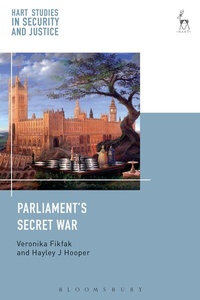
Parliament's Secret War
Published on 22. February 2018
Book
Hardback
272 pages
978-1-5099-0287-3 (ISBN)
Description
The invasion of Iraq in 2003, and the Coalition Government's failure to win parliamentary approval for armed intervention in Syria in 2013, mark a period of increased scrutiny of the process by which the UK engages in armed conflict. For much of the media and civil society there now exists a constitutional convention which mandates that the Government consults Parliament before commencing hostilities. This is celebrated as representing a redistribution of power from the executive towards a more legitimate, democratic institution. This book offers a critical inquiry into Parliament's role in the war prerogative since the beginning of the twentieth century, evaluating whether the UK's decisions to engage in conflict meet the recognised standards of good governance: accountability, transparency and participation. The analysis reveals a number of persistent problems in the decision-making process, including Parliament's lack of access to relevant information, government 'legalisation' of parliamentary debates which frustrates broader discussions of political legitimacy, and the skewing of debates via the partial public disclosure of information based upon secret intelligence. The book offers solutions to these problems to reinvigorate parliamentary discourse and to address government withholding of classified information. It is essential reading for anyone interested in war powers, the relationship between international law and domestic politics, and the role of the Westminster Parliament in questions of national security.
Reviews / Votes
The literature on parliamentary control of military action has blossomed since the predictably ill-fated war in Iraq. Parliament's Secret War represents its clear high point. It is exceptionally well researched, intellectually well rounded, and responds fully to the challenge it sets itself, showing why the war powers convention falls short and making a compelling case for reforms which might remedy some of its current failings. -- Paul F Scott, School of Law, University of Glasgow * Public Law * By any measure, this is an excellent book. It is innovative, timely, thorough, and challenges orthodoxy in a sustained, compelling, and methodical way. Bringing together research from both domestic and international legal scholarship gives the book depth and nuance. -- Leah Trueblood, St Hilda's College, University of Oxford * Law Quarterly Review * The book is a timely, comprehensive, and necessary study of 'how Britain constitutionally decides to go to war', or, 'how the House of Commons is and should be involved in the decision to send British troops into harm's way'... The book's core message - that we must strive to keep in good health the political constitution, that we must continue to expose and scrutinise those 'hidden power structures' - will resonate not only with those concerned specifically with the issue of domestic accountability arrangements vis-a-vis UK war powers, and the place of the nascent War Powers Convention within these arrangements. The book will be of interest to those keen to understand how the UK's constitutional machinery continues to evolve against the backdrop of pressing issues of contemporary constitutional import, more broadly. -- Mark Bennett, School of Law and Social Justice, University of Liverpool * Legal Studies *More details
Series
Language
English
Place of publication
Oxford
United Kingdom
Publishing group
Bloomsbury Publishing PLC
Target group
College/higher education
Professional and scholarly
Product notice
Hardback (stationery)
Dimensions
Height: 234 mm
Width: 156 mm
Weight
558 gr
ISBN-13
978-1-5099-0287-3 (9781509902873)
Copyright in bibliographic data and cover images is held by Nielsen Book Services Limited or by the publishers or by their respective licensors: all rights reserved.
Schweitzer Classification
Other editions
Additional editions
Veronika Fikfak | Hayley J. Hooper
Parliament's Secret War
E-Book
02/2018
1st Edition
Hart Publishing
€46.49
Available for download
Persons
Veronika Fikfak is Fellow and Lecturer in Law at Homerton College, University of Cambridge.
Hayley J Hooper is Fellow in Law at Christ Church, University of Oxford.
Hayley J Hooper is Fellow in Law at Christ Church, University of Oxford.
Content
1. Parliament's Secret War 1
Veronika Fikfak and Hayley J Hooper
A. The Role of the House of Commons in War Powers Decisions: An Historical View
B. From Discretion to Democratisation
C. Roadmap of the Book
D. Methodology: The Political Constitution and Evidence-Based Public Law
2. A Legal War?
Veronika Fikfak
A. Use of Force as an International Legal Question
B. Bringing the War Question Home
C. Use of Force as a Domestic Question
D. The Implications of Linking International Legality to Parliament's Constitutional Role on War
E. Shining a Light on the Subjugation of Politics
3. The Convention as a Battlefield
Veronika Fikfak
A. The Role of Conventions in the UK Constitutional Sphere
B. The Timing of the Engagement
C. Parliament's Hollow Veto Power
D. Emergencies, Drones and Special Forces
E. Unrealised Accountability
4. The Deployment of Secrecy
Hayley J Hooper
A. Groupthink and Information Asymmetry
B. Complete Asymmetry: Refusing Debates and Making Secret Pre-commitments
C. Partial Asymmetry: Selective Disclosures
D. Reforming the Intelligence Machinery: An Incomplete Solution
E. Towards a New Nomenclature of Secrecy
5. Re-arming Parliament: Fostering Politics
Veronika Fikfak and Hayley J Hooper
A. Moving Beyond the Standard Solutions
B. Creating Space for Politics and Equipping Parliament for Deliberation
C. Voting Within a Culture of Justification
6. Closed Intelligence Sessions
Hayley J Hooper
A. Chilcot's Proposal for Parliamentary Scrutiny of Intelligence Material
B. The Alternative: Closed Intelligence Sessions of the Whole House of Commons
C. Justifications for Initiating a Closed Intelligence Session
D. Controlling Abuse of Closed Intelligence Sessions
E. Security Considerations
F. Inclusive Secrecy, Transparency, Participation and Accountability
Veronika Fikfak and Hayley J Hooper
A. The Role of the House of Commons in War Powers Decisions: An Historical View
B. From Discretion to Democratisation
C. Roadmap of the Book
D. Methodology: The Political Constitution and Evidence-Based Public Law
2. A Legal War?
Veronika Fikfak
A. Use of Force as an International Legal Question
B. Bringing the War Question Home
C. Use of Force as a Domestic Question
D. The Implications of Linking International Legality to Parliament's Constitutional Role on War
E. Shining a Light on the Subjugation of Politics
3. The Convention as a Battlefield
Veronika Fikfak
A. The Role of Conventions in the UK Constitutional Sphere
B. The Timing of the Engagement
C. Parliament's Hollow Veto Power
D. Emergencies, Drones and Special Forces
E. Unrealised Accountability
4. The Deployment of Secrecy
Hayley J Hooper
A. Groupthink and Information Asymmetry
B. Complete Asymmetry: Refusing Debates and Making Secret Pre-commitments
C. Partial Asymmetry: Selective Disclosures
D. Reforming the Intelligence Machinery: An Incomplete Solution
E. Towards a New Nomenclature of Secrecy
5. Re-arming Parliament: Fostering Politics
Veronika Fikfak and Hayley J Hooper
A. Moving Beyond the Standard Solutions
B. Creating Space for Politics and Equipping Parliament for Deliberation
C. Voting Within a Culture of Justification
6. Closed Intelligence Sessions
Hayley J Hooper
A. Chilcot's Proposal for Parliamentary Scrutiny of Intelligence Material
B. The Alternative: Closed Intelligence Sessions of the Whole House of Commons
C. Justifications for Initiating a Closed Intelligence Session
D. Controlling Abuse of Closed Intelligence Sessions
E. Security Considerations
F. Inclusive Secrecy, Transparency, Participation and Accountability