

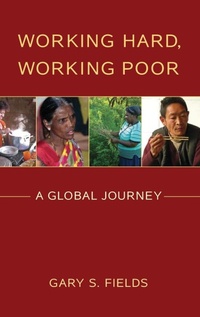
Working Hard, Working Poor
A Global Journey
1st Edition
Published on 5. January 2012
Book
Hardback
240 pages
978-0-19-979464-5 (ISBN)
Description
More than three billion people, nearly half of humankind, live on less than two-and-a-half U.S. dollars per person per day. Studies have shown repeatedly that the main and often the sole asset of the poor is their labor. It follows that to understand global poverty one must understand labor markets and labor earnings in the developing world. Excellent books exist on ending world poverty that discuss in depth many important aspects of economic development but do not focus on employment and self-employment, work and non-work. Working Hard, Working Poor fills in where the other books leave off.
Issues of analyzing poverty and low earnings in the developing world are quite different from those in the developed world. The discourse in the developed world is about incentive effects of social welfare programs, cultures of poverty, single-parenthood, homelessness, drug and alcohol abuse, ill health, mental illness, domestic violence, and the like. But in the developing world, different issues predominate, such as own-account work and household enterprises, agricultural work, casual employment, and informal work. And some of the policy issues--stimulating economic growth, harnessing the energies of the private sector, increasing paid employment, and raising the returns to self-employment--take a different twist. This book shows how people in poverty work, what has been effective in helping the poor earn their way out of poverty, and how readers might help.
Issues of analyzing poverty and low earnings in the developing world are quite different from those in the developed world. The discourse in the developed world is about incentive effects of social welfare programs, cultures of poverty, single-parenthood, homelessness, drug and alcohol abuse, ill health, mental illness, domestic violence, and the like. But in the developing world, different issues predominate, such as own-account work and household enterprises, agricultural work, casual employment, and informal work. And some of the policy issues--stimulating economic growth, harnessing the energies of the private sector, increasing paid employment, and raising the returns to self-employment--take a different twist. This book shows how people in poverty work, what has been effective in helping the poor earn their way out of poverty, and how readers might help.
Reviews / Votes
Gary Fields shows us the lives of the poor in developing countries and explains why so many are condemned to a life of hardship, no matter how hard they work. He also distills some of what's worked around the world and shows that solutions are possible. * Joseph E. Stiglitz, Nobel Laureate in Economics, 2001 *More details
Language
English
Place of publication
New York
United States
Target group
College/higher education
Illustrations
37 illustrations
Dimensions
Height: 240 mm
Width: 161 mm
Thickness: 18 mm
Weight
531 gr
ISBN-13
978-0-19-979464-5 (9780199794645)
Copyright in bibliographic data and cover images is held by Nielsen Book Services Limited or by the publishers or by their respective licensors: all rights reserved.
Schweitzer Classification
Other editions
Additional editions
E-Book
12/2011
1st Edition
OUP eBook
€35.49
Available for download
E-Book
07/2011
1st Edition
OUP eBook
€35.49
Available for download
Person
Gary S. Fields is John P. Windmuller Professor of International and Comparative Labor at Cornell University. He has published more than 100 articles and books and is the recipient of numerous grants from international organizations including the World Bank, the Inter-American Development Bank, the International Labor Organization, and others. Earlier in his career, he was named one of the 25 most widely-cited economists under the age of 40, and his book Retirement, Pensions, and Social Security (MIT Press) was designated an outstanding book of the year by Princeton University.
Content
Acknowledgments ; Part I: How the Poorer Half Works ; Chapter One: A Life's Journey ; Chapter Two: A Problem of Enormous Proportions ; Chapter Three: Four Workers' Stories ; Chapter Four: How the Poor Are Working ; Chapter Five: Labor Markets in a Globalized World ; Part II: Helping the Poor Earn Their Way Out of Poverty ; Chapter Six: Setting Objectives, Facing Tradeoffs ; Chapter Seven: Growth, Trade, and Aid ; Chapter Eight: Harnessing the Energies of Private Companies ; Chapter Nine: Labor Market Policies for Generating More Wage Employment ; Chapter Ten: Increasing Self-Employment Earnings ; Part III: Taking Action ; Chapter Eleven: What Can You Do? ; References ; Index