

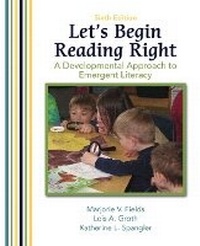
Let's Begin Reading Right
A Developmental Approach to Emergent Literacy
6th Edition
Published on 31. May 2007
Book
Paperback/Softback
448 pages
978-0-13-159502-6 (ISBN)
Description
For Literacy in Early Childhood or Early Childhood Reading Methods courses.
Let's Begin Reading Right: A Developmental Approach to Emergent Literacy, sixth edition, takes a constructivist, developmental approach to emergent literacy for infants to 8-year olds. This revision includes new introductory chapters that cover current issues (NCLB, standards) about emergent literacy, new features "Maintaining Developmentally Appropriate Practice in a No Child Left Behind World" and "Home-School Connection", and expanded coverage of working with English language learners. It includes chapters and discussions on oral language development, reading, writing, setting up classrooms for literacy activities, how to select and read children's literature, how to assess literacy development, and how to select teaching resources.
Let's Begin Reading Right: A Developmental Approach to Emergent Literacy, sixth edition, takes a constructivist, developmental approach to emergent literacy for infants to 8-year olds. This revision includes new introductory chapters that cover current issues (NCLB, standards) about emergent literacy, new features "Maintaining Developmentally Appropriate Practice in a No Child Left Behind World" and "Home-School Connection", and expanded coverage of working with English language learners. It includes chapters and discussions on oral language development, reading, writing, setting up classrooms for literacy activities, how to select and read children's literature, how to assess literacy development, and how to select teaching resources.
More details
Edition
6th edition
Language
English
Place of publication
United States
Publishing group
Pearson Education (US)
Target group
Professional and scholarly
Dimensions
Height: 190 mm
Width: 234 mm
Thickness: 15 mm
Weight
735 gr
ISBN-13
978-0-13-159502-6 (9780131595026)
Copyright in bibliographic data and cover images is held by Nielsen Book Services Limited or by the publishers or by their respective licensors: all rights reserved.
Schweitzer Classification
Other editions
Previous edition
Marjorie V. Fields | Lois Groth | Katherine Spangler
Let's Begin Reading Right
Book
06/2003
5th Edition
Pearson
€30.94
Article exhausted; check for reprint
Persons
Marjorie V. Fields is Professor Emeritus of early childhood education at the University of Alaska Southeast. She coordinated early childhood graduate teacher education programs throughout the state of Alaska for many years. A former kindergarten and first grade teacher, she has studied how children become literate for several decades. She has published several articles in professional journals and chapters in edited books on the topic of emergent literacy and wrote the book Your Child Learns to Read and Write (1998) for parents. (Olney, MD: Association for Childhood Education International, 1998). With kindergarten teacher Deborah Hillstead, she also wrote a how-to book on literacy in pretend play, published by Scholastic. She has been active in early-childhood professional associations at the local, state, and national levels. She is currently president of the National Association of Early Childhood Teacher Educators (NAECTE) and has served in several otherNAECTE leadership roles; she has also served on the governing board of the National Association for the Education of Young Children. Her proudest accomplishments relate to raising two sons: Michael and David, fine men and loving fathers. Her new focus is her grandchildren Sarah, Caroline, and Jackson who are being closely documented during their emergent literacy processes.
Lois A. Groth is an assistant professor in the Graduate School of Education at George Mason University. A former elementary teacher, she now teaches literacy courses in the elementary education and literacy programs. As the university facilitator of a Professional Development School, Lois works with student interns and clinical faculty throughout Annandale Terrace Elementary School. She has three young children, Kyle, Jennifer, and Sara, who help her practice reading and writing right.
Katherine L. (Katy) Spangler is a professor of education at the University of Alaska Southeast, where she coordinates a graduate teacher education program. She teaches courses in literacy and children's literature. Examples of her children's work appear throughout Let's Begin Reading Right. Patrick is now a college student and Mary is in high school; both have grown up to be good readers and effective writers.
Lois A. Groth is an assistant professor in the Graduate School of Education at George Mason University. A former elementary teacher, she now teaches literacy courses in the elementary education and literacy programs. As the university facilitator of a Professional Development School, Lois works with student interns and clinical faculty throughout Annandale Terrace Elementary School. She has three young children, Kyle, Jennifer, and Sara, who help her practice reading and writing right.
Katherine L. (Katy) Spangler is a professor of education at the University of Alaska Southeast, where she coordinates a graduate teacher education program. She teaches courses in literacy and children's literature. Examples of her children's work appear throughout Let's Begin Reading Right. Patrick is now a college student and Mary is in high school; both have grown up to be good readers and effective writers.
Content
1. Understanding How Children Learn.
2. Understanding How Literacy Emerges.
3. Emergent Literacy Develops through Play and Experiences.
4. Emergent Literacy Develops through Oral Language and Story.
5. Assisting Emergent Readers.
6. Creating a Classroom for Readers.
7. Assisting Emergent Writers.
8. Supporting Independent Writers.
9. Assessing Growth in Literacy.
10. Selecting Early Literacy Teaching Resources.
References.
Index.
2. Understanding How Literacy Emerges.
3. Emergent Literacy Develops through Play and Experiences.
4. Emergent Literacy Develops through Oral Language and Story.
5. Assisting Emergent Readers.
6. Creating a Classroom for Readers.
7. Assisting Emergent Writers.
8. Supporting Independent Writers.
9. Assessing Growth in Literacy.
10. Selecting Early Literacy Teaching Resources.
References.
Index.