

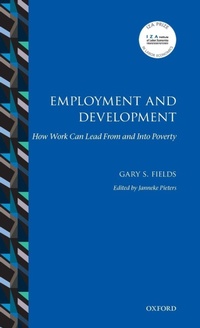
Employment and Development
How Work Can Lead From and Into Poverty
Published on 14. December 2018
Book
Hardback
468 pages
978-0-19-881550-1 (ISBN)
Description
Employment and Development brings together the contributions of 2014 IZA Prize in Labor Economics award winner Gary S. Fields to address global employment and poverty problems. Most of the poor in developing countries live in households in which people work, but still they are poor because the best available work pays so little. Employment and Development: How Work Can Lead From and Into Poverty questions how economic growth affects standards of living, how labor markets work in developing countries, and how different labor market policies affect well-being.
Through a collection of essays, this book tackles major questions in development and labor economics. Who benefits from economic growth and who is hurt by economic decline? Why are distributional factors and labor market conditions improving in some countries but not in others? How do developing countries' labor markets work? How would labor market conditions change if different policies were to be put into effect? What are the welfare consequences of these changes? Through distributional analysis, Fields examines inequality, poverty, income mobility, and economic well-being, and through analysis of changing labor market conditions he examines employment and unemployment, employment composition, and labor earnings. By concentrating on the poor and understanding how the labor markets work for them and how their labor market earnings might be raised in response to different policy interventions, Fields addresses questions of first-order importance for human well-being.
Through a collection of essays, this book tackles major questions in development and labor economics. Who benefits from economic growth and who is hurt by economic decline? Why are distributional factors and labor market conditions improving in some countries but not in others? How do developing countries' labor markets work? How would labor market conditions change if different policies were to be put into effect? What are the welfare consequences of these changes? Through distributional analysis, Fields examines inequality, poverty, income mobility, and economic well-being, and through analysis of changing labor market conditions he examines employment and unemployment, employment composition, and labor earnings. By concentrating on the poor and understanding how the labor markets work for them and how their labor market earnings might be raised in response to different policy interventions, Fields addresses questions of first-order importance for human well-being.
More details
Series
Language
English
Place of publication
Oxford
United Kingdom
Target group
Professional and scholarly
Dimensions
Height: 222 mm
Width: 145 mm
Thickness: 29 mm
Weight
715 gr
ISBN-13
978-0-19-881550-1 (9780198815501)
Copyright in bibliographic data and cover images is held by Nielsen Book Services Limited or by the publishers or by their respective licensors: all rights reserved.
Schweitzer Classification
Other editions
Additional editions
E-Book
11/2018
1st Edition
OUP eBook
€94.99
Available for download
E-Book
11/2018
1st Edition
OUP eBook
€94.99
Available for download
Persons
Gary Fields is the John P. Windmuller Professor of International and Comparative Labor and Professor of Economics at Cornell University, Program Coordinator of the IZA Program on Labor and Development, and a UNU-WIDER Non-Resident Senior Research Fellow. He is the 2014 winner of the IZA Prize in Labor Economics, the top world-wide award in the field. He has been an Ivy League teacher and professor for more than forty years. He teaches and conducts research in labor economics and development economics, and has published more than 150 books and articles.
Content
Part I: Introduction by the Editor
Part II: Introduction by the Author
Part III: Setting the Framework
1: Aid, Growth, and Jobs: A Five Part Policy Framework
2: The Distributional Effects of Economic Growth
3: How the Poor are Working
Part IV: Modelling Labor Markets and the Effects of Labor Market Policies
4: Rural-Urban Migration, Urban Unemployment and Underemployment, and Job Search Activity in LDCs
5: On-the-Job Search in a Labor Market Model
6: A Welfare Economic Approach to Growth and Distribution in the Dual Economy
7: Labor Market Modeling and the Urban Informal Sector
8: Changes over Time in Individual Countries
Part V: Assessing Changes in Income Distribution
9: On Inequality Comparisons
10: Do Inequality Measures Measure Inequality?
11: The Absolute Poverty Approach
12: Economic Well-Being
13: Income Mobility
14: Earnings Mobility, Inequality, and Economic Growth
Part VI: Bringing the Components Together
15: Private and Social Returns to Education
16: A Welfare Economic Analysis of Labor Market Policies
Part VII: Concluding Thoughts
17: Directions for Future Research
Part II: Introduction by the Author
Part III: Setting the Framework
1: Aid, Growth, and Jobs: A Five Part Policy Framework
2: The Distributional Effects of Economic Growth
3: How the Poor are Working
Part IV: Modelling Labor Markets and the Effects of Labor Market Policies
4: Rural-Urban Migration, Urban Unemployment and Underemployment, and Job Search Activity in LDCs
5: On-the-Job Search in a Labor Market Model
6: A Welfare Economic Approach to Growth and Distribution in the Dual Economy
7: Labor Market Modeling and the Urban Informal Sector
8: Changes over Time in Individual Countries
Part V: Assessing Changes in Income Distribution
9: On Inequality Comparisons
10: Do Inequality Measures Measure Inequality?
11: The Absolute Poverty Approach
12: Economic Well-Being
13: Income Mobility
14: Earnings Mobility, Inequality, and Economic Growth
Part VI: Bringing the Components Together
15: Private and Social Returns to Education
16: A Welfare Economic Analysis of Labor Market Policies
Part VII: Concluding Thoughts
17: Directions for Future Research