

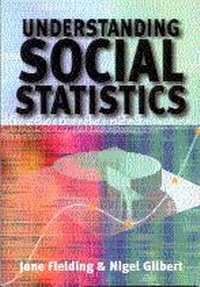
Understanding Social Statistics
1st Edition
Published on 2. February 2000
Book
Paperback/Softback
336 pages
978-0-8039-7983-3 (ISBN)
Description
Designed to help take the fear out of the essential use of numbers in social research, this textbook introduces students to statistics as a powerful means of revealing patterns in human behaviour. The authors provide an accessible guide to quantitative data analysis including: clear explanations of all the methods; comprehensive coverage of analytic tools; an introduction to using SPSS, the most widely used statistical analysis program; examples based on real datasets - the UK General Household Survey and the World Bank's Social Indicators of Development - available to students on the World Wide Web; helpful chapter summaries; exercises at the end of each chapter; and a glossary of key terms.
Understanding Social Statistics will be an essential textbook for courses on statistics and quantitative research across the social sciences.
Understanding Social Statistics will be an essential textbook for courses on statistics and quantitative research across the social sciences.
Reviews / Votes
'Understanding Social Statistics is aimed at undergraduate sociology students, but it would also be useful to mature seekers of statistical expertise. It is well written, attractively laid out and uses a language that demystifies the subject, instead of cloaking it with obscure technical terms' - Times Higher Education SupplementMore details
Edition
First Edition
Language
English
Place of publication
London
United Kingdom
Target group
College/higher education
Dimensions
Height: 242 mm
Width: 170 mm
Weight
566 gr
ISBN-13
978-0-8039-7983-3 (9780803979833)
Copyright in bibliographic data and cover images is held by Nielsen Book Services Limited or by the publishers or by their respective licensors: all rights reserved.
Schweitzer Classification
Other editions
New editions
Jane L. Fielding | Nigel Gilbert
Understanding Social Statistics
Book
01/2006
2nd Edition
SAGE Publications Inc
€120.00
Shipment within 10-20 days
Persons
Jane Fielding gained her DPhil in Biochemistry in 1976 to be followed by postdoctoral fellowships at Queen Elizabeth College and Imperial College, University of London. She joined Surrey University in 1981 as a researcher on several part-time contracts in the departments of Sociology, Psychology and Human Biology. In 1984 she was appointed as the Departmental Research Fellow and has been involved with the teaching of computing and quantitative methods since that time. In 1994 she took up her current lectureship in quantitative methods and was promoted to Senior Lecturer in 2001. Nigel Gilbert is Professor of Sociology at the University of Surrey, Guildford, England. He is the author or editor of 34 books and many academic papers and was the founding editor of the Journal of Artificial Societies and Social Simulation. His current research focuses on the application of agent-based models to understanding social and economic phenomena, especially the emergence of norms, culture, and innovation. He obtained a doctorate in the sociology of scientific knowledge in 1974 from the University of Cambridge and has subsequently taught at the universities of York and Surrey in England. He is one of the pioneers in the field of social simulation and is past president of the European Social Simulation Association. He is a Fellow of the UK Academy of Social Sciences and of the Royal Academy of Engineering.
Content
PART ONE: PRELIMINARIES
Numbers, Data and Analysis
Using Computers in Statistics
PART TWO: UNIVARIATE ANALYSIS
Frequencies, Proportions and Percentages
Graphics for Display
Measures of Central Tendency and Dispersion
Graphics for Analysis
The Normal Curve
PART THREE: BIVARIATE ANALYSIS
Interval Data
Correlation and Regression
Categorial Data
Tables
Sampling and Inference
Hypotheses Testing
Modelling Data
Numbers, Data and Analysis
Using Computers in Statistics
PART TWO: UNIVARIATE ANALYSIS
Frequencies, Proportions and Percentages
Graphics for Display
Measures of Central Tendency and Dispersion
Graphics for Analysis
The Normal Curve
PART THREE: BIVARIATE ANALYSIS
Interval Data
Correlation and Regression
Categorial Data
Tables
Sampling and Inference
Hypotheses Testing
Modelling Data