

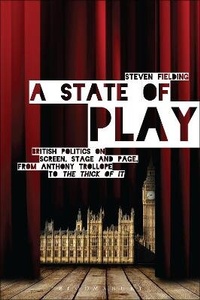
A State of Play
British Politics on Screen, Stage and Page, from Anthony Trollope to 'The Thick of It'
Published on 24. April 2014
Book
Paperback/Softback
312 pages
978-1-78093-316-0 (ISBN)
Description
This book is available as open access through the Bloomsbury Open Access programme and is available on www.bloomsburycollections.com.
A State of Play explores how the British have imagined their politics, from the parliament worship of Anthony Trollope to the cynicism of The Thick of It. In an account that mixes historical with political analysis, Steven Fielding argues that fictional depictions of politics have played an important but insidious part in shaping how the British think about their democracy and have helped ventilate their many frustrations with Westminster. He shows that dramas and fictions have also performed a significant role in the battle of ideas, in a way undreamt of by those who draft party manifestos.
The book examines the work of overtly political writers have treated the subject, discussing the novels of H.G. Wells, the comedy series Yes, Minister and the plays of David Hare. However, it also assesses how less obvious sources, such as the films of George Formby, the novels of Agatha Christie, the Just William stories and situation comedies like Steptoe and Son, have reflected on representative democracy.
A State of Play is an invaluable, distinctive and engaging guide to a new way of thinking about Britain's political past and present.
A State of Play explores how the British have imagined their politics, from the parliament worship of Anthony Trollope to the cynicism of The Thick of It. In an account that mixes historical with political analysis, Steven Fielding argues that fictional depictions of politics have played an important but insidious part in shaping how the British think about their democracy and have helped ventilate their many frustrations with Westminster. He shows that dramas and fictions have also performed a significant role in the battle of ideas, in a way undreamt of by those who draft party manifestos.
The book examines the work of overtly political writers have treated the subject, discussing the novels of H.G. Wells, the comedy series Yes, Minister and the plays of David Hare. However, it also assesses how less obvious sources, such as the films of George Formby, the novels of Agatha Christie, the Just William stories and situation comedies like Steptoe and Son, have reflected on representative democracy.
A State of Play is an invaluable, distinctive and engaging guide to a new way of thinking about Britain's political past and present.
Reviews / Votes
Well researched and judiciously selective, not to mention fastidiously politically correct - nearly every chapter includes a sub-section on women - Steven Fielding's study makes a concise and thought-provoking shadow history of modern British politics. -- Houman Barekat * The Spectator * [A] brilliant analysis of a simple, obvious and usually overlooked idea: that what people think about politics is formed as much by popular fictions as by media reporting of politics itself. -- John Rentoul * The Independent * Britain has an honourable tradition of puncturing the pomposity of the powerful. But Professor Steven Fielding contends that rather than merely reflect the problems with our politics, such satires help to create them. Unable to distinguish between fact and fiction, viewers are left with a view of MPs as irremediably crooked. It is an argument that liberals will instinctively revolt against, but by the end of Fielding's analysis, at least some will be left with the uneasy feeling that he may well be right. * New Statesman * Steven Fielding has grasped something that has been staring British politics in the face for years without anyone else seeming to notice. Fiction and screen representations don't simply reflect the crisis of politics. As Fielding shows, they are an active part of that crisis too * Martin Kettle, The Guardian * In a witty, empirically dense and provocative book, Fielding argues that culture has always informed, for good and ill, popular perceptions of politics. It entwines fiction, films, plays and politics - where else can you find obscure turn-of-the-century cinema gems and forgotten ITV dramas alongside Anthony Trollope and Malcolm Tucker? Could this be a book that nudges political history out of its methodological impasse? -- Lawrence Black * Times Higher Education * Fielding is a prodigious reader and his book will lead aficionados towards many long-forgotten novels. * Times Higher Education Supplement * [A State of Play] is a scholarly and meticulously research study of how novels, plays, films and television have influenced the way we view our politicians. Fielding has written a cosy, engrossing treatise, informing and educating the reader even as you enjoy the comfortable familiarity of all the examples and case studies he cites -- Sarla Langdon * The Bay, Issue 59 * [A] richly detailed and rewarding book. -- Jeffrey Richards * History Today * Steven Fielding's book provides an insightful overview of British political fiction ... A useful and entertaining book; one with a good deal of useful analysis on how the British have interpreted politics over time. * Political Studies Review *More details
Language
English
Place of publication
London
United Kingdom
Publishing group
Bloomsbury Publishing PLC
Target group
College/higher education
Professional and scholarly
Dimensions
Height: 234 mm
Width: 156 mm
Weight
480 gr
ISBN-13
978-1-78093-316-0 (9781780933160)
Copyright in bibliographic data and cover images is held by Nielsen Book Services Limited or by the publishers or by their respective licensors: all rights reserved.
Schweitzer Classification
Other editions
Additional editions
Steven Fielding
A State of Play
British Politics on Screen, Stage and Page, from Anthony Trollope to 'the Thick of it'
E-Book
04/2014
1st Edition
Bloomsbury Academic
€26.49
Available for download
Person
Steven Fielding is Professor of Political History in the School of Politics and International Relations at the University of Nottingham, UK, where he is also Director of the Centre for British Politics. His books include England Arise! The Labour Party and Popular Politics in 1940s Britain (1995, with Peter Thompson and Nick Tiratsoo) and The Labour Party: Continuity and Change in the Making of 'New' Labour (2003). He is a regular writer and broadcaster on the fictional representation of formal politics.
Content
Acknowledgements
Introduction: Depicting democracy
Chapter One: Parliament worship
Chapter Two: Disappointing democracy
Chapter Three: The people's war and after
Chapter Four: Imagining the post-war consensus
Chapter Five: The established order undermined
Chapter Six: The televised crisis
Chapter Seven: Yes, conspirator
Chapter Eight: Still no job for a lady
Chapter Nine: A thick ending
Epilogue: What would Plato say?
Bibliography
Index
Introduction: Depicting democracy
Chapter One: Parliament worship
Chapter Two: Disappointing democracy
Chapter Three: The people's war and after
Chapter Four: Imagining the post-war consensus
Chapter Five: The established order undermined
Chapter Six: The televised crisis
Chapter Seven: Yes, conspirator
Chapter Eight: Still no job for a lady
Chapter Nine: A thick ending
Epilogue: What would Plato say?
Bibliography
Index