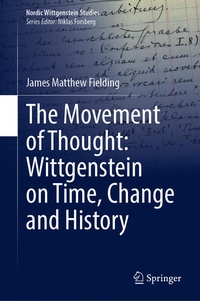
This book covers the topic of history and the role that it played in the Austrio-British philosopher Ludwig Wittgenstein's thought. The topic is explored from multiple angles, both chronologically and thematically. Reviewing Wittgenstein's two
magnum opera
- the
Tractatus Logico-Philosophicus
(1921) and
Philosophical Investigations
(1952), this work is an investigation into an under-acknowledged element in Wittgenstein's thought, one which in many cases acted as an impetus for that life-long process of novel philosophical reflection:
History.
This volume traces the evolution of Wittgenstein's thoughts on time and temporality from the
Tractatus
, through the
Investigations
, into some key post-
Investigations
remarks and also examines the motivations behind Wittgenstein's post-Tractarian return to philosophy and, in particular, the unique methodology he developed in order to serve his renewed purpose. The final chapter seeks to answer thequestion, What was Wittgenstein trying to achieve with
Philosophical Investigations?
This book is of interest to philosophers.
Series
Edition
Language
Place of publication
Publishing group
Springer International Publishing
Target group
Professional and scholarly
Illustrations
1 s/w Abbildung
XVII, 284 p. 1 illus.
Dimensions
Height: 241 mm
Width: 160 mm
Thickness: 22 mm
Weight
ISBN-13
978-3-031-29260-6 (9783031292606)
DOI
10.1007/978-3-031-29261-3
Schweitzer Classification
James Fielding
received his doctorate from the University of Bergen in 2021. His work focuses on the tension between realism and pluralism, which he investigates with an eye to the historical, linguistic and cultural contexts in which conceptual frameworks develop. He has pursued graduate studies at the Université Paris I, Panthéon-Sorbonne, and research in Berlin, Leipzig, Saarbrücken, and at the Wittgenstein Archives Bergen.
Chapter 1. The Myth of a Temporality: Time and Progress in Wittgenstein's Tractatus.- Chapter 2. The Inheritance of Language: Knowing How to 'Go On' in the Investigations.- Chapter 3. The Riverbed of Thought May Shift: the Demystification of Historicism in on Certainty.- Chapter 4: Descriptive Approaches to History: Wittgenstein and Goethe on the Morphological Method.- Chapter 5: The Spectre of Conservatism.- Chapter 6. Ethics and Aesthetics are One: Wittgenstein and the Avante-Garde.