

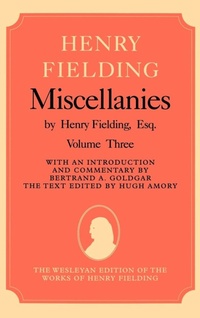
Miscellanies by Henry Fielding, Esq: Volume Three
Edited by Bertrand A. / Amory, Hugh Goldgar
Published on 30. October 1997
Book
Hardback
414 pages
978-0-19-818275-7 (ISBN)
Description
Volume Three of Henry Fielding's Miscellanies, first published as a three-volume set in 1743, consists in its entirety of a major work of fiction, The history of the Life of the Late Mr. Jonathan Wild the Great. Jonathan Wild takes its title from the `thief-taker' and gang-leader of that name who was hanged in 1725, but in Fielding's hands, the history of Wild is transformed into a mock-hostorical work of sustained irony aimed at all who would be `great men'.
The general introduction to this edition sets the novel against its historical and biographical background and argues against the view, common since the mid-nineteenth century, that it is a personal satire directed at the figure of Sir Robert Walpole. In both the general and the textual introductions, the editors also offer a fresh view on questions about the date and history of the work's composition. Full explanatory notes and commentary place Fielding's allusions and details in their contemporary context.
As in previous volumes of the Weslyan Edition, this provides critical, unmodernized text, based on the Greg-Bowers `Rationale of Copy-text'. The version is that of the first edition, with an appendix giving all variants in wording and presentation in the 1754 revision. In his introduction the textual editor lays out the rationale for his choice of version. This volume also includes, for the first time in modern edition, Fielding's list of subscribers to the Miscellanies, along with detailed biographical notes and an analysis of the subscription list by the textual editor.
The general introduction to this edition sets the novel against its historical and biographical background and argues against the view, common since the mid-nineteenth century, that it is a personal satire directed at the figure of Sir Robert Walpole. In both the general and the textual introductions, the editors also offer a fresh view on questions about the date and history of the work's composition. Full explanatory notes and commentary place Fielding's allusions and details in their contemporary context.
As in previous volumes of the Weslyan Edition, this provides critical, unmodernized text, based on the Greg-Bowers `Rationale of Copy-text'. The version is that of the first edition, with an appendix giving all variants in wording and presentation in the 1754 revision. In his introduction the textual editor lays out the rationale for his choice of version. This volume also includes, for the first time in modern edition, Fielding's list of subscribers to the Miscellanies, along with detailed biographical notes and an analysis of the subscription list by the textual editor.
Reviews / Votes
This is a superbly produced volume, a fitting inheritor of the work of Henry Knight Miller. The scholarship of both editors is exemplary: the erudition of Bertrand Goldgar's notes perfectly complements the precision of Hugh Amory's text. It is almost impossible to fault ... The Wesleyan editors have to be congratulated on such a rigorous example of eighteenth-century scholarship, and we should look forward to the final volume appearing before the end of the decade. * Nick Groom, University of Exeter, British Journal for Eighteenth-century Studies, Vol. 19, No. 1, Spring 1996 * an admirable volume ... The editorial matter is exemplary. The introductions are always informative. The annotation is very thorough ... it preserves the tang of Fielding's highly nuanced allegiances in their immediate rather than retrospective form ... This is the best edition of Jonathan Wild we have, and should quickly be made available in paperback to non-specialist readers. * Times Literary Supplement * Bertrand A. Goldgar's commentary is expert, rich, and a further bonus comes with Amory's annotations and introductory essay to the Miscellanies subscription list, which add a wealth of new detail about Fielding's circle and readership to the best-known fact about the list, which is that Walpole subscribed for ten sets on royal paper ... the case jointly assembled by Amory and Goldgar here is a formidable one, and all future accounts of the politics of Jonathan Wild - and of Fielding's work more generally in the crucial period surrounding Walpole's fall - will have to take it on board. * Tom Keymer, St. Anne's College, Oxford, The Review of English Studies, Vol 50. no 199, 1999 *More details
Series
Language
English
Place of publication
Oxford
United Kingdom
Publishing group
Oxford University Press
Target group
Professional and scholarly
Illustrations
halftones
Dimensions
Height: 235 mm
Width: 157 mm
Thickness: 29 mm
Weight
823 gr
ISBN-13
978-0-19-818275-7 (9780198182757)
Copyright in bibliographic data and cover images is held by Nielsen Book Services Limited or by the publishers or by their respective licensors: all rights reserved.
Schweitzer Classification
Persons
>