

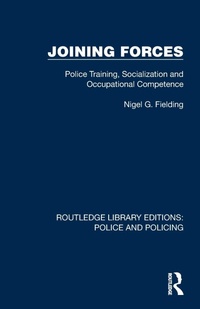
Joining Forces
Police Training, Socialization and Occupational Competence
1st Edition
Published on 15. March 2025
Book
Paperback/Softback
228 pages
978-1-032-42421-7 (ISBN)
Description
The police, their methods, and their relations with the community had been the focus of considerable criticism and debate in the 1980s. While there were few books available on police training, it was widely recognised that training lay at the heart of many initiatives for police reform. Originally published in 1988, this book, based on a five-year study, provides a detailed picture of the training of police recruits in Britain at the time.
The results themselves have centre stage in the book, which addresses questions basic to any working group: what kind of people join; whether they think the job changes them; their evaluation of the training and their officers; their thoughts on new policies such ass equal opportunities and community policing.
A direct connection is made between the recruits' impressions and experiences and their growing conception of what makes for good policing. The book traces how their attitudes to the force and their own roles change as they become familiar with the work and the occupational culture. The formal and informal socialization process is a crucial influence on the standards of competence which lie behind every contact between police and public and is central to our understanding of how the police operate.
The author is a well-known researcher in the police world both here and in the USA. He relates his findings throughout to the North American experience, which provides valuable points of comparison. The important new material he presents informs debate and will still be of keen interest to students and researchers in the field.
The results themselves have centre stage in the book, which addresses questions basic to any working group: what kind of people join; whether they think the job changes them; their evaluation of the training and their officers; their thoughts on new policies such ass equal opportunities and community policing.
A direct connection is made between the recruits' impressions and experiences and their growing conception of what makes for good policing. The book traces how their attitudes to the force and their own roles change as they become familiar with the work and the occupational culture. The formal and informal socialization process is a crucial influence on the standards of competence which lie behind every contact between police and public and is central to our understanding of how the police operate.
The author is a well-known researcher in the police world both here and in the USA. He relates his findings throughout to the North American experience, which provides valuable points of comparison. The important new material he presents informs debate and will still be of keen interest to students and researchers in the field.
More details
Series
Language
English
Place of publication
London
United Kingdom
Publishing group
Taylor & Francis Ltd
Target group
College/higher education
Professional and scholarly
Postgraduate, Professional, and Undergraduate
Dimensions
Height: 216 mm
Width: 140 mm
Thickness: 13 mm
Weight
310 gr
ISBN-13
978-1-032-42421-7 (9781032424217)
Copyright in bibliographic data and cover images is held by Nielsen Book Services Limited or by the publishers or by their respective licensors: all rights reserved.
Schweitzer Classification
Other editions
Additional editions
Book
03/2023
1st Edition
Routledge
€133.10
Shipment within 10-20 days
E-Book
03/2023
1st Edition
Routledge
€39.49
Available for download
E-Book
03/2023
1st Edition
Routledge
€39.49
Available for download
Person
Content
Preface. 1. Situating the Police 2. The Socialization Process 3. The Structure and Process of Training 4. Experiencing Police Work 5. The Police Employee 6. Situating Police Competence 7. Conclusion. Appendixes. Bibliography. Index.