

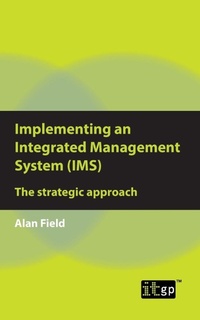
Implementing an Integrated Management System (IMS)
The strategic approach
Published on 21. May 2019
Book
Paperback/Softback
62 pages
978-1-78778-124-5 (ISBN)
Description
Understand how to implement an IMS (integrated management system) and how it can benefit your organisation
Achieving certification to multiple ISO standards can be time consuming and costly, but an IMS incorporates all of an organisation's processes and systems so that they are working under - and towards - one set of policies and objectives.
This guide discusses the benefits of an IMS, and the strategies you should consider before implementing one. It references a vast number of standards that can be integrated but stresses the need for senior management to lead the implementation.
Ideal for the c-suite, directors, compliance managers, auditors and trainers, this pocket guide will explain:
What an IMS is - even if you have no prior knowledge, this book will help you envisage what an IMS is and how it works;
How to develop a strategy for IMS implementation - this guide emphasises the importance of effectively planning your IMS implementation by having objectives set by senior management to encourage a unified approach; and
The benefits of an IMS - information on how an IMS can benefit your organisation, e.g. avoiding duplication of effort as management systems are no longer working in silos and reducing the number of audits required.
Key features:
An easy-to-follow introduction to an IMS, and advice on IMS implementation strategies.
Discusses the challenges you may face during implementation and how to prepare for and overcome them.
Advice on audits and IMS certification.
Your strategic guide to implementing an IMS - buy this book today to get the help and guidance you need!
Achieving certification to multiple ISO standards can be time consuming and costly, but an IMS incorporates all of an organisation's processes and systems so that they are working under - and towards - one set of policies and objectives.
This guide discusses the benefits of an IMS, and the strategies you should consider before implementing one. It references a vast number of standards that can be integrated but stresses the need for senior management to lead the implementation.
Ideal for the c-suite, directors, compliance managers, auditors and trainers, this pocket guide will explain:
What an IMS is - even if you have no prior knowledge, this book will help you envisage what an IMS is and how it works;
How to develop a strategy for IMS implementation - this guide emphasises the importance of effectively planning your IMS implementation by having objectives set by senior management to encourage a unified approach; and
The benefits of an IMS - information on how an IMS can benefit your organisation, e.g. avoiding duplication of effort as management systems are no longer working in silos and reducing the number of audits required.
Key features:
An easy-to-follow introduction to an IMS, and advice on IMS implementation strategies.
Discusses the challenges you may face during implementation and how to prepare for and overcome them.
Advice on audits and IMS certification.
Your strategic guide to implementing an IMS - buy this book today to get the help and guidance you need!
More details
Language
English
Place of publication
Ely
United Kingdom
Target group
Professional and scholarly
Dimensions
Height: 178 mm
Width: 111 mm
Thickness: 4 mm
Weight
62 gr
ISBN-13
978-1-78778-124-5 (9781787781245)
Copyright in bibliographic data and cover images is held by Nielsen Book Services Limited or by the publishers or by their respective licensors: all rights reserved.
Schweitzer Classification
Other editions
Additional editions
E-Book
05/2019
1st Edition
IT Governance Publishing
€12.49
Available for download
E-Book
05/2019
1st Edition
IT Governance Publishing
€11.49
Available for download
Person
Alan Field, LL.B (Hons), PgC, MCQI CQP, GIFireE is a Chartered Quality Professional and Member of The Society of Authors.
Alan has particular expertise in auditing and third party assessing Anti-bribery Management Systems (ABMS) to ISO 37001 and Integrated Management Systems to ISO 9001 and ISO 14001 requirements. Alan has many years' experience with Quality and Integrated Management Systems in the legal, financial, property services and project management sectors in auditing, assessment and gap analysis roles.
Alan has particular expertise in auditing and third party assessing Anti-bribery Management Systems (ABMS) to ISO 37001 and Integrated Management Systems to ISO 9001 and ISO 14001 requirements. Alan has many years' experience with Quality and Integrated Management Systems in the legal, financial, property services and project management sectors in auditing, assessment and gap analysis roles.
Content
Introduction
What is an IMS?
The decision to integrate
1: Benefits of an IMS
2: Terms and definitions
Annex SL
Leadership
PDCA
Risk-based thinking
3: IMS Implementation Strategies
Does an IMS always have to be aligned to any particular management standards?
Strategic buy-in
How far does Annex SL help a leadership team with
thinking about an IMS?
Why should leadership be interested in an IMS?
PDCA and managing uncertainty
IMS and process-based thinking
IMS, risk and metrics
How does this risk-based thinking impact on policy and objectives?
4: Implementing an IMS - Policies and Objectives
Policy
Objectives
What should the objectives say?
5: Acting on the IMS
Mind the gap
Pursuing the project
Conclusion
6: Third-party assessment
Is it worth considering?
The assessment processes
The endgame?
Further reading
What is an IMS?
The decision to integrate
1: Benefits of an IMS
2: Terms and definitions
Annex SL
Leadership
PDCA
Risk-based thinking
3: IMS Implementation Strategies
Does an IMS always have to be aligned to any particular management standards?
Strategic buy-in
How far does Annex SL help a leadership team with
thinking about an IMS?
Why should leadership be interested in an IMS?
PDCA and managing uncertainty
IMS and process-based thinking
IMS, risk and metrics
How does this risk-based thinking impact on policy and objectives?
4: Implementing an IMS - Policies and Objectives
Policy
Objectives
What should the objectives say?
5: Acting on the IMS
Mind the gap
Pursuing the project
Conclusion
6: Third-party assessment
Is it worth considering?
The assessment processes
The endgame?
Further reading