

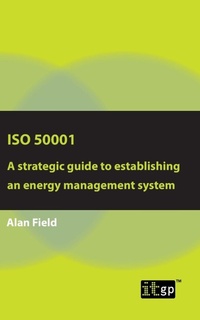
ISO 50001
A strategic guide to establishing an energy management system
Published on 28. November 2019
Book
Paperback/Softback
60 pages
978-1-78778-152-8 (ISBN)
Description
Reduce energy costs and combat climate change with ISO 50001
ISO 50001:2018, the international standard for energy management, provides a framework for organisations - both large and small - to manage and reduce their energy usage and associated costs. Implementing an effective EnMS (energy management system) that complies with ISO 50001 ensures that an organisation can:
Meet legal and contractual energy compliance requirements;
Save money by managing energy more efficiently;
Reduce its carbon footprint;
Increase energy security; and
Demonstrate a commitment to improved energy performance.
With energy security concerns rising and climate change an existential threat, consumers are increasingly aware of sustainability issues.
ISO 50001 - A strategic guide to establishing an energy management system provides a practical but strategic overview for leadership teams of what an EnMS is and how implementing one can bring added value to an organisation. It:
Explains how ISO 50001:2018 (which is based on ISO's Annex SL) differs from the previous version of the Standard;
Provides readers with a greater understanding of what energy management is and how taking a risk-based approach can save money and improve brand reputation; and
Covers how ISO 50001 can be implemented and how the EnMS can be integrated with other management systems, such as an ISO 14001 EMS (environmental management system).
Your strategic guide to energy management and ISO 50001 - buy this book today!
ISO 50001:2018, the international standard for energy management, provides a framework for organisations - both large and small - to manage and reduce their energy usage and associated costs. Implementing an effective EnMS (energy management system) that complies with ISO 50001 ensures that an organisation can:
Meet legal and contractual energy compliance requirements;
Save money by managing energy more efficiently;
Reduce its carbon footprint;
Increase energy security; and
Demonstrate a commitment to improved energy performance.
With energy security concerns rising and climate change an existential threat, consumers are increasingly aware of sustainability issues.
ISO 50001 - A strategic guide to establishing an energy management system provides a practical but strategic overview for leadership teams of what an EnMS is and how implementing one can bring added value to an organisation. It:
Explains how ISO 50001:2018 (which is based on ISO's Annex SL) differs from the previous version of the Standard;
Provides readers with a greater understanding of what energy management is and how taking a risk-based approach can save money and improve brand reputation; and
Covers how ISO 50001 can be implemented and how the EnMS can be integrated with other management systems, such as an ISO 14001 EMS (environmental management system).
Your strategic guide to energy management and ISO 50001 - buy this book today!
More details
Language
English
Place of publication
Ely
United Kingdom
Target group
Professional and scholarly
Dimensions
Height: 178 mm
Width: 111 mm
Thickness: 4 mm
Weight
60 gr
ISBN-13
978-1-78778-152-8 (9781787781528)
Copyright in bibliographic data and cover images is held by Nielsen Book Services Limited or by the publishers or by their respective licensors: all rights reserved.
Schweitzer Classification
Other editions
Additional editions
E-Book
11/2019
1st Edition
IT Governance Publishing
€12.49
Available for download
E-Book
11/2019
1st Edition
IT Governance Publishing
€11.49
Available for download
Persons
Alan Field, LL.B (Hons), PgC, MCQI CQP, GIFireE is a Chartered Quality Professional and Member of The Society of Authors.
Alan has particular expertise in auditing and third party assessing Anti-bribery Management Systems (ABMS) to ISO 37001 and Integrated Management Systems to ISO 9001 and ISO 14001 requirements. Alan has many years' experience with Quality and Integrated Management Systems in the legal, financial, property services and project management sectors in auditing, assessment and gap analysis roles.
Alan has particular expertise in auditing and third party assessing Anti-bribery Management Systems (ABMS) to ISO 37001 and Integrated Management Systems to ISO 9001 and ISO 14001 requirements. Alan has many years' experience with Quality and Integrated Management Systems in the legal, financial, property services and project management sectors in auditing, assessment and gap analysis roles.
Content
Introduction
Chapter 1: Why is energy management a strategic issue?
Benefits of an EnMS
ISO 50001 - essential for an EnMS?
Chapter 2: Terms and definitions
Annex SL HLS
Annex SL HLS clauses
Leadership
PDCA
Risk-based thinking
Key terminology of an EnMS
Chapter 3: Integrating ISO 50001 and ISO 14001 - the strategic advantage
ISO 50001 and ISO 14001 - the benefits of integration
Should an EMS and EnMS be combined or integrated?
Chapter 4: A brief overview of what an EnMS will require
Reducing energy consumption
Communication
Technical solutions
Chapter 5: How an EMS can support an EnMS
What are the differences and similarities between an EnMS and EMS?
Chapter 6: ISO 50001 - the key differences between 2011 and 2018
The key differences
Chapter 7: Third-party assessment
The assessment process
The end game?
Further reading
Chapter 1: Why is energy management a strategic issue?
Benefits of an EnMS
ISO 50001 - essential for an EnMS?
Chapter 2: Terms and definitions
Annex SL HLS
Annex SL HLS clauses
Leadership
PDCA
Risk-based thinking
Key terminology of an EnMS
Chapter 3: Integrating ISO 50001 and ISO 14001 - the strategic advantage
ISO 50001 and ISO 14001 - the benefits of integration
Should an EMS and EnMS be combined or integrated?
Chapter 4: A brief overview of what an EnMS will require
Reducing energy consumption
Communication
Technical solutions
Chapter 5: How an EMS can support an EnMS
What are the differences and similarities between an EnMS and EMS?
Chapter 6: ISO 50001 - the key differences between 2011 and 2018
The key differences
Chapter 7: Third-party assessment
The assessment process
The end game?
Further reading