

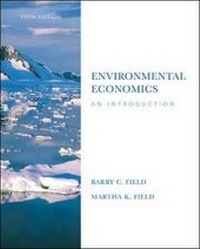
Environmental Economics
5th Edition
Published on 16. October 2008
Book
Paperback/Softback
512 pages
978-0-07-337576-2 (ISBN)
Description
Environmental Economics is an introduction to the basic principles of environmental economics as they have been developed in the past and as they continue to evolve. The examples discussed in this textbook represent only a sample of the full range of issues that actually exists. For this reason, the Fifth Edition sticks to the basic ideas and ways that environmental economists have found to make the basic concepts and models more specific and relevant to concrete environmental issues. The basic structure and sequence of chapters are unchanged but contains new and updated material that reflects the new research efforts by environmental economists over the last few years.
More details
Edition
5th edition
Language
English
Place of publication
United States
Publishing group
McGraw-Hill Education - Europe
Target group
College/higher education
Illustrations
ill
Dimensions
Height: 231 mm
Width: 163 mm
Thickness: 20 mm
Weight
644 gr
ISBN-13
978-0-07-337576-2 (9780073375762)
Copyright in bibliographic data and cover images is held by Nielsen Book Services Limited or by the publishers or by their respective licensors: all rights reserved.
Schweitzer Classification
Other editions
Previous edition
Barry Field | Martha k. Field
Environmental Economics
Book
10/2005
4th Edition
McGraw Hill Higher Education
€63.13
Article exhausted; check for reprint
Persons
Barry C. Field is Professor of Resource Economics at the University of Massachusetts in Amherst. Previously he taught at the University of Miami and The George Washington University. He received his B.S. and M.S. degrees from Cornell University, and his Ph.D. from the University of California at Berkeley. At the University of Massachusetts he has devoted many years to teaching natural resource economics to students at all levels, and has worked to develop an undergraduate major in environmental and resource economics. Professor Field is the author of numerous articles on resource and environmental economics.
Martha K. Field is Professor of Economics at Greenfield Community College, where she has taught environmental economics for many years. She has taught at the University of Massachusetts, Mount Holyoke College, Westfield State College, Holyoke Community College, and the Consumer Cooperative at Gomel, Belarus. She received a B.S. and M.S. from the University of Massachusetts and holds a Ph.D. from the University of Connecticut.
Martha K. Field is Professor of Economics at Greenfield Community College, where she has taught environmental economics for many years. She has taught at the University of Massachusetts, Mount Holyoke College, Westfield State College, Holyoke Community College, and the Consumer Cooperative at Gomel, Belarus. She received a B.S. and M.S. from the University of Massachusetts and holds a Ph.D. from the University of Connecticut.
Content
Section 1: IntroductionChapter 1: What is Environmental Economics?Chapter 2: The Economy and the Environment Section 2: Analytical ToolsChapter 3: Benefits and Costs, Supply and DemandChapter 4: Economic Efficiency and MarketsChapter 5: The Economics of Environmental Quality Section 3: Environmental AnalysisChapter 6: Frameworks of AnalysisChapter 7: Benefit-Cost Analysis: BenefitsChapter 8: Benefit-Cost Analysis: Costs Section 4: Environmental Policy AnalysisChapter 9: Criteria for Evaluating Environmental PoliciesChapter 10: Decentralized Policies: Liability Laws, Property Rights, Voluntary ActionChapter 11: Command-and-Control Strategies: The Case of StandardsChapter 12: Incentive-Based Strategies: Emission Charges and SubsidiesChapter 13: Incentive-Based Strategies: Transferable Discharge Permits Section 5: Environmental Policy in the United StatesChapter 14: Federal Water Pollution-Control PolicyChapter 15: Federal Air Pollution Control PolicyChapter 16: Federal Polity on Toxic and Hazardous SubstancesChapter 17: State and Local Environmental Issues Section 6: International Environmental IssuesChapter 18: Comparative Environmental PoliciesChapter 19: Economic Development and the EnvironmentChapter 20: The Global EnvironmentChapter 21: International Environmental AgreementsAppendix: Abbreviations and Acronyms used in the book