

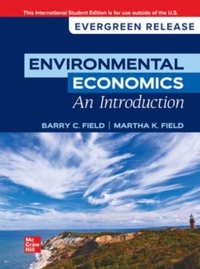
Environmental Economics, An Introduction: 2024 Release ISE
9th Edition
Published on 20. February 2024
Book
Paperback/Softback
448 pages
978-1-266-88739-0 (ISBN)
Description
The 2024 Release from Martha & Barry Field, Environmental Economics: An Introduction is a comprehensive learning experience designed for students with limited to no economics background. This release has a brand-new print version, updated eBook, and an innovative integration of digital content via Connect (R) for the first time ever, with SmartBook and a robust test bank. Explore a wealth of new and revitalized material: updated data and content, cutting-edge exhibits reflecting current global issues and real-world applications, refreshed figures, tables, sources, and references. Engage with thought-provoking end-of-chapter discussion questions that encourage critical thinking and application of knowledge. Enhancements include a shift in focus from "global warming" to "climate change," which takes a more prominent role throughout the text. The discussion of social and environmental justice topics has been significantly expanded, complemented by a comprehensive DEI review. This book is not just a guide; it's a call to action; to explore the intersection of economics and the environment, where informed decisions pave the way for a sustainable future.
More details
Edition
9th edition
Language
English
Place of publication
OH
United States
Target group
College/higher education
US School Grade: From College Freshman to College Graduate Student
Illustrations
71 Illustrations
Dimensions
Height: 231 mm
Width: 162 mm
Thickness: 17 mm
Weight
510 gr
ISBN-13
978-1-266-88739-0 (9781266887390)
Copyright in bibliographic data and cover images is held by Nielsen Book Services Limited or by the publishers or by their respective licensors: all rights reserved.
Schweitzer Classification
Persons
Barry C. Field is Professor of Resource Economics at the University of Massachusetts in Amherst. Previously he taught at the University of Miami and The George Washington University. He received his B.S. and M.S. degrees from Cornell University, and his Ph.D. from the University of California at Berkeley. At the University of Massachusetts he has devoted many years to teaching natural resource economics to students at all levels, and has worked to develop an undergraduate major in environmental and resource economics. Professor Field is the author of numerous articles on resource and environmental economics.
Martha K. Field is Professor of Economics at Greenfield Community College, where she has taught environmental economics for many years. She has taught at the University of Massachusetts, Mount Holyoke College, Westfield State College, Holyoke Community College, and the Consumer Cooperative at Gomel, Belarus. She received a B.S. and M.S. from the University of Massachusetts and holds a Ph.D. from the University of Connecticut.
Martha K. Field is Professor of Economics at Greenfield Community College, where she has taught environmental economics for many years. She has taught at the University of Massachusetts, Mount Holyoke College, Westfield State College, Holyoke Community College, and the Consumer Cooperative at Gomel, Belarus. She received a B.S. and M.S. from the University of Massachusetts and holds a Ph.D. from the University of Connecticut.
Content
SECTION ONE: INTRODUCTION
1 What Is Environmental Economics?
2 The Economy and the Environment
SECTION TWO: ANALYTICAL TOOLS
3 Benefits and Costs, Supply and Demand
4 Markets, Externalities, and Public Goods
5 The Economics of Environmental Quality
SECTION THREE: ENVIRONMENTAL ANALYSIS
6 Frameworks of Analysis
7 Benefit-Cost Analysis Benefits
8 Benefit-Cost Analysis Costs
SECTION FOUR: ENVIRONMENTAL POLICY ANALYSIS
9 Criteria for Evaluating Environmental Policies
10 Decentralized Policies Liability Laws, Property Rights, Voluntary Action
11 Command-and-Control Strategies: The Case of Standards
12 Incentive-Based Strategies: Environmental Charges and Subsidies
13 Incentive-Based Strategies: Market Trading Systems
SECTION FIVE: ENVIRONMENTAL POLICY IN THE UNITED STATES
14 Federal Water Pollution Control Policy
15 Federal Air Pollution Control Policy
16 Federal Policy on Toxic and Hazardous Substances
17 State and Local Environmental Issues
SECTION SIX: GLOBAL ENVIRONMENTAL ISSUES
18 Global Climate Change
19 International Environmental Agreements
20 Globalization
21 Economic Development and the Environment
APPENDIX A: Abbreviations and Acronyms Used in the Book
APPENDIX B: Additional Websites
1 What Is Environmental Economics?
2 The Economy and the Environment
SECTION TWO: ANALYTICAL TOOLS
3 Benefits and Costs, Supply and Demand
4 Markets, Externalities, and Public Goods
5 The Economics of Environmental Quality
SECTION THREE: ENVIRONMENTAL ANALYSIS
6 Frameworks of Analysis
7 Benefit-Cost Analysis Benefits
8 Benefit-Cost Analysis Costs
SECTION FOUR: ENVIRONMENTAL POLICY ANALYSIS
9 Criteria for Evaluating Environmental Policies
10 Decentralized Policies Liability Laws, Property Rights, Voluntary Action
11 Command-and-Control Strategies: The Case of Standards
12 Incentive-Based Strategies: Environmental Charges and Subsidies
13 Incentive-Based Strategies: Market Trading Systems
SECTION FIVE: ENVIRONMENTAL POLICY IN THE UNITED STATES
14 Federal Water Pollution Control Policy
15 Federal Air Pollution Control Policy
16 Federal Policy on Toxic and Hazardous Substances
17 State and Local Environmental Issues
SECTION SIX: GLOBAL ENVIRONMENTAL ISSUES
18 Global Climate Change
19 International Environmental Agreements
20 Globalization
21 Economic Development and the Environment
APPENDIX A: Abbreviations and Acronyms Used in the Book
APPENDIX B: Additional Websites