

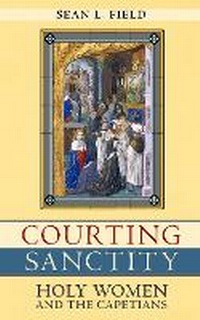
Courting Sanctity
Holy Women and the Capetians
Published on 15. May 2019
Book
Hardback
288 pages
978-1-5017-3619-3 (ISBN)
Description
The rise of the Capetian dynasty across the long thirteenth century, which rested in part on the family's perceived sanctity, is a story most often told through the actions of male figures, from Louis IX's metamorphosis into "Saint Louis" to Philip IV's attacks on Pope Boniface VIII. In Courting Sanctity, Sean L. Field argues that, in fact, holy women were central to the Capetian's self-presentation as being uniquely favored by God. Tracing the shifting relationship between holy women and the French royal court, he shows that the roles and influence of these women were questioned and reshaped under Philip III and increasingly assumed to pose physical, spiritual, and political threats by the time of Philip IV's death.
Field's narrative highlights six holy women. The saintly reputations of Isabelle of France and Douceline of Digne helped to crystalize the Capetians' claims of divine favor by 1260. In the 1270s, the French court faced a crisis that centered on the testimony of Elizabeth of Spalbeek, a visionary holy woman from the Low Countries. After 1300, the arrests and interrogations of Paupertas of Metz, Margueronne of Bellevillette, and Marguerite Porete served to bolster Philip IV's crusades against the dangers supposedly threatening the kingdom of France. Courting Sanctity thus reassesses key turning points in the ascent of the "most Christian" Capetian court through examinations of the lives and images of the holy women that the court sanctified or defamed.
Field's narrative highlights six holy women. The saintly reputations of Isabelle of France and Douceline of Digne helped to crystalize the Capetians' claims of divine favor by 1260. In the 1270s, the French court faced a crisis that centered on the testimony of Elizabeth of Spalbeek, a visionary holy woman from the Low Countries. After 1300, the arrests and interrogations of Paupertas of Metz, Margueronne of Bellevillette, and Marguerite Porete served to bolster Philip IV's crusades against the dangers supposedly threatening the kingdom of France. Courting Sanctity thus reassesses key turning points in the ascent of the "most Christian" Capetian court through examinations of the lives and images of the holy women that the court sanctified or defamed.
Reviews / Votes
In an elegantly written book, Field (Univ. of Vermont) takes readers through the complexities of politics and personal ambitions to better understand Philip IV's relationships with Boniface VIII, the Templars, and the Jews.(Choice) With this engaging and thought-provoking study of the political and spiritual intersections between the thirteenth-century Capetian royal family and contemporary Flemish and French female mystics, seers, and ascetics, Sean L. Field solidifies his standing as one of the leading scholars of women and sanctity in medieval France. This work, like his earlier work, is an extraordinarily comprehensive and erudite work of scholarship.
(AMERICAN HISTORICAL REVIEW) Courting Sanctity is compulsively readable, a tour de force in its integration of religious and political histories.
(SPECULUM) Courting Sanctity will cement Sean Field's reputation as one of our leading contemporary authorities on the later Capetians. This is not only a thoroughly convincing study but a notable pleasure to read, being exceptionally well written. It combines meticulous source analysis with a lightness of prose that reminded me of Sir Steven Runciman at his best. Courting Sanctity is, in short, that rarest of beasts: a good academic book.
(The Medieval Review) Courting Sanctity is a handsome volume with a beautifully edited text, as well as that rarest of pleasures for the reader-actual notes at the bottom of the page. It also boasts a splendid bibliography and a useful index. Once again, we benefit from Field's ability to conceptualize complicated historical events and to lay them for us out in lucid prose.
(Royal Studies Journal)
More details
Language
English
Place of publication
Ithaca
United States
Product notice
Paper over boards
Illustrations
3 maps - 3 Maps
Dimensions
Height: 229 mm
Width: 152 mm
Thickness: 27 mm
Weight
907 gr
ISBN-13
978-1-5017-3619-3 (9781501736193)
Copyright in bibliographic data and cover images is held by Nielsen Book Services Limited or by the publishers or by their respective licensors: all rights reserved.
Schweitzer Classification
Other editions
Additional editions
E-Book
05/2019
Cornell University Press
€34.49
Available for download
E-Book
05/2019
1st Edition
Cornell University Press
€163.99
Available for download
Person
Sean L. Field is Professor of History at the University of Vermont. He is the author, editor, or translator of nine previous books, including, most recently, Late Medieval Heresy, Visions of Sainthood in Medieval Rome, and The Sanctity of Louis IX.
Content
List of Maps
Preface
List of Abbreviations
Introduction
Part One: Creation
Prologue: The Rise of Capetian Sanctity and the Reign of Louis IX
1. Isabelle of France: A Holy Woman at the Heart of the Capetian Court
2. Douceline of Digne: Co-mother to the Capetians
Part Two: Interrogation
Prologue: A Crisis in the Reign of Philip III
3. Elizabeth of Spalbeek: A Prince's Death, a Queen's Crime, and a King's Sin
4. Writing Holy Women, 1282-85
Part Three: Destruction
Prologue: The Culminating Reign of Philip IV
5. Paupertas of Metz: Peacemaker, Prophet, or Poisoner?
6. Marguerite Porete and Margueronne of Bellevillette: The Beguine and the Sorceress
Epilogue: Echoes and Afterlives
Bibliography
Index
Preface
List of Abbreviations
Introduction
Part One: Creation
Prologue: The Rise of Capetian Sanctity and the Reign of Louis IX
1. Isabelle of France: A Holy Woman at the Heart of the Capetian Court
2. Douceline of Digne: Co-mother to the Capetians
Part Two: Interrogation
Prologue: A Crisis in the Reign of Philip III
3. Elizabeth of Spalbeek: A Prince's Death, a Queen's Crime, and a King's Sin
4. Writing Holy Women, 1282-85
Part Three: Destruction
Prologue: The Culminating Reign of Philip IV
5. Paupertas of Metz: Peacemaker, Prophet, or Poisoner?
6. Marguerite Porete and Margueronne of Bellevillette: The Beguine and the Sorceress
Epilogue: Echoes and Afterlives
Bibliography
Index