

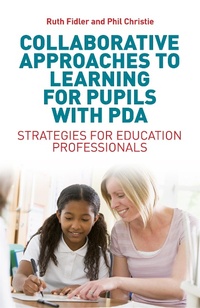
Collaborative Approaches to Learning for Pupils with PDA
Strategies for Education Professionals
Published on 21. September 2018
Book
Paperback/Softback
176 pages
978-1-78592-017-2 (ISBN)
Description
Educational environments can present challenges for children with Pathological Demand Avoidance (PDA), who require different strategies than children with a more straightforward presentation of autism, and schools frequently find themselves struggling to meet their complex needs. In this guide PDA experts Ruth Fidler and Phil Christie outline effective strategies for supporting pupils with PDA in education settings.
Including a useful overview of PDA, this book outlines the impact of this diagnostic profile on learning, and explains why Collaborative Approaches to Learning is such a successful method for supporting pupils with PDA. It shows how teaching professionals can get started with this approach, with advice for implementing key strategies to overcome common challenges. The book also includes information on creating PDA-friendly learning environments, helping pupils to develop long-term social and emotional resilience. With handy downloadable resources, valuable information on supporting the wellbeing of adults who work with children with PDA, this is an essential resource for teaching and support staff in mainstream and special education schools.
Including a useful overview of PDA, this book outlines the impact of this diagnostic profile on learning, and explains why Collaborative Approaches to Learning is such a successful method for supporting pupils with PDA. It shows how teaching professionals can get started with this approach, with advice for implementing key strategies to overcome common challenges. The book also includes information on creating PDA-friendly learning environments, helping pupils to develop long-term social and emotional resilience. With handy downloadable resources, valuable information on supporting the wellbeing of adults who work with children with PDA, this is an essential resource for teaching and support staff in mainstream and special education schools.
Reviews / Votes
As medical lead for ASD in Surrey, I witness first-hand the challenge that teachers face in responding to the needs of children with PDA symptoms. It's very clear that this book stems from the authors' unparalleled educational experience and I am excited about the good it is going to do. -- Dr Gloria Dura-Vila, Consultant Child & Adolescent Psychiatrist, Surrey and Borders NHS Trust, author of 'My Autism Book' and 'Me and my PDA'More details
Language
English
Place of publication
London
United Kingdom
Target group
Primary & secondary/elementary & high school
College/higher education
Professional and scholarly
Product notice
Paperback (UK-trade)
Illustrations
20 black and white charts and diagrams
Dimensions
Height: 228 mm
Width: 153 mm
Thickness: 17 mm
Weight
266 gr
ISBN-13
978-1-78592-017-2 (9781785920172)
Copyright in bibliographic data and cover images is held by Nielsen Book Services Limited or by the publishers or by their respective licensors: all rights reserved.
Schweitzer Classification
Other editions
Additional editions
Ruth Fidler | Phil Christie
Collaborative Approaches to Learning for Pupils with PDA
Strategies for Education Professionals
E-Book
09/2018
Jessica Kingsley Publishers
€18.99
Available for download
Persons
Ruth Fidler is Assistant Head Teacher at Sutherland House School run by the autism charity NORSACA. She works throughout the school (aged 3-19) developing whole school approaches to working interactively with children across the autism spectrum, with a particular focus on social and emotional well being. Phil Christie is Director of Sutherland House Children's Services, run by autism charity NORSACA (www.norsaca.org.uk), and leads a team of Consultant Child Psychologists at the Elizabeth Newson Centre. The centre carries out training and research activities and has particular expertise in PDA. He is also Associate Editor of 'Good Autism Practice', and became Chair of the Advisory Council of the Autism Education Trust in 2009.
Content
1. Towards an Understanding of PDA. 2. Implications for Teaching and Learning. 3. What are Collaborative Approaches to Learning. 4. Key Strategies. 5. Getting started. 6. Personalising the curriculum. 7. Encouraging social understanding and promoting emotional wellbeing. 8. Demonstrating progress. 9. Looking after yourself. Summary.