

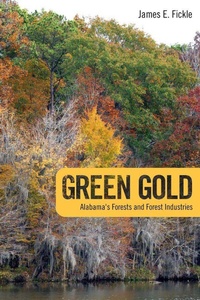
Green Gold
Alabama's Forests and Forest Industries
Will be published approx. on 28. February 2014
Book
Hardback
376 pages
978-0-8173-1813-0 (ISBN)
Description
Green Gold is a thorough and valuable compilation of information on Alabama's timber and forest products industry, the largest manufacturing industry in the state.
Alabama has the third-largest commercial forest in the nation, after only Georgia and Oregon. Fully two-thirds of the state's land supports the growth of over fifteen billion trees on twenty-two million acres, which explains why Alabama looks entirely green from space. Green Gold presents the story of human use of and impact on Alabama's forests from pioneer days to the present, as James E. Fickle chronicles the history of the industry from unbridled greed and exploitation through virtual abandonment to revival, restoration, and enlightened stewardship.
As the state's largest manufacturing industry, forest products have traditionally included naval stores such as tar, pitch, and turpentine, especially in the southern longleaf stands; sawmill lumber, both hardwood and pine; and pulp and paper milling. Green Gold documents all aspects of the industry, including the advent of ?scientific forestry" and the development of reforestation practices with sustained yields. Also addressed are the historical impacts of Native Americans and of early settlers who used axes, saws, and water- and steam-powered sawmills to clear and utilize forests. Along with an account of railroad logging and the big mills of the lumber bonanza days of the late nineteenth and early twentieth centuries, the book also chronicles the arrival of professional foresters to the state, who began to deal with the devastating legacy of ?cut out and get out" logging and to fight the perennial curse of woods arson. Finally, Green Gold examines the rise of the tree farm movement, the rebirth of large-scale lumbering, the advent of modern environmental concerns, and the movement toward the ?Fourth Forest" in Alabama.
A Copublication with the Alabama Forestry Foundation
Alabama has the third-largest commercial forest in the nation, after only Georgia and Oregon. Fully two-thirds of the state's land supports the growth of over fifteen billion trees on twenty-two million acres, which explains why Alabama looks entirely green from space. Green Gold presents the story of human use of and impact on Alabama's forests from pioneer days to the present, as James E. Fickle chronicles the history of the industry from unbridled greed and exploitation through virtual abandonment to revival, restoration, and enlightened stewardship.
As the state's largest manufacturing industry, forest products have traditionally included naval stores such as tar, pitch, and turpentine, especially in the southern longleaf stands; sawmill lumber, both hardwood and pine; and pulp and paper milling. Green Gold documents all aspects of the industry, including the advent of ?scientific forestry" and the development of reforestation practices with sustained yields. Also addressed are the historical impacts of Native Americans and of early settlers who used axes, saws, and water- and steam-powered sawmills to clear and utilize forests. Along with an account of railroad logging and the big mills of the lumber bonanza days of the late nineteenth and early twentieth centuries, the book also chronicles the arrival of professional foresters to the state, who began to deal with the devastating legacy of ?cut out and get out" logging and to fight the perennial curse of woods arson. Finally, Green Gold examines the rise of the tree farm movement, the rebirth of large-scale lumbering, the advent of modern environmental concerns, and the movement toward the ?Fourth Forest" in Alabama.
A Copublication with the Alabama Forestry Foundation
Reviews / Votes
"Green Gold is a valuable work for the many people who have been involved in the forest products industry. As a compilation of the vast amount of information that is available not only from portions of narrowly focused historical works, but also from original sources available primarily in archival libraries and oral histories, it is much broader and more encompassing than previously written historical works on Alabama forests." - Richard W. Brinker, Dean Emeritus, School of Forestry and Wildlife Sciences, Auburn University|"I grew up in the South hearing forestry tales from my grandfather and working with my father, a consulting forester. This book pulls together the many things I heard and observed into a coherent package and is worthwhile as both an educational piece for businessmen, historians, and students who want to understand Southern forestry, and as a heritage and tribute to the many people who worked in forestry in Alabama and elsewhere in the South."-Chad Oliver, coauthor of Forest Stand DynamicsMore details
Language
English
Place of publication
Alabama
United States
Target group
Professional and scholarly
Product notice
sewn/stitched
Cloth over boards
With dust jacket
Illustrations
38 illustrations
Dimensions
Height: 231 mm
Width: 155 mm
Thickness: 36 mm
Weight
726 gr
ISBN-13
978-0-8173-1813-0 (9780817318130)
Copyright in bibliographic data and cover images is held by Nielsen Book Services Limited or by the publishers or by their respective licensors: all rights reserved.
Schweitzer Classification
Other editions
Additional editions
E-Book
02/2014
1st Edition
University of Alabama Press
€127.99
Available for download
Person
James E. Fickle is a visiting professor of forest and environmental history at Yale University and a professor of history at the University of Memphis. He is the author of Mississippi Forests and Forestry, Timber: A Photographic History of Mississippi Forestry, and The New South and the "New Competition":Trade Association Development in the Southern Pine Industry.