

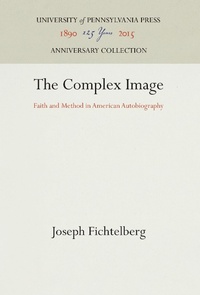
The Complex Image
Faith and Method in American Autobiography
Published on 29. November 1989
Book
Hardback
252 pages
978-0-8122-8146-0 (ISBN)
Description
In The Complex Image, Joseph Fichtelberg takes a twofold approach to the role of revision in significant American autobiographies. He reexamines the problem of the autobiographical subject from a poststructuralist perspective, and he places that problem in the context of American culture. As a framework for his unique study, he offers a reading of Ecce Homo that argues that Nietzsche's autobiographical "I" is both buried in and created by the text itself. Only by revising his text, by retelling his life to himself, can Nietzsche arrive at self-knowledge. Ultimately, Nietzsche finds himself in all literature everywhere. He becomes a universal soul.
Fichtelberg demonstrates that Nietzsche's complex ideas about where subject and language meet in a text can be used to understand the dominant millennial impulse evident in American autobiographies. Thomas Shepard cast the American portion of his autobiography as a compendium of colonial triumphs; John Woolman rearranged his Journal to make a vision of Christian unity its climax; and Walt Whitman fashioned Specimen Days to highlight his late tour of the west during which he realized an earlier poetic vision of national unity. In the nineteenth century, this easy faith in millennial union began to collapse, and Fichtelberg contends that it remained only in the autobiographies of such "marginal" groups as those represented by Frederick Douglass arid Gertrude Stein. He offers a close analysis of their autobiographies and, in a concluding chapter, examines the work of four recent writers: W. E. B. DuBois, Lillian Hellman, Mary McCarthy, and Maya Angelou.
The Complex Image will interest scholars and students of American history and literature.
Fichtelberg demonstrates that Nietzsche's complex ideas about where subject and language meet in a text can be used to understand the dominant millennial impulse evident in American autobiographies. Thomas Shepard cast the American portion of his autobiography as a compendium of colonial triumphs; John Woolman rearranged his Journal to make a vision of Christian unity its climax; and Walt Whitman fashioned Specimen Days to highlight his late tour of the west during which he realized an earlier poetic vision of national unity. In the nineteenth century, this easy faith in millennial union began to collapse, and Fichtelberg contends that it remained only in the autobiographies of such "marginal" groups as those represented by Frederick Douglass arid Gertrude Stein. He offers a close analysis of their autobiographies and, in a concluding chapter, examines the work of four recent writers: W. E. B. DuBois, Lillian Hellman, Mary McCarthy, and Maya Angelou.
The Complex Image will interest scholars and students of American history and literature.
More details
Series
Edition
Reprint 2016 edition
Language
English
Place of publication
Pennsylvania
United States
Target group
College/higher education
Product notice
Paper over boards
Dimensions
Height: 236 mm
Width: 160 mm
Thickness: 20 mm
Weight
547 gr
ISBN-13
978-0-8122-8146-0 (9780812281460)
Copyright in bibliographic data and cover images is held by Nielsen Book Services Limited or by the publishers or by their respective licensors: all rights reserved.
Schweitzer Classification
Other editions
Additional editions
E-Book
11/2016
1st Edition
University of Pennsylvania Press
€220.99
Available for download
Person
Joseph Fichtelberg is Professor of English at Hofstra University.