

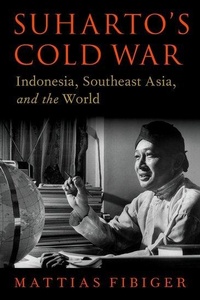
Suharto's Cold War
Indonesia, Southeast Asia, and the World
Published on 21. August 2023
Book
Hardback
384 pages
978-0-19-766722-4 (ISBN)
Description
After the murder of senior generals in the Indonesian army by elements of the country's communist party in 1965, General Suharto orchestrated the mass killing of some half a million leftists and fellow travelers. But his ambitions spanned far beyond perpetrating a politicide. Seeking to ensure that communism could never again take root in the archipelago, he constructed a New Order to reverse Indonesia's descent into political instability and economic crisis.
Based on unprecedented access to Indonesian archives and a wealth of international sources, Suharto's Cold War masterfully narrates the first decades of the Suharto regime at the national, regional, and global levels. Suharto mobilized international aid and investment to build his counterrevolutionary dictatorship and ignite processes of economic development. He then aimed to project authoritarianism elsewhere in Southeast Asia by assisting right-wing dictators across the region. International capital made available through the global Cold War enabled Suharto to achieve the dictatorial and developmental ambitions that lay at the heart of his domestic and regional Cold Wars. Material realities at home and abroad disciplined Suharto's political project, while political considerations in Indonesia and around the world shaped his economic programs.
Paying close attention to the interrelationship between the domestic and the international, the political and the economic, Suharto's Cold War makes a pathbreaking contribution to understanding Indonesia, Southeast Asia, and the world.
Based on unprecedented access to Indonesian archives and a wealth of international sources, Suharto's Cold War masterfully narrates the first decades of the Suharto regime at the national, regional, and global levels. Suharto mobilized international aid and investment to build his counterrevolutionary dictatorship and ignite processes of economic development. He then aimed to project authoritarianism elsewhere in Southeast Asia by assisting right-wing dictators across the region. International capital made available through the global Cold War enabled Suharto to achieve the dictatorial and developmental ambitions that lay at the heart of his domestic and regional Cold Wars. Material realities at home and abroad disciplined Suharto's political project, while political considerations in Indonesia and around the world shaped his economic programs.
Paying close attention to the interrelationship between the domestic and the international, the political and the economic, Suharto's Cold War makes a pathbreaking contribution to understanding Indonesia, Southeast Asia, and the world.
Reviews / Votes
In Suharto's Cold War, Mattias Fibiger not only situates the consolidation of the Suharto regime in Indonesia in the late 1960s and 1970s within the global Cold War context but also shows the consequences of the anti-communist turn in Indonesia under Suharto for the direction of the Cold War across Southeast Asia during this period. The book thus offers a major contribution to our understanding of the history of modern Indonesia and Southeast Asia, and of the Cold War. * John T. Sidel, London School of Economics and Political Science * Fibiger's well-researched book provides an incomparably detailed account of an all-important moment in the story of the Cold War in the Third World: the violent ending in the mid-1960s of President Sukarno's project of non-alignment and the founding of President Suharto's US-allied dictatorship. By revealing what the Cold War looked like from Jakarta, Fibiger re-orients our understanding of international relations history. * John Roosa, author of Buried Histories: The Anticommunist Massacres of 1965-1966 in Indonesia * The book contributes to a greater understanding of how a post-colonial country navigates its domestic interest amidst immense global ideological tensions...Mattias Fibiger's Suharto's Cold War presents a highly original study to help make sense of the actions of Indonesia under Suharto in its interaction with other countries both in the region and beyond. The book reaffirms the importance of understanding the domestic context and political situation in explaining a country's foreign policy behaviour. * Yosef Djakababa, South East Asia Research * Suharto's Cold War is a major achievement and promises to be a key reference in years to come for the study of Indonesia, the Global Cold War,Third World counterrevolution, and the IR of Southeast Asia. * Deepak Nair, The Australian National University, Canberra *More details
Series
Language
English
Place of publication
New York
United States
Target group
Professional and scholarly
Product notice
sewn/stitched
Cloth over boards
Illustrations
14 black and white halftones
Dimensions
Height: 239 mm
Width: 159 mm
Thickness: 30 mm
Weight
658 gr
ISBN-13
978-0-19-766722-4 (9780197667224)
Copyright in bibliographic data and cover images is held by Nielsen Book Services Limited or by the publishers or by their respective licensors: all rights reserved.
Schweitzer Classification
Other editions
Additional editions
E-Book
06/2023
OUP eBook
€28.99
Available for download
E-Book
06/2023
OUP eBook
€28.99
Available for download
Person
Mattias Fibiger is an Assistant Professor in the Business, Government, and International Economy Unit at Harvard Business School. He is a historian of Asia's twentieth century specializing in political economy and international relations in Southeast Asia.
Content
Acknowledgments
Note on Spelling, Names, and Translation
Abbreviations
Introduction
Chapter 1: The Path to Power
Chapter 2: In the Shadow of Vietnam
Chapter 3: A New Order
Chapter 4: An Anti-Chinese Axis
Chapter 5: Internationalizing Counterrevolution
Chapter 6: Capital and Consolidation
Chapter 7: The Travails of Development
Chapter 8: The Age of Oil
Chapter 9: Realignments
Conclusion
Notes
Index
Note on Spelling, Names, and Translation
Abbreviations
Introduction
Chapter 1: The Path to Power
Chapter 2: In the Shadow of Vietnam
Chapter 3: A New Order
Chapter 4: An Anti-Chinese Axis
Chapter 5: Internationalizing Counterrevolution
Chapter 6: Capital and Consolidation
Chapter 7: The Travails of Development
Chapter 8: The Age of Oil
Chapter 9: Realignments
Conclusion
Notes
Index