

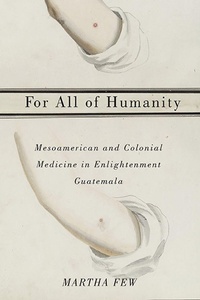
For All of Humanity
Mesoamerican and Colonial Medicine in Enlightenment Guatemala
Published on 30. October 2015
Book
Paperback/Softback
320 pages
978-0-8165-3187-5 (ISBN)
Description
Smallpox, measles, and typhus. The scourges of lethal disease - as threatening in colonial Mesoamerica as in other parts of the world - called for widespread efforts and enlightened attitudes to battle the centuries-old killers of children and adults. Even before edicts from Spain crossed the Atlantic, colonial elites oftentimes embraced medical experimentation and reform in the name of the public good, believing it was their moral responsibility to apply medical innovations to cure and prevent disease. Their efforts included the first inoculations and vaccinations against smallpox, new strategies to protect families and communities from typhus and measles, and medical interventions into pregnancy and childbirth.
For All of Humanity examines the first public health campaigns in Guatemala, southern Mexico, and Central America in the eighteenth and early nineteenth centuries. Martha Few pays close attention to Indigenous Mesoamerican medical cultures, which not only influenced the shape and scope of those regional campaigns but also affected the broader New World medical cultures. The author reconstructs a rich and complex picture of the ways colonial doctors, surgeons, Indigenous healers, midwives, priests, government officials, and ordinary people engaged in efforts to prevent and control epidemic disease.
Few's analysis weaves medical history and ethnohistory with social, cultural, and intellectual history. She uses prescriptive texts, medical correspondence, and legal documents to provide rich ethnographic descriptions of Mesoamerican medical cultures, their practitioners, and regional pharmacopeia that came into contact with colonial medicine, at times violently, during public health campaigns.
For All of Humanity examines the first public health campaigns in Guatemala, southern Mexico, and Central America in the eighteenth and early nineteenth centuries. Martha Few pays close attention to Indigenous Mesoamerican medical cultures, which not only influenced the shape and scope of those regional campaigns but also affected the broader New World medical cultures. The author reconstructs a rich and complex picture of the ways colonial doctors, surgeons, Indigenous healers, midwives, priests, government officials, and ordinary people engaged in efforts to prevent and control epidemic disease.
Few's analysis weaves medical history and ethnohistory with social, cultural, and intellectual history. She uses prescriptive texts, medical correspondence, and legal documents to provide rich ethnographic descriptions of Mesoamerican medical cultures, their practitioners, and regional pharmacopeia that came into contact with colonial medicine, at times violently, during public health campaigns.
More details
Language
English
Place of publication
Tucson
United States
Target group
Professional and scholarly
Product notice
Paperback (trade)
Unsewn / adhesive bound
Illustrations
4 figures, 3 maps
Dimensions
Height: 226 mm
Width: 150 mm
Thickness: 18 mm
Weight
431 gr
ISBN-13
978-0-8165-3187-5 (9780816531875)
Copyright in bibliographic data and cover images is held by Nielsen Book Services Limited or by the publishers or by their respective licensors: all rights reserved.
Schweitzer Classification
Person
Martha Few is an associate professor of Latin American history at the University of Arizona, USA. She is the author of Women Who Live Evil Lives: Gender, Religion, and the Politics of Power in Colonial Guatemala and co-editor of Centering Animals in Latin American History.