

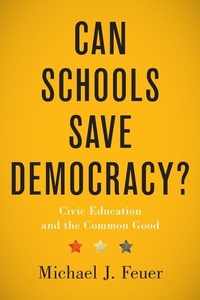
Can Schools Save Democracy?
Civic Education and the Common Good
Published on 2. January 2024
Book
Hardback
208 pages
978-1-4214-4777-3 (ISBN)
Description
How can education protect and strengthen democracy?
In an era when democracy is at critical risk, is it reasonable to expect the education system-already buckling under the ordeal of a global pandemic-to solve the converging problems of inequality, climate change, and erosion of trust in government and science? Will more civics instruction help? In Can Schools Save Democracy? Michael J. Feuer offers a new approach to addressing these questions with a strategy for improving the process and substance of civic education.
Although schooling alone cannot save democracy, it must play a part. Feuer introduces a framework for educator preparation that emphasizes collective action, experiential learning, and partnerships between schools and their complex constituencies. His proposed reform aims to equip teachers with an appreciation of the paradoxes of pluralism-in particular, the tensions between individual choice and social outcomes. And he offers practical suggestions for how to bring those concepts to life so that students in and out of the classroom acquire the skills, knowledge, and dispositions for enlightened democratic leadership.
Adopting a definition of public education that celebrates the engagement between schools and their environments, Feuer argues for reinforced partnerships within the education system and between educators and their diverse constituents. He anticipates new collaborations between education faculty and their colleagues in the behavioral, social, and physical sciences and humanities; stronger links between schools and their complex outside environments; and improved mechanisms for global cooperation. Can Schools Save Democracy? includes lively examples of how theoretical principles can inform familiar problems and offers a hopeful path for progress toward a stronger democracy.
In an era when democracy is at critical risk, is it reasonable to expect the education system-already buckling under the ordeal of a global pandemic-to solve the converging problems of inequality, climate change, and erosion of trust in government and science? Will more civics instruction help? In Can Schools Save Democracy? Michael J. Feuer offers a new approach to addressing these questions with a strategy for improving the process and substance of civic education.
Although schooling alone cannot save democracy, it must play a part. Feuer introduces a framework for educator preparation that emphasizes collective action, experiential learning, and partnerships between schools and their complex constituencies. His proposed reform aims to equip teachers with an appreciation of the paradoxes of pluralism-in particular, the tensions between individual choice and social outcomes. And he offers practical suggestions for how to bring those concepts to life so that students in and out of the classroom acquire the skills, knowledge, and dispositions for enlightened democratic leadership.
Adopting a definition of public education that celebrates the engagement between schools and their environments, Feuer argues for reinforced partnerships within the education system and between educators and their diverse constituents. He anticipates new collaborations between education faculty and their colleagues in the behavioral, social, and physical sciences and humanities; stronger links between schools and their complex outside environments; and improved mechanisms for global cooperation. Can Schools Save Democracy? includes lively examples of how theoretical principles can inform familiar problems and offers a hopeful path for progress toward a stronger democracy.
More details
Language
English
Place of publication
Baltimore, MD
United States
Target group
Professional and scholarly
Product notice
sewn/stitched
Cloth over boards
Illustrations
4 s/w Abbildungen
4 Illustrations, black and white
Dimensions
Height: 219 mm
Width: 142 mm
Thickness: 21 mm
Weight
378 gr
ISBN-13
978-1-4214-4777-3 (9781421447773)
DOI
10.56021/9781421447773
Copyright in bibliographic data and cover images is held by Nielsen Book Services Limited or by the publishers or by their respective licensors: all rights reserved.
Schweitzer Classification
Other editions
Additional editions
E-Book
01/2024
Johns Hopkins University Press
€24.99
Available for download
Person
Michael J. Feuer (WASHINGTON, DC) has been dean of the Graduate School of Education and Human Development at George Washington University since 2010, following a 25-year career at the Congressional Office of Technology Assessment and the National Academy of Sciences. He has held faculty positions at Drexel University and Georgetown, and is a past president of the National Academy of Education. Feuer is the author of The Rising Price of Objectivity: Philanthropy, Government, and the Future of Education Research and Moderating the Debate: Rationality and the Promise of American Education.
Content
Introduction: Education and Democracy
1. Free to Bruise: Political Economy and the Limits of Liberty
2. Civics as Process and Product: Origins and Opportunities
3. Curriculum Options: Schools of Thought
4. Beyond the Schoolhouse: Education as Public Good
Postscript: "Commons" Sense in Democratic Education
Acknowledgments
Notes
References
Index
1. Free to Bruise: Political Economy and the Limits of Liberty
2. Civics as Process and Product: Origins and Opportunities
3. Curriculum Options: Schools of Thought
4. Beyond the Schoolhouse: Education as Public Good
Postscript: "Commons" Sense in Democratic Education
Acknowledgments
Notes
References
Index