

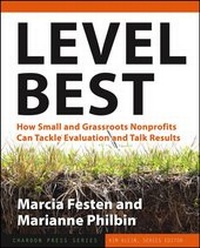
Level Best
How Small and Grassroots Nonprofits Can Tackle Evaluation and Talk Results
Published on 31. October 2006
Book
Paperback/Softback
160 pages
978-0-7879-7906-5 (ISBN)
Description
Level Best offers guidance that demystifies evaluation and takes into account the unique challenges and realities of grassroots nonprofit organizations. It provides a new framework for thinking about evaluation and tools for measuring and sharing results in ways that are practical, efficient, and meaningful.
Reviews / Votes
"Level Best proves to be a foolproof fear buster. The book does an excellent job of presenting evaluation as a tool for grassroots organizations to use to their benefit." (American Journal of Evaluation)More details
Product info
Paperback
Series
Edition
1. Auflage
Language
English
Place of publication
New York
United States
Publishing group
John Wiley & Sons Inc
Target group
Professional and scholarly
Product notice
Paperback (trade)
Unsewn / adhesive bound
Dimensions
Height: 235 mm
Width: 191 mm
Thickness: 9 mm
Weight
305 gr
ISBN-13
978-0-7879-7906-5 (9780787979065)
Schweitzer Classification
Other editions
Additional editions
Marcia Festen | Marianne Philbin
Level Best
How Small and Grassroots Nonprofits Can Tackle Evaluation and Talk Results
E-Book
11/2006
Jossey-Bass
€16.99
Available for download
Persons
Marcia Festen of Marcia K. Festen Associates in Chicago is a consultant to nonprofits and foundations.In addition to conducting evaluations, she develops policy and grantmaking strategies, programs, and initiatives. She was a senior program officer at the John D. and Catherine T. MacArthur Foundation and hasover twenty years of experience in the field.
Marianne Philbin is a writer, trainer, and consultant specializing in nonprofit organizational development.She has worked for a wide range of foundations and nonprofit organizations, and has an extensive background in grantmaking, fundraising, and nonprofit management. She is an instructor for the Donors Forum of Chicago and a lecturer at Northwestern University's School of Continuing Studies.
Content
Figure, Tables, Worksheets, Exhibits, Agendas.
Introduction.
How to Use This Book.
Instruction with Samples and Examples.
1 Understanding Evaluation.
Evaluation as Power Instead of Pain.
What Evaluation Is and What It Is Not.
2 A Simple Evaluation Framework.
The Basic Evaluation Framework.
Key Concepts:What to Evaluate and How to Get Started.
The Rolling Evaluation Method.
3 Planning Your Evaluation.
A Quick Review of Basic Organizational Readiness.
Definition of an Effective Organization.
What You Plan Affects What You Learn.
Step by Step: Planning Your Evaluation.
Understanding Funders'Needs and Fitting Them into Your Evaluation Plan.
Why Setting Goals Makes Evaluation Easier.
How You Can Prepare.
4 Asking the Right Questions.
Clear Program Goals Guide Evaluation Questions and Choices.
What to Evaluate:What You Do Versus What Your Constituents Do.
If or Then:Which to Evaluate?
The Relationship Between Evaluating What You Do (Process) and What They Do (Outcome).
Determine the Right Questions.
Ask What You Really Want to Know.
How Advocacy Organizations Can Approach Evaluation.
How to Be Answerable When Advocacy and Organizing Are Your Agenda.
Ideas for Measuring Organizing Efforts.
5 Tracking Information.
Options for Tracking Information.
The Right Goal Statement Helps Determine the Right Things to Track.
6 Learning From and Using the Information.
Making Use of Your Information.
Organizing Your Information.
Drawing Conclusions.
Using What You Learn.
Sharing Your Evaluation Results with the Outside World.
Feeding Results into the Cycle of Planning.
Tying Evaluation into Planning.
Deciding Where to Begin.
Incorporating Evaluation into Your Strategic Planning Process.
Resources.
A Commonly Used Terms and Their Definitions.
B Types of Evaluation.
C Sample Completed Evaluation Planning Worksheet.
D Sample Evaluation Report Outline.
E Program Evaluation Standards.
Acknowledgments.
About the Authors.
References.
Index.