

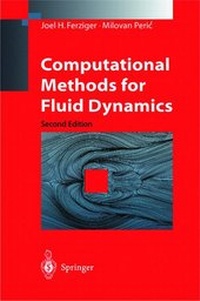
Computational Methods for Fluid Dynamics
2nd Edition
Published on 3. March 1999
Book
Paperback/Softback
XIV, 389 pages
978-3-540-65373-8 (ISBN)
Description
This standard-textbook is among the top-ten bestselling books in fluid-mechanics worldwide. The authors have high reputation both as lecturers and scientifically and give an excellent overview of what is possible in CFD today. They do not only describe the state-of-art but also give access to some fine programs.
More details
Edition
2nd ed. 1999
Language
English
Place of publication
Heidelberg
Germany
Publishing group
Springer Berlin
Target group
College/higher education
Professional and scholarly
Illustrations
80 s/w Abbildungen
100 illustrations
Dimensions
Height: 23.5 cm
Width: 15.5 cm
Weight
600 gr
ISBN-13
978-3-540-65373-8 (9783540653738)
DOI
10.1007/978-3-642-98037-4
Schweitzer Classification
Other editions
New editions
Joel H. Ferziger | Milovan Peric | Robert L. Street
Computational Methods for Fluid Dynamics
Book
08/2019
4th Edition
Springer
€74.89
Shipment within 10-15 days
Joel H. Ferziger | Milovan Peric
Computational Methods for Fluid Dynamics
Book
11/2001
3rd Edition
Springer
€64.19
Article exhausted; check for reprint
Previous edition
Joel H. Ferziger | Milovan Peric
Computational Methods for Fluid Dynamics
Book
08/1997
Springer
€85.55
Article exhausted; check for reprint
Content
1. Basic Concepts of Fluid Flow.- 1.1 Introduction.- 1.2 Conservation Principles.- 1.3 Mass Conservation.- 1.4 Momentum Conservation.- 1.5 Conservation of Scalar Quantities.- 1.6 Dimensionless Form of Equations.- 1.7 Simplified Mathematical Models.- 1.7.1 Incompressible Flow.- 1.7.2 Inviscid (Euler) Flow.- 1.7.3 Potential Flow.- 1.7.4 Creeping (Stokes) Flow.- 1.7.5 Boussinesq Approximation.- 1.7.6 Boundary Layer Approximation.- 1.7.7 Modeling of Complex Flow Phenomena.- 1.8 Mathematical Classification of Flows.- 1.8.1 Hyperbolic Flows.- 1.8.2 Parabolic Flows.- 1.8.3 Elliptic Flows.- 1.8.4 Mixed Flow Types.- 1.9 Plan of This Book.- 2. Introduction to Numerical Methods.- 2.1 Approaches to Fluid Dynamical Problems.- 2.2 What is CFD?.- 2.3 Possibilities and Limitations of Numerical Methods.- 2.4 Components of a Numerical Solution Method.- 2.4.1 Mathematical Model.- 2.4.2 Discretization Method.- 2.4.3 Coordinate and Basis Vector Systems.- 2.4.4 Numerical Grid.- 2.4.5 Finite Approximations.- 2.4.6 Solution Method.- 2.4.7 Convergence Criteria.- 2.5 Properties of Numerical Solution Methods.- 2.5.1 Consistency.- 2.5.2 Stability.- 2.5.3 Convergence.- 2.5.4 Conservation.- 2.5.5 Boundedness.- 2.5.6 Realizability.- 2.5.7 Accuracy.- 2.6 Discretization Approaches.- 2.6.1 Finite Difference Method.- 2.6.2 Finite Volume Method.- 2.6.3 Finite Element Method.- 3. Finite Difference Methods.- 3.1 Introduction.- 3.2 Basic Concept.- 3.3 Approximation of the First Derivative.- 3.3.1 Taylor Series Expansion.- 3.3.2 Polynomial Fitting.- 3.4 Approximation of the Second Derivative.- 3.5 Approximation of Mixed Derivatives.- 3.6 Approximation of Other Terms.- 3.7 Implementation of Boundary Conditions.- 3.8 An Introduction to Spectral Methods.- 3.8.1 Basic Concept.- 3.8.2 Another View of Discretization Error.- 3.9 The Algebraic Equation System.- 3.10 Discretization Errors.- 3.11 Example.- 4. Finite Volume Methods.- 4.1 Introduction.- 4.2 Approximation of Surface Integrals.- 4.3 Approximation of Volume Integrals.- 4.4 Interpolation Practices.- 4.4.1 Upwind Interpolation (UDS).- 4.4.2 Linear Interpolation (CDS).- 4.4.3 Quadratic Upwind Interpolation (QUICK).- 4.4.4 Higher-Order Schemes.- 4.4.5 Other Schemes.- 4.5 Deferred Correction.- 4.6 Implementation of Boundary Conditions.- 4.7 The Algebraic Equation System.- 4.8 Examples.- 5. Solution of Linear Equation Systems.- 5.1 Introduction.- 5.2 Direct Methods.- 5.2.1 Gauss Elimination.- 5.2.2 LU Decomposition.- 5.2.3 Tridiagonal Systems.- 5.2.4 Cyclic Reduction.- 5.3 Iterative Methods.- 5.3.1 Basic Concept.- 5.3.2 Convergence.- 5.3.3 Some Basic Methods.- 5.3.4 Incomplete LU Decomposition: Stone's Method.- 5.3.5 ADI and Other Splitting Methods.- 5.3.6 Conjugate Gradient Methods.- 5.3.7 Biconjugate Gradients and CGSTAB.- 5.3.8 Multigrid Methods.- 5.3.9 Other Iterative Solvers.- 5.4 Coupled Equations and Their Solution.- 5.4.1 Simultaneous Solution.- 5.4.2 Sequential Solution.- 5.4.3 Under-relaxation.- 5.5 Non-Linear Equations and their Solution.- 5.5.1 Newton-like Techniques.- 5.5.2 Other Techniques.- 5.6 Convergence Criteria and Iteration Errors.- 5.7 Examples.- 6. Methods for Unsteady Problems.- 6.1 Introduction.- 6.2 Methods for Initial Value Problems in ODEs.- 6.2.1 Two-Level Methods.- 6.2.2 Predictor-Corrector and Multipoint Methods.- 6.2.3 Runge-Kutta Methods.- 6.2.4 Other Methods.- 6.3 Application to the Generic Transport Equation.- 6.3.1 Explicit Methods.- 6.3.2 Implicit Methods.- 6.3.3 Other Methods.- 6.4 Examples.- 7. Solution of the Navier-Stokes Equations.- 7.1 Special Features of the Navier-Stokes Equations.- 7.1.1 Discretization of Convective and Viscous Terms.- 7.1.2 Discretization of Pressure Terms and Body Forces.- 7.1.3 Conservation Properties.- 7.2 Choice of Variable Arrangement on the Grid.- 7.2.1 Colocated Arrangement.- 7.2.2 Staggered Arrangements.- 7.3 Calculation of the Pressure.- 7.3.1 The Pressure Equation and its Solution.- 7.3.2 A Simple Explicit Time Advance Scheme.- 7.3.3 A Simple Implicit Time Advance Method.- 7.3.4 Implicit Pressure-Correction Methods.- 7.4 Other Methods.- 7.4.1 Fractional Step Methods.- 7.4.2 Streamfunction-Vorticity Methods.- 7.4.3 Artificial Compressibility Methods.- 7.5 Solution Methods for the Navier-Stokes Equations.- 7.5.1 Implicit Scheme Using Pressure-Correction and a Staggered Grid.- 7.5.2 Treatment of Pressure for Colocated Variables.- 7.5.3 SIMPLE Algorithm for a Colocated Variable Arrangement.- 7.6 Note on Pressure and Incompressibility.- 7.7 Boundary Conditions for the Navier-Stokes Equations.- 7.8 Examples.- 8. Complex Geometries.- 8.1 The Choice of Grid.- 8.1.1 Stepwise Approximation Using Regular Grids.- 8.1.2 Overlapping Grids.- 8.1.3 Boundary-Fitted Non-Orthogonal Grids.- 8.2 Grid Generation.- 8.3 The Choice of Velocity Components.- 8.3.1 Grid-Oriented Velocity Components.- 8.3.2 Cartesian Velocity Components.- 8.4 The Choice of Variable Arrangement.- 8.4.1 Staggered Arrangements.- 8.4.2 Colocated Arrangement.- 8.5 Finite Difference Methods.- 8.5.1 Methods Based on Coordinate Transformation.- 8.5.2 Method Based on Shape Functions.- 8.6 Finite Volume Methods.- 8.6.1 Approximation of Convective Fluxes.- 8.6.2 Approximation of Diffusive Fluxes.- 8.6.3 Approximation of Source Terms.- 8.6.4 Three-Dimensional Grids.- 8.6.5 Block-Structured Grids.- 8.6.6 Unstructured Grids.- 8.7 Control-Volume-Based Finite Element Methods.- 8.8 Pressure-Correction Equation.- 8.9 Axisymmetric Problems.- 8.10 Implementation of Boundary Conditions.- 8.10.1 Inlet.- 8.10.2 Outlet.- 8.10.3 Impermeable Walls.- 8.10.4 Symmetry Planes.- 8.10.5 Specified Pressure.- 8.11 Examples.- 9. Turbulent Flows.- 9.1 Introduction.- 9.2 Direct Numerical Simulation (DNS).- 9.2.1 Example: Spatial Decay of Grid Turbulence.- 9.3 Large Eddy Simulation (LES).- 9.3.1 Smagorinsky and Related Models.- 9.3.2 Dynamic Models.- 9.3.3 Example: Flow Over a Wall-Mounted Cube.- 9.4 RANS Models.- 9.4.1 Reynolds Averaged Navier-Stokes (RANS) Equations.- 9.4.2 Simple Turbulence Models and their Application.- 9.4.3 Example: Flow Around an Engine Valve.- 9.5 Reynolds Stress Models.- 10. Compressible Flow.- 10.1 Introduction.- 10.2 Pressure-Correction Methods for Arbitrary Mach Number.- 10.2.1 Pressure-Velocity-Density Coupling.- 10.2.2 Boundary Conditions.- 10.2.3 Examples.- 10.3 Methods Designed for Compressible Flow.- 10.3.1 An Overview of Some Specific Methods.- 11. Efficiency and Accuracy Improvement.- 11.1 Error Analysis and Estimation.- 11.1.1 Description of Errors.- 11.1.2 Estimation of Errors.- 11.1.3 Recommended Practice for CFD Uncertainty Analysis.- 11.2 Multigrid Methods for Flow Calculation.- 11.3 Adaptive Grid Methods and Local Grid Refinement.- 11.4 Parallel Computing in CFD.- 11.4.1 Iterative Schemes for Linear Equations.- 11.4.2 Domain Decomposition in Space.- 11.4.3 Domain Decomposition in Time.- 11.4.4 Efficiency of Parallel Computing.- 12. Special Topics.- 12.1 Moving Grids.- 12.2 Free Surface Flows.- 12.2.1 Interface-Capturing Methods.- 12.2.2 Interface-Tracking Methods.- 12.3 Heat Transfer.- 12.4 Flow With Variable Fluid Properties.- 12.5 Meteorological and Oceanographic Applications.- 12.6 Combustion.- 12.7 Multiphase flows.- A. Appendices.- A.1 List of Computer Codes and How to Access Them.- A.2 List of Frequently Used Abbreviations.