

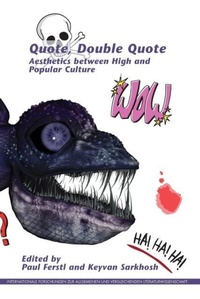
Quote, Double Quote
Aesthetics between High and Popular Culture
Published on 1. January 2014
Book
Paperback/Softback
248 pages
978-90-420-3796-0 (ISBN)
Description
The boundary between 'high' culture and 'popular' culture is neither hermetic nor stable. A wide-spread mechanism of a reception strongly influenced by structuralism and post-modernism has led to the amplification and acceleration of cultural production between these two poles. Relying on a decidedly theoretical approach, this volume offers a broad perspective transgressing linguistic, cultural, temporal, and media borders.
Reflections and perspectives on the relationship between 'high' and 'popular' culture are the subject of the thirteen articles collected here. Side by side with theoretical approaches, case studies covering classical and Heavy Metal music, TV series and pornographic films, zombies and 'Creature Features', philosophically infused comics and popular lexicography, professional wrestling and hypertext literature pave the way to a contemporary aesthetics.
Reflections and perspectives on the relationship between 'high' and 'popular' culture are the subject of the thirteen articles collected here. Side by side with theoretical approaches, case studies covering classical and Heavy Metal music, TV series and pornographic films, zombies and 'Creature Features', philosophically infused comics and popular lexicography, professional wrestling and hypertext literature pave the way to a contemporary aesthetics.
More details
Series
Language
English
Place of publication
Leiden
Netherlands
Publishing group
Brill
Target group
Professional and scholarly
Product notice
Paperback (trade)
Unsewn / adhesive bound
Dimensions
Height: 227 mm
Width: 154 mm
Thickness: 18 mm
Weight
345 gr
ISBN-13
978-90-420-3796-0 (9789042037960)
Copyright in bibliographic data and cover images is held by Nielsen Book Services Limited or by the publishers or by their respective licensors: all rights reserved.
Schweitzer Classification
Content
Keyvan Sarkhosh and Paul Ferstl: Introduction: Popular Culture in the Field of 'Undercomplexity' and 'Imbalanced Coding'
Moritz Bassler: "New Standards of Beauty and Style and Taste". Expanding the Concept of Camp
Achim Hoelter: Doppelte Optik and lange Ohren - Notes on the Aesthetic Compromise
Marion Wittfeld: "Wartime Entertainment": Press Instructions of the NS Propaganda Ministry on Literary Texts in Magazines
Norbert Bachleitner: Literary Field or "Digital Soup"? Literature in the Internet
Keyvan Sarkhosh: >>Sick, sick, sick<<? Pornography, Disgust, and the Limit Values of Aesthetics
Daniel Syrovy: Sharks, Spiders, Locusts, Bats, and Rats: Thoughts Toward the Morphology of Creature Features
Sabine Schoenfellner: Appropriating the Undead: Zombies Outside the Horror Genre
Stefan Tetzlaff: Narrative Devices in Contemporary Animated Series, or: Why Family Guy Does not Copy The Simpsons
Paul Ferstl: Wrestling with Narratives: Reflections on the Montreal Screwjob
Esteban Sanchino Martinez: The Logic of Metallica out of the Spirit of the Drastic: Reflections on Serious Writing in Popular Culture
Ulrich Meurer: Becoming Line: On Some Features of Philosophy in Salut, Deleuze!
Monika Schmitz-Emans: Alphabetical Writing between Information, Entertainment, and Experiment. Playful Variations of Lexicography in High and Popular Culture
Notes on Contributors
Moritz Bassler: "New Standards of Beauty and Style and Taste". Expanding the Concept of Camp
Achim Hoelter: Doppelte Optik and lange Ohren - Notes on the Aesthetic Compromise
Marion Wittfeld: "Wartime Entertainment": Press Instructions of the NS Propaganda Ministry on Literary Texts in Magazines
Norbert Bachleitner: Literary Field or "Digital Soup"? Literature in the Internet
Keyvan Sarkhosh: >>Sick, sick, sick<<? Pornography, Disgust, and the Limit Values of Aesthetics
Daniel Syrovy: Sharks, Spiders, Locusts, Bats, and Rats: Thoughts Toward the Morphology of Creature Features
Sabine Schoenfellner: Appropriating the Undead: Zombies Outside the Horror Genre
Stefan Tetzlaff: Narrative Devices in Contemporary Animated Series, or: Why Family Guy Does not Copy The Simpsons
Paul Ferstl: Wrestling with Narratives: Reflections on the Montreal Screwjob
Esteban Sanchino Martinez: The Logic of Metallica out of the Spirit of the Drastic: Reflections on Serious Writing in Popular Culture
Ulrich Meurer: Becoming Line: On Some Features of Philosophy in Salut, Deleuze!
Monika Schmitz-Emans: Alphabetical Writing between Information, Entertainment, and Experiment. Playful Variations of Lexicography in High and Popular Culture
Notes on Contributors