

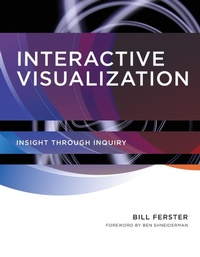
Interactive Visualization
Insight through Inquiry
Published on 16. May 2023
Book
Paperback/Softback
296 pages
978-0-262-54767-3 (ISBN)
Description
A guide to fundamental issues in designing interactive visualizations, exploring ideas of inquiry, design, structured data, and usability.
Interactive visualization is emerging as a vibrant new form of communication, providing compelling presentations that allow viewers to interact directly with information in order to construct their own understandings of it. Building on a long tradition of print-based information visualization, interactive visualization utilizes the technological capabilities of computers, the Internet, and computer graphics to marshal multifaceted information in the service of making a point visually. This book offers an introduction to the field, presenting a framework for exploring historical, theoretical, and practical issues. It is not a “how-to” book tied to specific and soon-to-be-outdated software tools, but a guide to the concepts that are central to building interactive visualization projects whatever their ultimate form.
The framework the book presents (known as the ASSERT model, developed by the author), allows the reader to explore the process of interactive visualization in terms of choosing good questions to ask; finding appropriate data for answering them; structuring that information; exploring and analyzing the data; representing the data visually; and telling a story using the data. Interactive visualization draws on many disciplines to inform the final representation, and the book reflects this, covering basic principles of inquiry, data structuring, information design, statistics, cognitive theory, usability, working with spreadsheets, the Internet, and storytelling.
Interactive visualization is emerging as a vibrant new form of communication, providing compelling presentations that allow viewers to interact directly with information in order to construct their own understandings of it. Building on a long tradition of print-based information visualization, interactive visualization utilizes the technological capabilities of computers, the Internet, and computer graphics to marshal multifaceted information in the service of making a point visually. This book offers an introduction to the field, presenting a framework for exploring historical, theoretical, and practical issues. It is not a “how-to” book tied to specific and soon-to-be-outdated software tools, but a guide to the concepts that are central to building interactive visualization projects whatever their ultimate form.
The framework the book presents (known as the ASSERT model, developed by the author), allows the reader to explore the process of interactive visualization in terms of choosing good questions to ask; finding appropriate data for answering them; structuring that information; exploring and analyzing the data; representing the data visually; and telling a story using the data. Interactive visualization draws on many disciplines to inform the final representation, and the book reflects this, covering basic principles of inquiry, data structuring, information design, statistics, cognitive theory, usability, working with spreadsheets, the Internet, and storytelling.
More details
Language
English
Place of publication
Cambridge (Massachusetts)
United States
Publishing group
MIT Press Ltd
Target group
College/higher education
Interest Age: From 18 years
Product notice
Paperback (trade)
Illustrations
161 FIGURES
Dimensions
Height: 229 mm
Width: 178 mm
Thickness: 19 mm
Weight
738 gr
ISBN-13
978-0-262-54767-3 (9780262547673)
Copyright in bibliographic data and cover images is held by Nielsen Book Services Limited or by the publishers or by their respective licensors: all rights reserved.
Schweitzer Classification
Persons
Bill Ferster is on the faculty of the University of Virginia with a joint appointment to the Center for Technology and Teacher Education at the Curry School of Education and at the Science, Humanities, and Arts Network of Technological Initiatives (SHANTI) at the College of Arts and Sciences.
Ben Shneiderman is Professor of Computer Science and Founding Director (1983–2000) of the Human-Computer Interaction Laboratory at the University of Maryland, College Park.
Ben Shneiderman is Professor of Computer Science and Founding Director (1983–2000) of the Human-Computer Interaction Laboratory at the University of Maryland, College Park.
Content
Foreword by Ben Shneiderman ix
Preface xiii
I About Interactive Visualization 1
1 Introduction 3
II An Assertive Approach to Visualization 43
2 Ask a Question 45
3 Search for Information 63
4 Structure the Information 75
5 Envision the Answer 87
6 Represent the Visualization 107
7 Tell a Story Using Data 175
8 Visualization in the Classroom 187
9 The Internet 203
10 Statistics 213
11 Using Spreadsheets 221
12 Databases and XML 241
13 Accessibility 245
14 About VisualEyes 251
Further Reading 257
References 259
Index 265
Preface xiii
I About Interactive Visualization 1
1 Introduction 3
II An Assertive Approach to Visualization 43
2 Ask a Question 45
3 Search for Information 63
4 Structure the Information 75
5 Envision the Answer 87
6 Represent the Visualization 107
7 Tell a Story Using Data 175
8 Visualization in the Classroom 187
9 The Internet 203
10 Statistics 213
11 Using Spreadsheets 221
12 Databases and XML 241
13 Accessibility 245
14 About VisualEyes 251
Further Reading 257
References 259
Index 265