

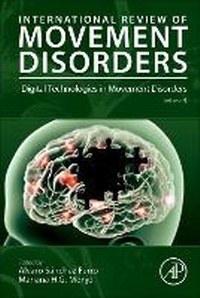
Digital Technologies in Movement Disorders: Volume 5
Published on 20. July 2023
Book
Hardback
312 pages
978-0-323-99237-4 (ISBN)
Description
Digital Technologies in Movement Disorders, Volume Five updates on the latest advances in new technologies for the care of common conditions, including Parkinson's disease and other diseases. The book has been organized in four differentiated sections with chapters that cover an Introduction, key concepts, and overview of digital solutions, Applications of AI in MD, Digital Biomarkers in MD, Sensors basic concepts for the MD specialist, Wearable systems in MD, Quantitative gait analysis, The challenges and opportunities of remote evaluation in MD, Telemedicine in MD, ePROs, eCOA and other digital health solutions, HIFU, and other therapeutical applications of technology, and more.
Reviews / Votes
*4 stars* "...a short but dense text focused entirely on the use of digital technologies and artificial intelligence techniques to measure and to understand movement disorders....[explaining] clinical findings [on] the use of wearable sensors to measure and record movement and clinical instruments, including patient-reported outcome measures, to assess movement in patients with these disorders. ....[Helps] readers understand the technological breakthroughs in assessment.... [and] addresses innovative topics such as functional neurosurgical techniques and ultrasound treatment.... The figures and diagrams ae well-done and very important....very well-referenced." - (c)Doody's Review Service, 2024, Elliot J Roth, MD (Shirley Ryan AbilityLab)More details
Series
Language
English
Place of publication
Oxford
United Kingdom
Publishing group
Elsevier Science & Technology
Target group
Professional and scholarly
Dimensions
Height: 229 mm
Width: 152 mm
Weight
630 gr
ISBN-13
978-0-323-99237-4 (9780323992374)
Copyright in bibliographic data and cover images is held by Nielsen Book Services Limited or by the publishers or by their respective licensors: all rights reserved.
Schweitzer Classification
Other editions
Additional editions
E-Book
07/2023
Academic Press
€196.00
Available for download
Persons
Dr. Sanchez Ferro specialized in neurology at the Hospital 12 de Octubre in Madrid (Spain). In the same center, he was trained specifically for the management of Parkinson's disease thanks to a program of the Carlos III Research Institute (Rio Hortega Program). During this period, he visited prestigious centers such as the "Hertie Institut" in Tuebingen (Germany) and the "MINDS laboratory" from Harvard University where he also received training in neurodegenerative diseases. In 2013, Dr. Sanchez Ferro received a scholarship from a program of the Community of Madrid and the Massachusetts Institute of Technology (Cambridge, USA) to be part of a biomedical innovation program. As part of it, he developed new methods for the objective quantification of Parkinson's disease signs. Currently, Dr. Sanchez-Ferro continues applying these skills in his position as neurologist and researcher at 12 de Octubre Hospital and Chief Medical Officer of Leuko Labs. He is also Director of the Clinical Outcomes Assessment Program at the International Parkinson and Movement Disorders Society (MDS) and is an active member of the Technology Study Group of the MDS Society.
Dr Monje specialized in neurology at the Hospital Clinico San Carlos in Madrid (Spain). She received her PhD in Neuroscience from Universidad Autonoma de Madrid working in a progressive model of Parkinson's disease in non-human primate. She posteriorly pursued a clinical and research fellowship in Movement in HM-CINAC, where she got experience in new technologies for the objective quantification of movement disorders. Currently, Dr. Monje works as postdoctoral scholar in Northwestern University, Chicago (USA). She is the co-Chair of the Electronic Clinical Outcomes Assessment Program at the International Parkinson and Movement Disorders Society (MDS).
Dr Monje specialized in neurology at the Hospital Clinico San Carlos in Madrid (Spain). She received her PhD in Neuroscience from Universidad Autonoma de Madrid working in a progressive model of Parkinson's disease in non-human primate. She posteriorly pursued a clinical and research fellowship in Movement in HM-CINAC, where she got experience in new technologies for the objective quantification of movement disorders. Currently, Dr. Monje works as postdoctoral scholar in Northwestern University, Chicago (USA). She is the co-Chair of the Electronic Clinical Outcomes Assessment Program at the International Parkinson and Movement Disorders Society (MDS).
Content
Preface
Alvaro Sanchez Ferro and Mariana Hernandez Gonzalez-Monje
1. Applications of artificial intelligence in movement disorders, in the pursuit of personalized healthcare
Jorge Cancela, Ernst Bos, Jaclyn Loushine, Dario Motti and Foteini Orfaniotou
2. Machine learning basic concepts for the movement disorders specialist
Elina L. van den Brandhof, A.M. Madelein van der Stouwe, Jelle R. Dalenberg, Inge Tuitert, Marina A.J. Tijssen and Michael Biehl
3. Digital biomarkers in movement disorders
Daniele Urso, Daniel J van Wamelen, Dhaval Trivedi, K Ray Chaudhuri and Cristian Falup-Pecurariu
4. Basic concept of sensors for movement disorders specialists
Raquel Bouca-Machado, Linda Azevedo Kauppila, Tiago Guerreiro and Joaquim J Ferreira
5. Wearable systems in movement disorders
Edoardo Bianchini and Walter Maetzler
6. Digital gait and balance measures
Fay B. Horak, Vrutangkumar Shah and Martina Mancini
7. The challenges and opportunities for remotely evaluating movement disorders
Rochester Lynn, Del Din Silvia, Hu Michele T, Morgan Catherine and Carroll Camille
8. eCOA, ePROs and other digital health solutions in movement disorders
Sylvie Grosjean and Tiago A. Mestre
9. Telemedicine in movement disorders
Esther Cubo
10. Video and optoelectronics in movement disorders
Cristina Caro and Norberto Malpica
11. Therapeutic applications and technical developments of focused ultrasound for movement disorders
Jorge U. Manez-Miro, Elena Natera-Villalba and Raul Martinez-Fernandez
Glossary
Alvaro Sanchez Ferro and Mariana Hernandez Gonzalez-Monje
Alvaro Sanchez Ferro and Mariana Hernandez Gonzalez-Monje
1. Applications of artificial intelligence in movement disorders, in the pursuit of personalized healthcare
Jorge Cancela, Ernst Bos, Jaclyn Loushine, Dario Motti and Foteini Orfaniotou
2. Machine learning basic concepts for the movement disorders specialist
Elina L. van den Brandhof, A.M. Madelein van der Stouwe, Jelle R. Dalenberg, Inge Tuitert, Marina A.J. Tijssen and Michael Biehl
3. Digital biomarkers in movement disorders
Daniele Urso, Daniel J van Wamelen, Dhaval Trivedi, K Ray Chaudhuri and Cristian Falup-Pecurariu
4. Basic concept of sensors for movement disorders specialists
Raquel Bouca-Machado, Linda Azevedo Kauppila, Tiago Guerreiro and Joaquim J Ferreira
5. Wearable systems in movement disorders
Edoardo Bianchini and Walter Maetzler
6. Digital gait and balance measures
Fay B. Horak, Vrutangkumar Shah and Martina Mancini
7. The challenges and opportunities for remotely evaluating movement disorders
Rochester Lynn, Del Din Silvia, Hu Michele T, Morgan Catherine and Carroll Camille
8. eCOA, ePROs and other digital health solutions in movement disorders
Sylvie Grosjean and Tiago A. Mestre
9. Telemedicine in movement disorders
Esther Cubo
10. Video and optoelectronics in movement disorders
Cristina Caro and Norberto Malpica
11. Therapeutic applications and technical developments of focused ultrasound for movement disorders
Jorge U. Manez-Miro, Elena Natera-Villalba and Raul Martinez-Fernandez
Glossary
Alvaro Sanchez Ferro and Mariana Hernandez Gonzalez-Monje