

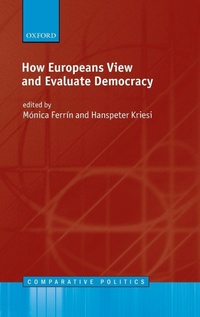
How Europeans View and Evaluate Democracy
Published on 3. March 2016
Book
Hardback
432 pages
978-0-19-876690-2 (ISBN)
Description
Based on a new data-set covering 29 European and neighboring countries, this volume shows how, Europeans view and evaluate democracy: what are their conceptions of democracy, how do they assess the quality of democracy in their own country, and to what extent do they consider their country's democracy as legitimate? The study shows that Europeans share a common view of liberal democracy, which is complemented by elements of social and direct democracy, which go beyond the basic liberal model. The level of their demands in terms of democracy varies, however, considerably across Europe and is related to their assessment of democracy: the worse the quality of democracy in a given country, the higher the respective demands on democracy. The analysis of the determinants of democratic views and evaluations shows that they depend on the political and economic (but less on the cultural) context conditions.
Comparative Politics is a series for students, teachers, and researchers of political science that deals with contemporary government and politics. Global in scope, books in the series are characterised by a stress on comparative analysis and strong methodological rigour. The series is published in association with the European Consortium for Political Research. For more information visit: www.ecprnet.eu.
The Comparative Politics series is edited by Emilie van Haute, Professor of Political Science, Universite libre de Bruxelles; Ferdinand Mueller-Rommel, Director of the Center for the Study of Democracy, Leuphana University; and Susan Scarrow, Chair of the Department of Political Science, University of Houston.
Comparative Politics is a series for students, teachers, and researchers of political science that deals with contemporary government and politics. Global in scope, books in the series are characterised by a stress on comparative analysis and strong methodological rigour. The series is published in association with the European Consortium for Political Research. For more information visit: www.ecprnet.eu.
The Comparative Politics series is edited by Emilie van Haute, Professor of Political Science, Universite libre de Bruxelles; Ferdinand Mueller-Rommel, Director of the Center for the Study of Democracy, Leuphana University; and Susan Scarrow, Chair of the Department of Political Science, University of Houston.
More details
Other editions
Additional editions
Mónica Ferrín | Hanspeter Kriesi
How Europeans View and Evaluate Democracy
E-Book
03/2016
1st Edition
OUP eBook
€61.49
Available for download
Mónica Ferrín | Hanspeter Kriesi
How Europeans View and Evaluate Democracy
E-Book
03/2016
1st Edition
OUP eBook
€53.49
Available for download
Persons
Monica Ferrin is Researcher at the University of Zuerich, where she works in several projects related to citizens' attitudes, behavior, and citizenship. She also collaborates with Collegio Carlo Alberto.
; Hanspeter Kriesi holds the Stein Rokkan Chair in Comparative Politics at the European University Institute in Florence. Previously, he had been teaching at the universities of Amsterdam, Geneva and Zurich. He was the director of a Swiss national research program on the 'Challenges to democracy in the 21st century' from 2005-2012.
; Hanspeter Kriesi holds the Stein Rokkan Chair in Comparative Politics at the European University Institute in Florence. Previously, he had been teaching at the universities of Amsterdam, Geneva and Zurich. He was the director of a Swiss national research program on the 'Challenges to democracy in the 21st century' from 2005-2012.
Content
PART I: VIEWS OF DEMOCRACY IN EUROPE; PART II: EVALUATIONS OF EUROPEAN DEMOCRACIES; PART III: LEGITIMACY OF EUROPEAN DEMOCRACIES