

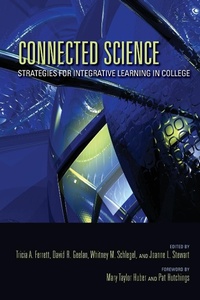
Connected Science
Strategies for Integrative Learning in College
Published on 10. July 2013
Book
Paperback/Softback
224 pages
978-0-253-00939-5 (ISBN)
Description
Informed by the scholarship of teaching and learning (SOTL), Connected Science presents a new approach to college science education for the 21st century. This interdisciplinary approach stresses integrative learning and pedagogies that engage students through open-ended inquiry, compelling real-world questions, and data-rich experiences. Faculty from a variety of disciplines and institutions present case studies based on research in the classroom, offering insights into student learning goals and best practices in curriculum design. Synthetic chapters bring together themes from the case studies, present an overview of the connected science approach, and identify strategies and future challenges to help move this work forward.
Reviews / Votes
"A significant contribution to science pedagogy and to the scholarship of teaching and learning. . . . [W]ill be of interest to researchers in the area of science education and to college and university faculty members who seek to improve their teaching."-David W. Oxtoby, Pomona College"The educational philosophy presented in Connected Science draws upon existing reform movements in higher education but goes further by providing a more coherent and intentional integration of pedagogy, assessment, faculty scholarship, and student learning. This type of integration is sorely needed in educational reform initiatives."-Trace Jordan, New York University
More details
Series
Language
English
Place of publication
Bloomington, IN
United States
Target group
Professional and scholarly
Product notice
Paperback (trade)
Dimensions
Height: 229 mm
Width: 152 mm
Thickness: 12 mm
Weight
322 gr
ISBN-13
978-0-253-00939-5 (9780253009395)
Copyright in bibliographic data and cover images is held by Nielsen Book Services Limited or by the publishers or by their respective licensors: all rights reserved.
Schweitzer Classification
Other editions
Additional editions
Tricia A. Ferrett | David R. Geelan | Whitney M. Schlegel
Connected Science
Strategies for Integrative Learning in College
E-Book
07/2013
1st Edition
Indiana University Press
from
€37.79
Available for download
Persons
Tricia A. Ferrett is Professor of Chemistry at Carleton College and founder and former director of the Carleton Interdisciplinary Science and Math Initiative.
David R. Geelan is Senior Lecturer in Science Education at Griffith University, Australia.
Whitney M. Schlegel is Associate Professor of Biology and Founding Director of the Human Biology Program at Indiana University.
Joanne L. Stewart is Professor of Chemistry at Hope College.
David R. Geelan is Senior Lecturer in Science Education at Griffith University, Australia.
Whitney M. Schlegel is Associate Professor of Biology and Founding Director of the Human Biology Program at Indiana University.
Joanne L. Stewart is Professor of Chemistry at Hope College.
Content
Foreword: The Scholarship of Integrative Teaching and LearningMary Taylor Huber and Pat Hutchings
Part I. Connected Science: Why Integrative Learning is Vital
1. Fostering Integrative Capacities for the 21st CenturyTricia Ferrett
2. From Student Learning to Teaching FoundationsTricia Ferrett
Part II. Courses that Foster Integrative Learning
3. Public Health and Biochemistry:Connecting Content, Issues, and Values for MajorsMatt Fisher
4. Designing to Make A Difference: Authentic Integration of Professional Skills in an Engineering Capstone Design CourseGregory Kremer
5. Integrative Learning in a Data-Rich Mathematics ClassroomMike Burke
6. Navigating Wormholes: Integrative Learning in a First-Year Field CourseBettie Higgs
Part III. Structures that Support Integrative Learning
7. Linking Integrated Middle-School Science with Literacy in Australian Teacher EducationDavid R. Geelan
8. SCALE-UP in a Large Introductory Biology CourseRobert Brooker, David Matthes, Robin Wright, Deena Wassenberg, Susan Wick, and Brett Couch
9. Reuniting the Arts and Sciences via Interdisciplinary Learning CommunitiesXian Liu, Kate Maiolatesi, and Jack Mino
10. Pedagogies of IntegrationRichard Gale
Part IV. Broader Contexts for Integrative Learning
11. Integrative Moves by Novices: Crossing Institutional, Course, and Student ContextsTricia Ferrett and Joanne Stewart
12. Facilitating and Sustaining Interdisciplinary Curricula: From Theory to PracticeWhitney M. Schlegel
Part I. Connected Science: Why Integrative Learning is Vital
1. Fostering Integrative Capacities for the 21st CenturyTricia Ferrett
2. From Student Learning to Teaching FoundationsTricia Ferrett
Part II. Courses that Foster Integrative Learning
3. Public Health and Biochemistry:Connecting Content, Issues, and Values for MajorsMatt Fisher
4. Designing to Make A Difference: Authentic Integration of Professional Skills in an Engineering Capstone Design CourseGregory Kremer
5. Integrative Learning in a Data-Rich Mathematics ClassroomMike Burke
6. Navigating Wormholes: Integrative Learning in a First-Year Field CourseBettie Higgs
Part III. Structures that Support Integrative Learning
7. Linking Integrated Middle-School Science with Literacy in Australian Teacher EducationDavid R. Geelan
8. SCALE-UP in a Large Introductory Biology CourseRobert Brooker, David Matthes, Robin Wright, Deena Wassenberg, Susan Wick, and Brett Couch
9. Reuniting the Arts and Sciences via Interdisciplinary Learning CommunitiesXian Liu, Kate Maiolatesi, and Jack Mino
10. Pedagogies of IntegrationRichard Gale
Part IV. Broader Contexts for Integrative Learning
11. Integrative Moves by Novices: Crossing Institutional, Course, and Student ContextsTricia Ferrett and Joanne Stewart
12. Facilitating and Sustaining Interdisciplinary Curricula: From Theory to PracticeWhitney M. Schlegel