

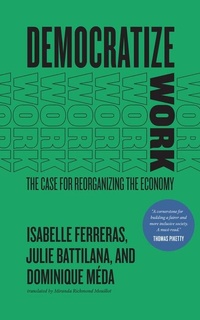
Democratize Work
The Case for Reorganizing the Economy
Published on 6. May 2022
Book
Paperback/Softback
168 pages
978-0-226-81962-4 (ISBN)
Description
An urgent and deeply resonant case for the power of workplace democracy to restore balance between economy and society.
What happens to a society-and a planet-when capitalism outgrows democracy? The tensions between democracy and capitalism are longstanding, and they have been laid bare by the social effects of COVID-19. The narrative of "essential workers" has provided thin cover for the fact that society's lowest paid and least empowered continue to work risky jobs that keep our capitalism humming. Democracy has been subjugated by the demands of capitalism. For many, work has become unfair.
In Democratize Work, essays from a dozen social scientists-all women-articulate the perils and frustrations of our collective moment, but they also see the current crisis as an opportunity for renewal and transformation. Amid mounting inequalities tied to race, gender, and class-and with huge implications for the ecological fate of the planet-the authors detail how adjustments in how we organize work can lead to sweeping reconciliation. By treating workers as citizens, treating work as something other than an asset, and treating the planet as something to be cared for, a better way is attainable. Building on cross-disciplinary research, Democratize Work is both a rallying cry and an architecture for a sustainable economy that fits the democratic project of our societies.
What happens to a society-and a planet-when capitalism outgrows democracy? The tensions between democracy and capitalism are longstanding, and they have been laid bare by the social effects of COVID-19. The narrative of "essential workers" has provided thin cover for the fact that society's lowest paid and least empowered continue to work risky jobs that keep our capitalism humming. Democracy has been subjugated by the demands of capitalism. For many, work has become unfair.
In Democratize Work, essays from a dozen social scientists-all women-articulate the perils and frustrations of our collective moment, but they also see the current crisis as an opportunity for renewal and transformation. Amid mounting inequalities tied to race, gender, and class-and with huge implications for the ecological fate of the planet-the authors detail how adjustments in how we organize work can lead to sweeping reconciliation. By treating workers as citizens, treating work as something other than an asset, and treating the planet as something to be cared for, a better way is attainable. Building on cross-disciplinary research, Democratize Work is both a rallying cry and an architecture for a sustainable economy that fits the democratic project of our societies.
Reviews / Votes
"A cornerstone for building a fairer and more inclusive society. A must-read." -- Thomas Piketty, author of Capital in the Twenty-First CenturyMore details
Language
English
Place of publication
Chicago
United States
Publishing group
The University of Chicago Press
Target group
Professional and scholarly
Product notice
Paperback (trade)
Unsewn / adhesive bound
Dimensions
Height: 206 mm
Width: 130 mm
Thickness: 9 mm
Weight
186 gr
ISBN-13
978-0-226-81962-4 (9780226819624)
Copyright in bibliographic data and cover images is held by Nielsen Book Services Limited or by the publishers or by their respective licensors: all rights reserved.
Schweitzer Classification
Other editions
Additional editions
Ferreras Isabelle Ferreras | Battilana Julie Battilana | Meda Dominique Meda
Democratize Work
The Case for Reorganizing the Economy
E-Book
05/2022
1st Edition
University of Chicago Press
€18.49
Available for download
Persons
Isabelle Ferreras is a senior research associate at the National Fund for Scientific Research in Brussels, professor of sociology at the University of Louvain in Belgium, and a senior research associate of the Labor and Worklife Program at Harvard Law School. She serves as president of the Royal Academy of Science, Letters and Fine Arts of Belgium and is the author of Firms as Political Entities. Julie Battilana is the Joseph C. Wilson Professor of Business Administration at Harvard Business School and the Alan L. Gleitsman Professor of Social Innovation at Harvard Kennedy School, where she is also the founder and faculty chair of the Social Innovation and Change Initiative. She is the coauthor of Power, For All. Dominique Meda is professor of sociology and director of the Institute for Interdisciplinary Research in the Social Sciences at Paris Dauphine University PSL. She is the coauthor of several books, including Post-Growth Economics and Society. Together they lead the www.DemocratizingWork.org movement.
Content
Introduction: For a Fairer, More Democratic, Greener Society
Julie Battilana
Manifesto: Work. Democratize. Decommodify. Decarbonize.
From the Politically Impossible to the Politically Inevitable: Taking Action
Isabelle Ferreras
Democratize Firms . . . Why, and How?
Helene Landemore
Equal Dignity for All Citizens Means Equal Voice at Work: The Importance of Epistemic Justice
Lisa Herzog
Democratizing Work to Reverse Increasing Inequalities
Imge Kaya-Sabanci
Work in Dignity
Adelle Blackett
Dual Majorities for Firm Governments
Sara Lafuente
Rescuing Journalism by Decommodifying the Media
Julia Cage
Decommodifying Work: The Power of a Job Guarantee
Pavlina R. Tcherneva
All Workers Produce Value
Neera Chandhoke
The Subaltern Worker-Body Speaks; Will the Privileged Listen?
Flavia Maximo
Sustaining Life on This Planet
Alyssa Battistoni
Working Against an End: Shifting Gears for a New Beginning
Dominique Meda
Acknowledgments
About the Authors
Index
Julie Battilana
Manifesto: Work. Democratize. Decommodify. Decarbonize.
From the Politically Impossible to the Politically Inevitable: Taking Action
Isabelle Ferreras
Democratize Firms . . . Why, and How?
Helene Landemore
Equal Dignity for All Citizens Means Equal Voice at Work: The Importance of Epistemic Justice
Lisa Herzog
Democratizing Work to Reverse Increasing Inequalities
Imge Kaya-Sabanci
Work in Dignity
Adelle Blackett
Dual Majorities for Firm Governments
Sara Lafuente
Rescuing Journalism by Decommodifying the Media
Julia Cage
Decommodifying Work: The Power of a Job Guarantee
Pavlina R. Tcherneva
All Workers Produce Value
Neera Chandhoke
The Subaltern Worker-Body Speaks; Will the Privileged Listen?
Flavia Maximo
Sustaining Life on This Planet
Alyssa Battistoni
Working Against an End: Shifting Gears for a New Beginning
Dominique Meda
Acknowledgments
About the Authors
Index