

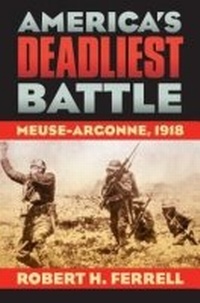
America's Deadliest Battle
Meuse-Argonne, 1918
Published on 28. February 2007
Book
Paperback/Softback
208 pages
978-0-7006-1857-6 (ISBN)
Description
American fighting men had never seen the likes of it before.
The great battle of the Meuse-Argonne was the costliest conflict in American history, with 26,000 men killed and tens of thousands wounded. Involving 1.2 million American troops over 47 days, it ended on November 11-what we now know as Armistice Day-and brought an end to World War I, but at a great price. Distinguished historian Robert Ferrell now looks back at this monumental struggle to create the definitive study of the battle-and to determine just what made it so deadly.
Ferrell re-examines factors in the war that many historians have chosen to disregard. He points first to the failure of the Wilson administration to mobilise the country for war. American industry had not been prepared to produce the weaponry or transport ships needed by our military, and the War Department-with outmoded concepts of battle shaped by the Spanish-American War-shared equal blame in failing to train American soldiers for a radically new type of warfare.
Once in France, under trained American doughboys were forced to learn how to conduct mobile warfare through bloody experience. Ferrell assesses the soldiers' lack of skill in the use of artillery, the absence of tactics for taking on enemy machine gun nests, and the reluctance of American officers to use poison gas-even though by 1918 it had become a staple of warfare. In all of these areas, the German army held the upper hand.
Ferrell relates how, during the last days of the Meuse-Argonne, the American divisions had finally learned up-to-date tactics, and their final attack on November 1 is now seen as a triumph of military art. Yet even as the armistice was being negotiated, some American officers-many of whom had never before commanded men in battle-continued to spur their troops on, wasting more lives in an attempt to take new ground mere hours before the settlement.
Besides the U.S. shortcomings in mobilisation and tactics, Ferrell points to the greatest failure of all: the failure to learn from the experience, as after the armistice the U.S. Army retreated to its prewar mindset. Enhanced by more than four dozen maps and photographs, America's Deadliest Battle is a riveting revisit to the forests of France that reminds us of the costs of World War I-and of the shadow that it cast on the twentieth century.
This book is part of the Modern War Studies series.
The great battle of the Meuse-Argonne was the costliest conflict in American history, with 26,000 men killed and tens of thousands wounded. Involving 1.2 million American troops over 47 days, it ended on November 11-what we now know as Armistice Day-and brought an end to World War I, but at a great price. Distinguished historian Robert Ferrell now looks back at this monumental struggle to create the definitive study of the battle-and to determine just what made it so deadly.
Ferrell re-examines factors in the war that many historians have chosen to disregard. He points first to the failure of the Wilson administration to mobilise the country for war. American industry had not been prepared to produce the weaponry or transport ships needed by our military, and the War Department-with outmoded concepts of battle shaped by the Spanish-American War-shared equal blame in failing to train American soldiers for a radically new type of warfare.
Once in France, under trained American doughboys were forced to learn how to conduct mobile warfare through bloody experience. Ferrell assesses the soldiers' lack of skill in the use of artillery, the absence of tactics for taking on enemy machine gun nests, and the reluctance of American officers to use poison gas-even though by 1918 it had become a staple of warfare. In all of these areas, the German army held the upper hand.
Ferrell relates how, during the last days of the Meuse-Argonne, the American divisions had finally learned up-to-date tactics, and their final attack on November 1 is now seen as a triumph of military art. Yet even as the armistice was being negotiated, some American officers-many of whom had never before commanded men in battle-continued to spur their troops on, wasting more lives in an attempt to take new ground mere hours before the settlement.
Besides the U.S. shortcomings in mobilisation and tactics, Ferrell points to the greatest failure of all: the failure to learn from the experience, as after the armistice the U.S. Army retreated to its prewar mindset. Enhanced by more than four dozen maps and photographs, America's Deadliest Battle is a riveting revisit to the forests of France that reminds us of the costs of World War I-and of the shadow that it cast on the twentieth century.
This book is part of the Modern War Studies series.
More details
Series
Language
English
Place of publication
Kansas
United States
Illustrations
30 photographs
Dimensions
Height: 228 mm
Width: 149 mm
Thickness: 12 mm
Weight
330 gr
ISBN-13
978-0-7006-1857-6 (9780700618576)
Copyright in bibliographic data and cover images is held by Nielsen Book Services Limited or by the publishers or by their respective licensors: all rights reserved.
Schweitzer Classification
Other editions
Additional editions
E-Book
02/2007
1st Edition
University Press of Kansas
from
€22.39
Available for download