

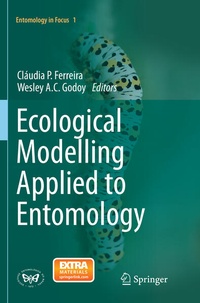
Ecological Modelling Applied to Entomology
Published on 30. April 2017
Book
Paperback/Softback
VIII, 262 pages
978-3-319-34540-6 (ISBN)
Description
Insects, when studied from the ecological perspective, provide a great opportunity for scientific studies emphasizing population theory. The simple fact of being successful organisms for their ability to colonize different habitats or even for their high reproductive potential, increases the interest of ecologists in conducting studies focused on population and community level. Mathematical models are powerful tools that can capture the essence of many biological systems and investigate ecological patterns associated to ecological stability dependent on endogenous and exogenous factors. This proposal comes from the idea of adding experiences of researchers interested in working at the interface between mathematical and computation theory and problems centered on entomology, showing how mathematical modelling can be an important tool for understanding population dynamics, behavior, pest management, spatial structure and conservation.
More details
Series
Edition
Softcover reprint of the original 1st ed. 2014
Language
English
Place of publication
Cham
Switzerland
Publishing group
Springer International Publishing
Target group
Professional and scholarly
Illustrations
76 s/w Abbildungen, 21 farbige Abbildungen
VIII, 262 p. 97 illus., 21 illus. in color.
Dimensions
Height: 235 mm
Width: 155 mm
Thickness: 14 mm
Weight
467 gr
ISBN-13
978-3-319-34540-6 (9783319345406)
DOI
10.1007/978-3-319-06877-0
Schweitzer Classification
Other editions
Additional editions
Cláudia P. Ferreira | Wesley A.C Godoy
Ecological Modelling Applied to Entomology
Book
11/2014
Springer
€106.99
Shipment within 10-15 days
Content
1: Insects and the Ecological Basis for Mathematical Modelling.- 2: Demographic processes in spatially structured host-parasitoid systems.- 3: Abiotic effects on population dynamics of mosquitoes and their influence on dengue transmission.- 4: Modelling the implications of temperature on the life cycle of Aedes aegypti mosquitoes.- 5: Predictive modelling of insect metacommunities in biomonitoring of aquatic networks.- 6: Modeling trophic interactions in insect population dynamics.- 7: Coupled Map Lattice Model for insects and spreadable substances.- 8: Computational Methods for Accurate Evaluation of Pest Insect Population Size.- 9: Models for over dispersed data in entomology.