

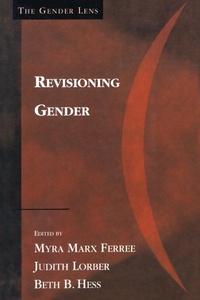
Revisioning Gender
1st Edition
Published on 2. August 1998
Book
Paperback/Softback
536 pages
978-0-7619-0617-9 (ISBN)
Description
This comprehensive handbook attempts to summarize the state of gender studies not only by examining the crucial research of the past decade, but by encouraging thinking about how the questions central to studying gender have themselves changed. Building on the work started by the contributors to this volume's predecessor, (Analyzing Gender, Sage 1987), editors Myra Marx Ferree, Judith Lorber, and Beth B. Hess reflect on the advances of gender scholarship during the past decade with its emphasis on all levels of social structure from the most macro to the most individual. Revisioning Gender is a step, albeit a tentative one, toward constructing a new analytical approach for the social sciences, one that calls into question disciplinary boundaries and the specific agendas that may be entailed within them. The editors, and the contributors to this important volume, illustrate how the use of gender by scholars in various and overlapping fields of study has helped alter concepts and research designs. The goal of this volume is to present, and encourage, the debates that advance the study of social science.
Reviews / Votes
It is likely to become a benchmark in gender scholarship for some time to come. The collection addresses the recent past, and potential future, of gender analysis across a range of social issues and across traditions of social analysis. The 16 mainly original chapters are authored primarily by American sociologists, and many of them are well known for their expertise in the study of gender. In addition, and in keeping with the boundary-stretching ethos set out in the editors' introduction, authors include prominent voices from other countries and other disciplines, as well as more recent generations of gender scholarship. The broader reach of this collection, in terms of generational, international and cross-disciplinary scholarship, does much to enhance its usefulness and appeal. -- Jan Siltanen, (University of Carleton) * Canadian Journal of Sociology * The book should appeal not only to academics but to all those who are interested in contemporary social questions. * The Journal of Sociology & Social Welfare * Articles in this collection spanning the social sciences are intended to reexamine gender in a more sophisticated manner as process and structure, from individual to societal levels of analysis. Calling disciplinary distinctions into question, the editorial focus does not assume dichotomous gender but begins to explain the meaning of gender. Contributors lay out the accomplishments and dilemmas of recent reconceptualization of gender in feminist theory and research, making it clear that there is no unified gender theory or constructs. They also address the macrostructures that organize gender, with regard to the state and political authority, the world-system of organizations and corporations, and the economies of industrial societies. Essays take upthe issue of gender discourse and culture at the macrosocietal level in religion and the media, and expand on feminist ideas of the social constriction of gender by the sciences, the workplace, family, and sports. Further, contributors deal with those interactive processes at the microlevel through which gender is constituted, performed, and recreated. The intent is to force a rethinking of social science concepts and to encourage debate with fresh perspectives. Upper-division undergraduates and above. -- M. Klatte, (Eastern Kentucky University) * Choice Reviews * Articles in this collection spanning the social sciences are intended to reexamine gender in a moresophisticated manner as process and structure, from individual to societal levels of analysis. Calling disciplinary distinctions into question, the editorial focus does not assume dichotomous gender but
begins to explain the meaning of gender. Contributors lay out the accomplishments and dilemmas of
recent reconceptualization of gender in feminist theory and research, making it clear that there is no
unified gender theory or constructs. They also address the macrostructures that organize gender, with
regard to the state and political authority, the world-system of organizations and corporations, and the economies of industrial societies. Essays take up the issue of gender discourse and culture at the macrosocietal level in religion and the media, and expand on feminist ideas of the social constriction of gender by the sciences, the workplace, family, and sports. Further, contributors deal with those
interactive processes at the microlevel through which gender is constituted, performed, and recreated. The intent is to force a rethinking of social science concepts and to encourage debate with fresh perspectives. Upper-division undergraduates and above. -- M. Klatte, (Eastern Kentucky University) * Choice Reviews *
More details
Series
Language
English
Place of publication
California
United States
Product notice
Paperback (trade)
Dimensions
Height: 229 mm
Width: 152 mm
Thickness: 29 mm
Weight
770 gr
ISBN-13
978-0-7619-0617-9 (9780761906179)
Copyright in bibliographic data and cover images is held by Nielsen Book Services Limited or by the publishers or by their respective licensors: all rights reserved.
Schweitzer Classification
Persons
Judith Lorber (born November 28, 1931) is Professor Emerita of Sociology and Women's Studies at The CUNY Graduate Center and Brooklyn College of the City University of New York. She is a foundational theorist of social construction of gender difference and has more recently called for a de-gendering of the social world.
Lorber was actively involved in Sociologists for Women in Society from the early 1970's. She developed and taught some of the first courses in the sociology of gender, women's studies, and feminist theory at Brooklyn College and the Graduate School, where she was the first Coordinator of the Women's Studies Certificate Program in 1988-1991. She was Chair of the ASA Sex and Gender Section in 1992-93 and was awarded the Jessie Bernard Award in 1996 "in recognition of scholarly work that has enlarged the horizons of sociology to encompass fully the role of women in society.
Lorber was actively involved in Sociologists for Women in Society from the early 1970's. She developed and taught some of the first courses in the sociology of gender, women's studies, and feminist theory at Brooklyn College and the Graduate School, where she was the first Coordinator of the Women's Studies Certificate Program in 1988-1991. She was Chair of the ASA Sex and Gender Section in 1992-93 and was awarded the Jessie Bernard Award in 1996 "in recognition of scholarly work that has enlarged the horizons of sociology to encompass fully the role of women in society.
Content
Part 1 I. Reconceptualizing Gender
Chapter 2 1. The Social Construction and Institutionalization of Gender and Race: An Integrative Framework
Chapter 3 2. Rewriting Class, Race, and Gender: Problems in Feminist Rethinking
Chapter 4 3. Some Reflections on Gender and Politics
Part 5 II. The Macrosocial Organization of Gender
Chapter 6 4. Feminist Thinking About the Welfare State
Chapter 7 5. Gender and the Global Economy
Chapter 8 6. Gender, Work, Who Cares?! Production, Reproduction, Deindustrialization, and Business as Usual
Part 9 III. Gender, Discourse, and Culture
Chapter 10 7. "Woman" as Symbol and Women as Agents: Gendered Religious Discourses and Practices
Chapter 11 8. Sex, Text, and Context: (In) Between Feminism and Cultural Studies
Part 12 IV. Gender in Social Institutions
Chapter 13 9. Moving Beyond Gender: Intersectionality and Scientific Knowledge
Chapter 14 10. Gender and Sexuality in Organizations
Chapter 15 11. Gender, Family Structure, and Social Structure: Racial Ethnic Families in the United States
Chapter 16 12. Just Do...What? Sport, Bodies, Gender
Part 17 V. Gendering the Person
Chapter 18 13. Gender, Power Dynamics, and Social Interaction
Chapter 19 14. Now You Can Choose! Issues in Parenting and Procreation
Chapter 20 15. Embattled Terrain: Gender and Sexuality
Chapter 21 16. Making Gendered People: Bodies, Identities, Sexualities
Chapter 2 1. The Social Construction and Institutionalization of Gender and Race: An Integrative Framework
Chapter 3 2. Rewriting Class, Race, and Gender: Problems in Feminist Rethinking
Chapter 4 3. Some Reflections on Gender and Politics
Part 5 II. The Macrosocial Organization of Gender
Chapter 6 4. Feminist Thinking About the Welfare State
Chapter 7 5. Gender and the Global Economy
Chapter 8 6. Gender, Work, Who Cares?! Production, Reproduction, Deindustrialization, and Business as Usual
Part 9 III. Gender, Discourse, and Culture
Chapter 10 7. "Woman" as Symbol and Women as Agents: Gendered Religious Discourses and Practices
Chapter 11 8. Sex, Text, and Context: (In) Between Feminism and Cultural Studies
Part 12 IV. Gender in Social Institutions
Chapter 13 9. Moving Beyond Gender: Intersectionality and Scientific Knowledge
Chapter 14 10. Gender and Sexuality in Organizations
Chapter 15 11. Gender, Family Structure, and Social Structure: Racial Ethnic Families in the United States
Chapter 16 12. Just Do...What? Sport, Bodies, Gender
Part 17 V. Gendering the Person
Chapter 18 13. Gender, Power Dynamics, and Social Interaction
Chapter 19 14. Now You Can Choose! Issues in Parenting and Procreation
Chapter 20 15. Embattled Terrain: Gender and Sexuality
Chapter 21 16. Making Gendered People: Bodies, Identities, Sexualities