

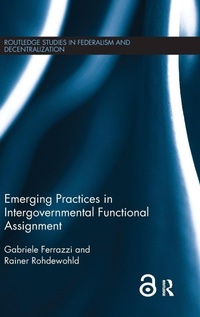
Emerging Practices in Intergovernmental Functional Assignment
1st Edition
Published on 30. May 2017
Book
Hardback
250 pages
978-1-138-65824-0 (ISBN)
Description
Attaining the benefits of (especially fiscal) decentralization in government remains an enduring challenge, in part because the re-arrangement of public functions across levels of government has often been carried out poorly.
This book aims to provide a firmer conceptual basis for the re-arrangement of public functions across levels of government. In doing so, it offers practical advice for policy makers from developing and emerging countries and development cooperation practitioners engaged in such activity. Combining a theoretical approach for inter-governmental functional assignment with an in-depth analysis of real-life country cases where functional assignment (FA) has been supported in the context of international development cooperation, it underscores the common technical and political challenges of FA, and also demonstrates the need to expect and support country made and context-specific solutions to FA processes and results. Examples are drawn from a number of developing/transition countries from the Asia-Pacific region, Africa and the OECD, which outline and suggest advisory approaches, tools, principles and good practices and approaches.
This text will be of key interest to scholars, students, policy-makers and practitioners in public policy, decentralization, local governance studies, public administration and development administration/studies.
The Open Access version of this book, available at www.taylorfrancis.com, has been made available under a Creative Commons Attribution-Non Commercial-No Derivatives 4.0 license.
This book aims to provide a firmer conceptual basis for the re-arrangement of public functions across levels of government. In doing so, it offers practical advice for policy makers from developing and emerging countries and development cooperation practitioners engaged in such activity. Combining a theoretical approach for inter-governmental functional assignment with an in-depth analysis of real-life country cases where functional assignment (FA) has been supported in the context of international development cooperation, it underscores the common technical and political challenges of FA, and also demonstrates the need to expect and support country made and context-specific solutions to FA processes and results. Examples are drawn from a number of developing/transition countries from the Asia-Pacific region, Africa and the OECD, which outline and suggest advisory approaches, tools, principles and good practices and approaches.
This text will be of key interest to scholars, students, policy-makers and practitioners in public policy, decentralization, local governance studies, public administration and development administration/studies.
The Open Access version of this book, available at www.taylorfrancis.com, has been made available under a Creative Commons Attribution-Non Commercial-No Derivatives 4.0 license.
More details
Series
Language
English
Place of publication
London
United Kingdom
Publishing group
Taylor & Francis Ltd
Target group
College/higher education
Illustrations
16 s/w Abbildungen, 16 s/w Zeichnungen, 10 s/w Tabellen
10 Tables, black and white; 16 Line drawings, black and white; 16 Illustrations, black and white
Dimensions
Height: 240 mm
Width: 161 mm
Thickness: 20 mm
Weight
584 gr
ISBN-13
978-1-138-65824-0 (9781138658240)
Copyright in bibliographic data and cover images is held by Nielsen Book Services Limited or by the publishers or by their respective licensors: all rights reserved.
Schweitzer Classification
Other editions
Additional editions
Gabriele Ferrazzi | Rainer Rohdewohld
Emerging Practices in Intergovernmental Functional Assignment
Book
01/2019
1st Edition
Routledge
€71.60
Shipment within 15-20 days
Gabriele Ferrazzi | Rainer Rohdewohld
Emerging Practices in Intergovernmental Functional Assignment
E-Book
06/2017
Routledge
€0.00
Available for download
Gabriele Ferrazzi | Rainer Rohdewohld
Emerging Practices in Intergovernmental Functional Assignment
E-Book
06/2017
Routledge
€0.00
Available for download
Persons
Gabriele Ferrazzi is Adjunct Professor at the School of Environmental Design and Rural Development, University of Guelph, Canada. He has worked for over 20 years as a consultant on decentralization and administrative reform projects of relevance to functional assignment supported by German development cooperation (GIZ) and other development partners.
Rainer Rohdewohld is a Senior Decentralization Policy Advisor from German development cooperation (GIZ), with more than 25 years of work experience on administrative reform, decentralization reforms/local governance and capacity development issues in Asia (Indonesia, Cambodia, India, Pakistan, Nepal) and West Africa (Ghana). He has worked for a range of multilateral and bilateral development cooperation agencies, like Asian Development Bank (ADB), UNDP, and Swiss Development Cooperation (SDC).
Rainer Rohdewohld is a Senior Decentralization Policy Advisor from German development cooperation (GIZ), with more than 25 years of work experience on administrative reform, decentralization reforms/local governance and capacity development issues in Asia (Indonesia, Cambodia, India, Pakistan, Nepal) and West Africa (Ghana). He has worked for a range of multilateral and bilateral development cooperation agencies, like Asian Development Bank (ADB), UNDP, and Swiss Development Cooperation (SDC).
Content
Introduction: Who does what? The Practice of Functional Assignment in Multilevel Governance
1. The Context of Functional Assignment - Decentralization, Multi-Level Governance and the Quest for Impact
2. Basic Concepts in Functional Assignment
3. The Conceptual and Legal Architecture of SNG Functions
4. The Process of Functional Assignment
5. The Political Economy of Functional Assignment
6. Country Case Studies in Functional Assignment in Asia
7. Functional Assignment Challenges and How to Address Them
1. The Context of Functional Assignment - Decentralization, Multi-Level Governance and the Quest for Impact
2. Basic Concepts in Functional Assignment
3. The Conceptual and Legal Architecture of SNG Functions
4. The Process of Functional Assignment
5. The Political Economy of Functional Assignment
6. Country Case Studies in Functional Assignment in Asia
7. Functional Assignment Challenges and How to Address Them