

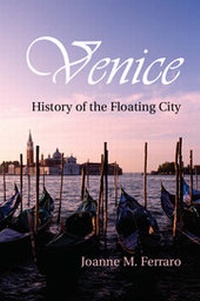
Venice
History of the Floating City
Published on 30. July 2012
Book
Hardback
299 pages
978-0-521-88359-7 (ISBN)
Description
This book is a sweeping historical portrait of the floating city of Venice from its foundations to the present day. Joanne M. Ferraro considers Venice's unique construction within an amphibious environment and identifies the Asian, European and North African exchange networks that made it a vibrant and ethnically diverse Mediterranean cultural centre. Incorporating recent scholarly insights, the author discusses key themes related to the city's social, cultural, religious and environmental history, as well as its politics and economy. A refuge and a pilgrim stop; an international emporium and centre of manufacture; a mecca of spectacle, theatre, music, gambling and sexual experimentation; and an artistic and architectural marvel, Venice's allure springs eternal in every phase of the city's fascinating history.
Reviews / Votes
'This is the best book written to date on the Venetian Republic ... In the future, when people want to learn about Venice's history, they'll turn to this book first.' Library Journal 'This is Ferraro's best book and not to be missed.' Open Letters Monthly (openlettersmonthly.com) 'In its emphasis on social and cultural rather than political or economic history, the book reflects contemporary interests in Venetian history and thus would be an outstanding accompaniment to a course on Venice. Ferraro not only incorporates recent scholarship; she also indicates where there are open questions and scholarly disagreements without letting these debates overwhelm her own narrative. In addition, there are fifteen sidebars that highlight objects and individuals characteristic to Venice: brief essays on gondolas, building construction techniques, chocolate, protofeminist writers, and taverns all point to particular manifestations of larger trends. This book is essential reading for all those interested in Venetian history. It will undoubtedly serve as a touchstone for scholarly and popular conversations about the city for years to come.' Monique O'Connell, Journal of Modern History 'The author's enthusiasm for and deep knowledge of Venice and its history shines through from the beginning to end, which is not surprising, considering her status as one of the preeminent historians of Venice, especially for the early modern period. Ferraro's treatment of the 'Floating City' will undoubtedly appear on the syllabi of history, geography, and other disciplines' courses for years to come; truth be told, I am certainly planning to include it on my reading list the next time I teach a course on Italian and/or Mediterranean history.' Brian N. Becker, H-MaritimeMore details
Language
English
Place of publication
Cambridge
United Kingdom
Target group
College/higher education
Professional and scholarly
Illustrations
16 Plates, color; 5 Maps; 60 Halftones, black and white; 1 Line drawings, black and white
Dimensions
Height: 235 mm
Width: 158 mm
Thickness: 21 mm
Weight
720 gr
ISBN-13
978-0-521-88359-7 (9780521883597)
Copyright in bibliographic data and cover images is held by Nielsen Book Services Limited or by the publishers or by their respective licensors: all rights reserved.
Schweitzer Classification
Other editions
New editions
Book
06/2016
Cambridge University Press
€59.80
Shipment within 15-20 days
Person
Joanne M. Ferraro is Professor and Chair of History at San Diego State University. She is the author of Family and Public Life in Brescia, 1580-1650: The Foundations of Power in the Venetian State (Cambridge, 1993); Marriage Wars in Late Renaissance Venice (2001), which was awarded best book from the Society for the Study of Early Modern Women and the Helen and Howard R. Marraro Prize in Italian History; and Nefarious Crimes, Contested Justice: Illicit Sex and Infanticide in the Republic of Venice, 1557-1789 (2008).
Content
Preface; Chronology of historical events; Chronology of architecture, art, literature, and music; 1. Reconstructing the floating city; 2. The riches of Asia, Europe, and North Africa; 3. A pride of lions; 4. Identities and modes of socialization; 5. Material life; 6. City of myth; 7. The Serenissima's wayward subjects; 8. The baroque stage; 9. Epilogue: the tides of change; Appendices.