

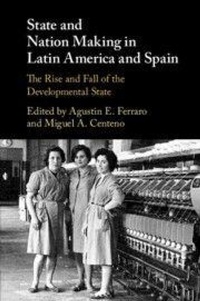
State and Nation Making in Latin America and Spain: Volume 2
Published on 25. January 2024
Book
Paperback/Softback
452 pages
978-1-316-63951-1 (ISBN)
Description
In 1960, Latin America and Spain had the same level of economic and social development, but, in just twenty years, Spain raced ahead. This book provides an in-depth analysis of the design and implementation of developmental state policies in both regions and examines the significant variance in success between Latin America and Spain. The second volume in a trilogy, this collection of studies on state institutions in Latin America and Spain covers the period 1930-1990 and focuses on the successes and failures of the developmental states. This book assumes a wide social science perspective on the phenomenon of the developmental state, focusing on the design, creation and management of public institutions, as well as the creation of national projects and political identities related to development strategies.
More details
Language
English
Place of publication
Cambridge
United Kingdom
Target group
College/higher education
Professional and scholarly
Product notice
Paperback (trade)
Illustrations
Worked examples or Exercises; 7 Tables, black and white; 6 Line drawings, black and white
Dimensions
Height: 151 mm
Width: 229 mm
Thickness: 31 mm
Weight
668 gr
ISBN-13
978-1-316-63951-1 (9781316639511)
Copyright in bibliographic data and cover images is held by Nielsen Book Services Limited or by the publishers or by their respective licensors: all rights reserved.
Schweitzer Classification
Other editions
Additional editions
Agustin E. Ferraro | Miguel A. Centeno
State and Nation Making in Latin America and Spain: Volume 2
The Rise and Fall of the Developmental State
Book
12/2018
Cambridge University Press
€155.50
No shipping information available
Persons
Content
Part I. Introduction: 1. Those were the days. The Latin American economic and cultural boom vs. the Spanish miracle Miguel A. Centeno, Agustin E. Ferraro and Vivekananda Nemana; Part II. Visions and Politics of Development: 2. CEPAL as idea factory for Latin American development. Intellectual and political influence 1950-90 Joseph Love; 3. The arc of development. Economists and sociologists' quest for the state Margarita Fajardo; 4. From 'showcase' to 'failure'. Democracy and the Colombian developmental state in the 1960s Robert Karl; Part III. Institutional Design: Infrastructural and Territorial Power: 5. One blueprint, three translations: Corporaciones de Fomento in Colombia, Chile and Peru Jose Carlos Orihuela; 6. The rise and fall of the Instituto Nacional de Planificacion in Peru (1962-92): exploring the limits of state capacity building in weak states Eduardo Dargent; 7. A double-edged sword: the institutional foundations of the Brazilian developmental state, 1930-85 Luciana de Souza Leao; 8. Life is a dream. Bureaucracy and industrial development in Spain, 1950-90 Agustin E. Ferraro and Juan Jose Rastrollo; Part IV. Industry, Trade and Growth: Economic Power: 9. Emergence and maturity of the developmental state in Argentina, Brazil and Spain, 1930-90. An economic history approach Jordi Catalan and Tomas Fernandez-de-Sevilla; 10. The Mexican developmental state, c.1920-c.1980 Alan Knight; 11. The developmental state and the agricultural machinery industry in Argentina Yovanna Pineda; 12. The Chilean developmental state. Political balance, economic accommodation, and technocratic insulation 1924-1973 Patricio Silva; Part V. National and Civic Identities: Symbolic Power: 13. The developmental state and the rise of popular nationalism: cause, coincidence, or elective affinity? Matthias vom Hau; 14. State, nation, and identity in Brazil, 1930-2000 Marshall Eakin; 15. Urban informality, citizenship, and the paradoxes of development Brodwyn Fisher; Part VI. Conclusion: 16. Authoritarianism, democracy, and development in Latin America and Spain 1930-1990 Agustin E. Ferraro and Miguel A. Centeno.