

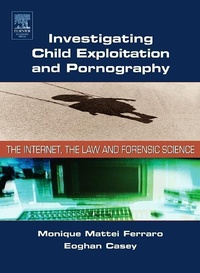
Investigating Child Exploitation and Pornography
The Internet, Law and Forensic Science
Published on 2. November 2004
Book
Hardback
320 pages
978-0-12-163105-5 (ISBN)
Description
Investigating Child Exploitation and Pornography provides the historical, legal, technical, and social background for the laws prohibiting child exploitation, in particular, child pornography.
It offers a history of child exploitation cases and studies, outlining the roles of technology in this type of crime and the evidence they can contain, and documenting new research performed by the authors.
It details how successful undercover Internet operations are conducted, how the associated evidence is collected, and how to use the evidence to locate and apprehend the offender. The heart of this work is a legal section, detailing all of the legal issues that arise in Internet child exploitation cases. A forensic examination section presents evidentiary issues from a technical perspective and describes how to conduct a forensic examination of digital evidence gathered in the investigative and probative stages of a child exploitation case.
The book will become an indispensable resource for those involved in the investigation, prosecution, and study of computer-assisted child sexual exploitation.
It offers a history of child exploitation cases and studies, outlining the roles of technology in this type of crime and the evidence they can contain, and documenting new research performed by the authors.
It details how successful undercover Internet operations are conducted, how the associated evidence is collected, and how to use the evidence to locate and apprehend the offender. The heart of this work is a legal section, detailing all of the legal issues that arise in Internet child exploitation cases. A forensic examination section presents evidentiary issues from a technical perspective and describes how to conduct a forensic examination of digital evidence gathered in the investigative and probative stages of a child exploitation case.
The book will become an indispensable resource for those involved in the investigation, prosecution, and study of computer-assisted child sexual exploitation.
More details
Language
English
Place of publication
San Diego
United States
Publishing group
Elsevier Science Publishing Co Inc
Target group
Professional and scholarly
Featured in the 2004 forensics leaflet distributed to end users, trade, and contributors and subscribers to Elsevier forensic journals. Publicised at key exhibitions and through forensic societies such as EAFS and IAFS and FSS.
Product notice
sewn/stitched
Cloth over boards
Dimensions
Height: 251 mm
Width: 192 mm
Thickness: 22 mm
Weight
717 gr
ISBN-13
978-0-12-163105-5 (9780121631055)
Copyright in bibliographic data and cover images is held by Nielsen Book Services Limited or by the publishers or by their respective licensors: all rights reserved.
Schweitzer Classification
Other editions
Additional editions
Monique M. Ferraro | Ma Casey BS
Investigating Child Exploitation and Pornography
The Internet, Law and Forensic Science
E-Book
11/2004
Academic Press
€75.95
Available for download
Persons
Eoghan Casey is an internationally recognized expert in data breach investigations and information security forensics. He is founding partner of CASEITE.com, and co-manages the Risk Prevention and Response business unit at DFLabs. Over the past decade, he has consulted with many attorneys, agencies, and police departments in the United States, South America, and Europe on a wide range of digital investigations, including fraud, violent crimes, identity theft, and on-line criminal activity. Eoghan has helped organizations investigate and manage security breaches, including network intrusions with international scope. He has delivered expert testimony in civil and criminal cases, and has submitted expert reports and prepared trial exhibits for computer forensic and cyber-crime cases.
In addition to his casework and writing the foundational book Digital Evidence and Computer Crime, Eoghan has worked as R&D Team Lead in the Defense Cyber Crime Institute (DCCI) at the Department of Defense Cyber Crime Center (DC3) helping enhance their operational capabilities and develop new techniques and tools. He also teaches graduate students at Johns Hopkins University Information Security Institute and created the Mobile Device Forensics course taught worldwide through the SANS Institute. He has delivered keynotes and taught workshops around the globe on various topics related to data breach investigation, digital forensics and cyber security.
Eoghan has performed thousands of forensic acquisitions and examinations, including Windows and UNIX systems, Enterprise servers, smart phones, cell phones, network logs, backup tapes, and database systems. He also has information security experience, as an Information Security Officer at Yale University and in subsequent consulting work. He has performed vulnerability assessments, deployed and maintained intrusion detection systems, firewalls and public key infrastructures, and developed policies, procedures, and educational programs for a variety of organizations. Eoghan has authored advanced technical books in his areas of expertise that are used by practitioners and universities around the world, and he is Editor-in-Chief of Elsevier's International Journal of Digital Investigation.
In addition to his casework and writing the foundational book Digital Evidence and Computer Crime, Eoghan has worked as R&D Team Lead in the Defense Cyber Crime Institute (DCCI) at the Department of Defense Cyber Crime Center (DC3) helping enhance their operational capabilities and develop new techniques and tools. He also teaches graduate students at Johns Hopkins University Information Security Institute and created the Mobile Device Forensics course taught worldwide through the SANS Institute. He has delivered keynotes and taught workshops around the globe on various topics related to data breach investigation, digital forensics and cyber security.
Eoghan has performed thousands of forensic acquisitions and examinations, including Windows and UNIX systems, Enterprise servers, smart phones, cell phones, network logs, backup tapes, and database systems. He also has information security experience, as an Information Security Officer at Yale University and in subsequent consulting work. He has performed vulnerability assessments, deployed and maintained intrusion detection systems, firewalls and public key infrastructures, and developed policies, procedures, and educational programs for a variety of organizations. Eoghan has authored advanced technical books in his areas of expertise that are used by practitioners and universities around the world, and he is Editor-in-Chief of Elsevier's International Journal of Digital Investigation.
Content
Section 1 - The Influence of technology; Overview; Internet Applications; Cyber Victims; Cyber Offenders; Sources of Digital Evidence; Section 2 - Investigating Internet Child Exploitation; Undercover Operations; Collecting and Preserving Evidence on the Internet; Collecting and Preserving Evidence on the Internet; Tracking on the Internet; Search and Seizure in Cyberspace I: Drafting Warrants and Warrantless Searches; Search and Seizure in Cyberspace II: Executing the Search; Section 3 - Forensic Examination of Digital Evidence; Overview of the Examination Process; Servers and Networks; Section 4 - The Law of Internet Child Sexual Exploitation; Child Pornography; Pre-Trial; Trial; Final Thoughts