

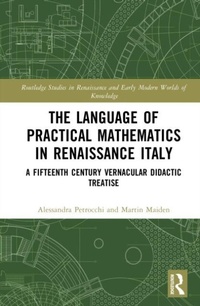
The Language of Practical Mathematics in Renaissance Italy
A Fifteenth Century Vernacular Didactic Treatise
1st Edition
Will be published approx. on 17. July 2026
Book
Hardback
474 pages
978-1-032-97929-8 (ISBN)
Description
This volume presents the first linguistic and philological analysis, and edition (with English translation) of a fifteenth-century vernacular manuscript from Renaissance Italy, written by an author from the city of Cremona, in northern Italy. The text is a libro d'abbaco, used to teach practical business mathematics to young boys. The vernacular language of these texts has been largely neglected. The libri d'abbaco, however, reveal much about the native language of the ordinary people and the language of banking, and artisan sectors in the major Italian cities of the time. This textbook serves as a starting point to reflect upon some key linguistic, cultural, and intellectual developments in fifteenth-century Lombardy. It provides a thorough comparative-historical analysis of the phonology, morphology, and syntax of the work, together with a detailed scrutiny of the lexicon, including specialist vocabulary and distinctively dialectal terms.
The volume broadens the understanding and mode of engagement with vernacular technical registers and early pedagogical works, and aims to throw light on the little-explored question of the language of the vernacular libri d'abbaco, in ways of interest to linguists, philologists, textual scholars, and historians.
The volume broadens the understanding and mode of engagement with vernacular technical registers and early pedagogical works, and aims to throw light on the little-explored question of the language of the vernacular libri d'abbaco, in ways of interest to linguists, philologists, textual scholars, and historians.
More details
Series
Language
English
Place of publication
London
United Kingdom
Publishing group
Taylor & Francis Ltd
Target group
College/higher education
Professional and scholarly
Academic and Postgraduate
Dimensions
Height: 234 mm
Width: 156 mm
Weight
453 gr
ISBN-13
978-1-032-97929-8 (9781032979298)
Copyright in bibliographic data and cover images is held by Nielsen Book Services Limited or by the publishers or by their respective licensors: all rights reserved.
Schweitzer Classification
Other editions
Additional editions

Valentina Ferrari | Martin Maiden
The Language of Practical Mathematics in Renaissance Italy
A Fifteenth Century Vernacular Didactic Treatise
E-Book
approx. 07/2026
1st Edition
Routledge
€60.49
Not yet available
Valentina Ferrari | Martin Maiden
The Language of Practical Mathematics in Renaissance Italy
A Fifteenth Century Vernacular Didactic Treatise
E-Book
approx. 07/2026
1st Edition
Routledge
€60.49
Not yet available
Persons
Valentina Ferrari is a historical linguist and in particular a historian of the origins of Italian vernaculars. She is currently Research Fellow on a project focusing on the linguistic history of vernacular mathematics in Renaissance Italy: Vernacular Mathematics in the Italian Dialects: A History, funded by the Leverhulme Trust. She is based in the Faculty of Linguistics, Philology, and Phonetics at the University of Oxford. She has published on a variety of topics on lexical, syntactic, and textual aspects of medieval Latin and Romance documents from Italy. She holds a PhD in linguistics from the Scuola Normale Superiore.
Martin Maiden is a Romance linguist with particular interests in Italian and Romanian. Since 1996 he has been Professor of the Romance Languages at Oxford University. He is a Fellow of the British Academy, a Member of Academia Europaea, and a corresponding member of Italy's Accademia della Crusca. He has been president of the Societa internazionale di linguistica e filologia italiana and the Societa di linguistica italiana. He is currently president of the Societe de linguistique romane. He is the author of A Linguistic History of Italian (1995) and co-editor of the forthcoming Oxford Handbook of the Italian Language.
Martin Maiden is a Romance linguist with particular interests in Italian and Romanian. Since 1996 he has been Professor of the Romance Languages at Oxford University. He is a Fellow of the British Academy, a Member of Academia Europaea, and a corresponding member of Italy's Accademia della Crusca. He has been president of the Societa internazionale di linguistica e filologia italiana and the Societa di linguistica italiana. He is currently president of the Societe de linguistique romane. He is the author of A Linguistic History of Italian (1995) and co-editor of the forthcoming Oxford Handbook of the Italian Language.
Content
1. Introduction: text and context
Valentina Ferrari
2. Text and translation
2.1 The manuscript: characteristics
2.2 The manuscript: contents
2.3 Editorial criteria
2.4 The translation
2.5 Abbreviations
2.6 The text: transcription and translation
Valentina Ferrari - Translation by Martin Maiden
3. Linguistic analysis
3.1 Introduction
3.2 Phonology and orthography
3.2.1 Introduction
3.2.2 Vowels
3.2.2.1 Stressed vowels
3.2.2.2 Unstressed vowels
3.2.3 Consonants
3.2.3.1 Voicing of intervocalic voiceless consonants
3.2.3.2 Shortening of long consonants
3.2.3.3 Original palatals and affricates
3.2.4 Other phenomena
3.3 Morphology
3.3.1 Nouns and adjectives
3.3.1.1 Number and gender marking
3.3.1.2 Numerative morphology (and remnants of a neuter gender)
3.3.2 Possessive adjectives
3.3.3 Articles
3.3.4 Pronouns
3.3.4.1 The system
3.3.4.2 Clitic pronouns
3.3.5 Demonstratives
3.3.6 Relative and interrogative forms
3.3.7 Verb
3.3.7.1 Inflexional paradigms
3.3.7.2 Conjugation classes
3.3.7.3 Person and number
3.3.7.4 Auxiliary selection
3.4 Syntax
3.3.1 Basic word order
3.3.2 The position of clitics
3.4.2.1 General principles
3.4.2.2 Clitic climbing
3.4.2.3 Clitic clusters (sequences of clitics)
3.4.2.4 Clitic doubling
3.4.3 Position of auxiliary verbs
3.4.4 Position of adverbs
3.5 Negation
3.6 Causatives
3.7 Complementation
3.8 Gerundial subordinate clauses
3.9 Presentative constructions
3.10 Relative constructions
3.11 The structure of comparative and superlative constructions
3.12 Agreement of verb with subject
3.13 Agreement of the past participle
3.14 Use of tenses
3.15 Position of numerals
3.16 Position of determiners
3.17 Anacolutha?
Martin Maiden
4. The Lexicon and Phraseology
4.1 Introduction
4.2 The mathematical language of the libro d'abbaco
4.2.1 Introduction
4.2.2 The language of arithmetic
4.2.2.1 Introduction
4.2.2.2 The system of numbering
4.2.2.3 Addition
4.2.2.4 Subtraction
4.2.2.5 Multiplication
4.2.2.6 Division
4.2.2.7 Operators
4.2.2.8 Expression of the result
4.2.2.9 Exquisire
4.2.3 The language of algebra
4.2.3.1 Introduction
4.2.3.2 The 'unknown' and its powers
4.2.3.3 The rule of the double false position and its lexicon
4.2.3.4 The grande guisa
4.2.4 The lexicon of calculations of net weight, gross weight, tare
4.2.5 The language of geometry
4.3 The northern Italo-Romance dialectal lexicon of the libro d'abbaco
4.4 Special uses of two common words: capitolo, mano.
4.5 Units of measurement and currency
4.5.1 Introduction
4.5.2 Units of measurement
4.5.3 Units of currency
4.6 Phraseology and discourse
4.6.1 Rhetorical characteristics
4.6.2 Structure of the text
4.6.3 Addressing the reader and giving instructions
Valentina Ferrari
5. Conclusion
Martin Maiden
6. References and bibliographical abbreviations
Valentina Ferrari
2. Text and translation
2.1 The manuscript: characteristics
2.2 The manuscript: contents
2.3 Editorial criteria
2.4 The translation
2.5 Abbreviations
2.6 The text: transcription and translation
Valentina Ferrari - Translation by Martin Maiden
3. Linguistic analysis
3.1 Introduction
3.2 Phonology and orthography
3.2.1 Introduction
3.2.2 Vowels
3.2.2.1 Stressed vowels
3.2.2.2 Unstressed vowels
3.2.3 Consonants
3.2.3.1 Voicing of intervocalic voiceless consonants
3.2.3.2 Shortening of long consonants
3.2.3.3 Original palatals and affricates
3.2.4 Other phenomena
3.3 Morphology
3.3.1 Nouns and adjectives
3.3.1.1 Number and gender marking
3.3.1.2 Numerative morphology (and remnants of a neuter gender)
3.3.2 Possessive adjectives
3.3.3 Articles
3.3.4 Pronouns
3.3.4.1 The system
3.3.4.2 Clitic pronouns
3.3.5 Demonstratives
3.3.6 Relative and interrogative forms
3.3.7 Verb
3.3.7.1 Inflexional paradigms
3.3.7.2 Conjugation classes
3.3.7.3 Person and number
3.3.7.4 Auxiliary selection
3.4 Syntax
3.3.1 Basic word order
3.3.2 The position of clitics
3.4.2.1 General principles
3.4.2.2 Clitic climbing
3.4.2.3 Clitic clusters (sequences of clitics)
3.4.2.4 Clitic doubling
3.4.3 Position of auxiliary verbs
3.4.4 Position of adverbs
3.5 Negation
3.6 Causatives
3.7 Complementation
3.8 Gerundial subordinate clauses
3.9 Presentative constructions
3.10 Relative constructions
3.11 The structure of comparative and superlative constructions
3.12 Agreement of verb with subject
3.13 Agreement of the past participle
3.14 Use of tenses
3.15 Position of numerals
3.16 Position of determiners
3.17 Anacolutha?
Martin Maiden
4. The Lexicon and Phraseology
4.1 Introduction
4.2 The mathematical language of the libro d'abbaco
4.2.1 Introduction
4.2.2 The language of arithmetic
4.2.2.1 Introduction
4.2.2.2 The system of numbering
4.2.2.3 Addition
4.2.2.4 Subtraction
4.2.2.5 Multiplication
4.2.2.6 Division
4.2.2.7 Operators
4.2.2.8 Expression of the result
4.2.2.9 Exquisire
4.2.3 The language of algebra
4.2.3.1 Introduction
4.2.3.2 The 'unknown' and its powers
4.2.3.3 The rule of the double false position and its lexicon
4.2.3.4 The grande guisa
4.2.4 The lexicon of calculations of net weight, gross weight, tare
4.2.5 The language of geometry
4.3 The northern Italo-Romance dialectal lexicon of the libro d'abbaco
4.4 Special uses of two common words: capitolo, mano.
4.5 Units of measurement and currency
4.5.1 Introduction
4.5.2 Units of measurement
4.5.3 Units of currency
4.6 Phraseology and discourse
4.6.1 Rhetorical characteristics
4.6.2 Structure of the text
4.6.3 Addressing the reader and giving instructions
Valentina Ferrari
5. Conclusion
Martin Maiden
6. References and bibliographical abbreviations