

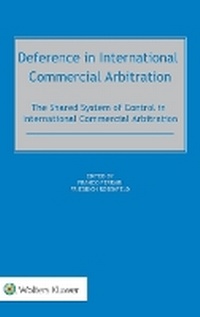
Deference in International Commercial Arbitration
The Shared System of Control in International Commercial Arbitration
Published on 12. May 2023
Book
Hardback
368 pages
978-94-035-0307-3 (ISBN)
Description
In international arbitration, deference entails that one decision-maker does not make an autonomous assessment but limits its decision-making power out of respect for the decision or authority of another actor. For example, a court exercising post-award review might refrain from reviewing a question of procedure de novo but instead defer to a prior determination made by the arbitral tribunal. In this book, prominent arbitration practitioners and academics offer the first systematic analysis of such deference in international arbitration.
With abundant reference to case law from major arbitration hubs, the analysis is organized around the three relationships in which questions of deference arise:
- public-private relationships in which a State actor (e.g., a court) must decide whether it should pay deference to determinations made by a private actor (e.g., a tribunal or an arbitral institution);
- public-public relationships in which a State actor (e.g., a court at the place of recognition and enforcement) must decide whether it should pay deference to another State actor (e.g., a court at the seat); and
- private-private relationships in which a private actor (e.g., an arbitral tribunal) must decide whether it should pay deference to another private actor (e.g., another arbitral tribunal or an arbitral institution).
The book makes an important contribution to tracing the boundaries of the multiple layers of control over arbitration proceedings. It takes a giant step towards establishing the right equilibrium between the different layers of authority and thus meeting a pivotal challenge for the viability of arbitration as a form of dispute resolution.
With abundant reference to case law from major arbitration hubs, the analysis is organized around the three relationships in which questions of deference arise:
- public-private relationships in which a State actor (e.g., a court) must decide whether it should pay deference to determinations made by a private actor (e.g., a tribunal or an arbitral institution);
- public-public relationships in which a State actor (e.g., a court at the place of recognition and enforcement) must decide whether it should pay deference to another State actor (e.g., a court at the seat); and
- private-private relationships in which a private actor (e.g., an arbitral tribunal) must decide whether it should pay deference to another private actor (e.g., another arbitral tribunal or an arbitral institution).
The book makes an important contribution to tracing the boundaries of the multiple layers of control over arbitration proceedings. It takes a giant step towards establishing the right equilibrium between the different layers of authority and thus meeting a pivotal challenge for the viability of arbitration as a form of dispute resolution.
More details
Language
English
Place of publication
Zuidpoolsingel
Netherlands
Product notice
sewn/stitched
Cloth over boards
Dimensions
Height: 234 mm
Width: 156 mm
Thickness: 21 mm
Weight
689 gr
ISBN-13
978-94-035-0307-3 (9789403503073)
Copyright in bibliographic data and cover images is held by Nielsen Book Services Limited or by the publishers or by their respective licensors: all rights reserved.
Schweitzer Classification